

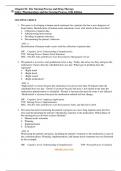
PRIMEXAM.COM Chapter 01: The Nursing Process and Drug Therapy Lilley: Pharmacology and the Nursing Process, 10th Edition MULTIPLE CHOICE 1. The nurse is developing a human needs statement for a patient who has a new diagnosis of heart failure. Identification of human needs statements occur with which of these activities? a. Collection of patient data b. Administering interventions c. Deciding on patient outcomes d. Documenting the patient‘s behavior ANS: A Identification of human needs occurs with the collection of patient data. DIF: Cognitive Level: Understanding (Comprehension) TOP: Nursing Process: Human Needs Statement MSC: NCLEX: Safe and Effective Care Environment: Management of Care 2. The patient is to receive oral guaifenesin twice a day. Today, the nurse was busy and gave the medication 2 hours after the scheduled dose was due. What type of problem does this represent? a. ―Right tim e‖ b. ―Right dos e‖ c. ―Right rout e‖ d. ―Right medication‖ ANS: A ―Right tim e‖ is correct because the medi cation was given m ore than 30 m inutes after the scheduled dose was due. ―Dose‖ is incorrect bec ause the dose is not related to the time the medi cation administr ation is scheduled. ―Route‖ is incorrect because the route is not affected. ―Medi cation‖ is incorrect because the medi cation ordered will not ch ange. DIF: Cognitive Level: Applying (Application) TOP: Nursing Process: Implementation MSC: NCLEX: Safe and Effective Care Environment: Safety and Infection Control 3. The nurse has been monitoring the patient‘s progress on a new drug regimen since the first dose and documentin g the patient‘s therapeutic response to the medication. Which phase of the nursing process do these actions illustrate? a. Human needs statement b. Planning c. Implementation d. Evaluation ANS: D Monitoring the patient‘s progress, including the patient‘s response to the medication, is part of the evaluation phase. Planning, implementation, and human needs statement are not illustrated by this example. DIF: Cognitive Level: Understanding (Comprehension) TOP: Nursing Process: Evaluation @ PRIMEXAM.COM MSC: NCLEX: Safe and Effective Care Environment: Management of Care 4. The nurse is assigned to a patient who is newly diagnosed with type 1 diabetes mellitus. Which statement best illustrates an outcome criterion for this patient? a. The patient will follow instructions. b. The patient will not experience complications. c. The patient will adhere to the new insulin treatment regimen. d. The patient will demonstrate correct blood glucose testing technique. ANS: D ―Demonstr ating correct blood glucose testing technique‖ is a specific and measurable outcome criterion. ―Following instructions‖ and ―not e xperiencing complic ations‖ are not specific crite ria. ―Adhering to new regimen‖ woul d be difficult to me asure. DIF: Cognitive Level: Applying (Application) TOP: Nursing Process: Planning MSC: NCLEX: Safe and Effective Care Environment: Management of Care 5. Which activity best reflects the implementation phase of the nursing process for the patient who is newly diagnosed with hypertension? a. Providing education on keeping a journal of blood pressure readings b. Setting goals and outcome criteria with the patient‘s input c. Recording a drug history regarding over-the-counter medications used at home d. Formulating human needs statements regarding deficient knowledge related to the new treatment regimen ANS: A Education is an intervention that occurs during the implementation phase. Setting goals and outcomes reflects the planning phase. Recording a drug history reflects the assessment phase. Formulating human needs statements reflects analysis of data as part of planning. DIF: Cognitive Level: Applying (Application) TOP: Nursing Process: Implementation MSC: NCLEX: Safe and Effective Care Environment: Management of Care 6. The medication order reads, ―Give ondansetron 4 mg, 30 minutes before beginning chemotherapy to prevent nausea.‖ The nurse notes that the route is missing from the order. What is the nurse‘s best action? a. Give the medication intravenously because the patien t might vomit. b. Give the medication orally because the tablets are available in 4 -mg doses. c. Contact the prescriber to clarify the route of the medication ordered. d. Hold the medication until the prescriber returns to make rounds. ANS: C A complete medication order includes the route of administration. If a medication order does not include the route, the nurse must ask the prescriber to clarify it. The intravenous and oral routes are not interchangeable. Holding the medication until the prescriber r eturns would mean that the patient would not receive a needed medication. DIF: Cognitive Level: Applying (Application) TOP: Nursing Process: Implementation MSC: NCLEX: Safe and Effective Care Environment: Management of Care PRIMEXAM.COM 7. When the nurse considers the timing of a drug dose, which factor is appropriate to consider when deciding when to give a drug? a. The patient‘s ability to swallow b. The patient‘s height c. The patient‘s last meal d. The patient‘s allergies ANS: C The nurse must consider specific pharmacokinetic/pharmacodynamic drug properties that may be affected by the timing of the last meal. The patient‘s ability to swallow, height, and allergies are not factors to consider regarding the timing of the drug‘s administration. DIF: Cogni tive Level: Understanding (Comprehension) TOP: Nursing Process: Assessment MSC: NCLEX: Safe and Effective Care Environment: Management of Care 8. The nurse is performing an assessment of a newly admitted patient. Which is an example of subjective data? a. Weight 155 pounds b. Pulse 72 beats/minute c. The patient reports that he uses the herbal product ginkgo d. The patient‘s complete blood count results ANS: C Subjective data include information shared through the spoken word by any reliable source, such as the pati ent. Objective data may be defined as any information gathered through the senses or that which is seen, heard, felt, or smelled. A patient‘s pulse, weight, and laboratory tests are all examples of objective data. DIF: Cognitive Level: Understanding (Comprehension) TOP: Nursing Process: Assessment MSC: NCLEX: Safe and Effective Care Environment: Management of Care MULTIPLE RESPONSE 1. When giving medications, the nurse will follow the rights of medication administration. The rights include the right documentation, the right reason, the right response, and the patient‘s right to refuse. Which of these are additional rights? (Select all that apply .) a. Right drug b. Right route c. Right dose d. Right diagnosis e. Right time f. Right patient ANS: A, B, C, E, F Additional rights of medication administration must always include the right drug, right dose, right time, right route, and right patient. The right diagnosis is incorrect. DIF: Cognitive Level: Remembering (Knowledge) TOP: Nursing Process: Implementation PRIMEXAM.COM MSC: NCLEX: Safe and Effective Care Environment: Safety and Infection Control OTHER 1. Place the phases of the nursing process in the correct order, with 1 as the first phase and 5 as the last phase. a. Planning b. Evaluation c. Assessment d. Implementation e. Human needs statement ANS: C, E, A, D, B The nursing process is an ongoing process that begins with assessing and continues with human needs statement, planning, implementing, and evaluating. DIF: Cognitive Level: Applying (Application) TOP: Nursing Process: General MSC: NCLEX: Safe and Effective Care Environment: Management of Care
Preview 4 out of 331 pages
Exam (elaborations)
Test Bank For Pharmacology And The Nursing Process 10th Edition
Preview 4 out of 331 pages
Includes questions, answers and rationale of correct answer. Great to study for exams and will increase your knowledge on the material. Ace your exams with this study material! We've helped students increase their grades just by utilizing this test bank. You can rest assured that these questions cover all of the key concepts in the book. This essential tool can make your academic dreams come true. Give yourself the edge you deserve. This is real practice to improve your exam passing skills. While results may vary, judicious use of this guide can lead to significantly higher scores
Content preview
Connected book
Document information
- Uploaded on
- October 6, 2023
- Number of pages
- 331
- Written in
- 2023/2024
- Type
- Exam (elaborations)
- Contains
- Questions & answers
$15.49
Wrong document? Swap it for free
Within 14 days of purchase and before downloading, you can choose a different document. You can simply spend the amount again.
Written by students who passed
Immediately available after payment
Read online or as PDF


