Pediatric Nursing Exam 1 Questions & Answers Latest Updated
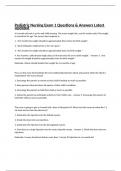
A 6-month old male is at his well-child checkup. The nurse weighs him, and his mother asks if his weight is normal for his age. The nurse's best response is: 1. "At 6 months his weight should be approximately three times his birth weight." 2. "Each child gains weight at his or her own pace." 3. "At 6 months his weight should be approximately twice his birth weight." 4. At 6 months a child should weigh about 10 lb more than his or her birth weight." - Answer 3. "At 6 months his weight should be approximately twice his birth weight." Rationale: Infants should double their weight by 4-6-months of age. How can the nurse best facilitate the trust relationship between infant and parents while the infant is hospitalized? The nurse should: 1. Encourage the parents to remain at their child's bedside as much as possible. 2. Keep parents informed about all aspects of their child's condition. 3. Encourage the parents to hold their child as much as possible. 4. Advise the parents to participate actively in their child's care. - Answer 3. Encourage the parents to hold their child as much as possible. The nurse is going to give a 6-month-old a dose of Rocephin IM. What must the nurse do when the 1.5 mL dose arrives from the pharmacy? 1. Administer the injection into the deltoid muscle. 2. Divide the dose into two injections. 3. Administer the injection into the dorsogluteal muscle. 4. Give dose as a single injection into the vastus lateralis muscle. - Answer 2. Divide the dose into two injections. Rationale: A nurse should not deliver more than 1 mL per IM injection to a 6-month old. Which statement by an infant's mother leads the nurse to believe she needs further education about the nutritional needs of a 6-month-old? 1. "I will continue to breastfeed my son and will give him rice cereal three times a day." 2. "I will start my son on fruits and gradually introduce vegetables." 3. "I will start my son on carrots and will introduce one new vegetable every few days." 4. "I will not give my son any more than 8 ounces of baby juice per day." - Answer 2. "I will start my son on fruits and gradually introduce vegetables." Rationale: Infants should be started on vegetables prior to fruits. The sweetness of fruits may inhibit infants from taking vegetables. ** As a parent, this is true! Trust me Which statement accurately describes the best method for assessing a 12-month old? 1. The nurse should assess the child on the examining table. 2. The nurse should assess the child in a head-to-toe sequence. 3. The nurse should have the child's mother assist in holding her down. 4. The nurse should assess the child while she is in her mother's lap. - Answer 4. The nurse should assess the child while she is in her mother's lap. The nurse is instructing a new breastfeeding mother in the need to provide her premature infant with an adequate source of iron in her diet. Which statement reflects a need for further education of the new mother? 1. "I will use only breast milk or an iron-fortified formula as a source of milk for my baby until she is at least 12 months old." 2. "My baby will need to have iron supplements introduce when she is 4 months old." 3. "I will need to add iron supplements to my baby's diet when she is 2 months old." 4. :When my baby begins to eat solid foods, I should introduce iron-fortified cereals to her diet." - Answer 3. "I will need to add iron supplements to my baby's diet when she is 2 months old." Rationale: Premature infants have iron stores from the mother that last approximately 2 months, so it is important to introduce iron supplement by 2 months of age. Full-term infants have iron stores that last approximately 4-6 months. A first-time mother brings in her 5-day-old baby for a well-child visit. The nurse weighs the infant and reports a weight of 7 lbs 5 oz to the mother. The mother looks concerned and tells the nurse that her baby weighed 7 lb 10 oz when she was discharged 4 days ago. The nurse's best response to the mother is: 1. "I will let the doctor the doctor know, and he will talk with you about the possible causes of our infant's weigh loss." 2. "A weight loss of a few ounces is common among newborns, especially for breastfeeding mothers." 3. I can tell you are a first-time mother. Don't worry; we will find out why she is losing weight." 4. "Maybe she isn't getting enough milk. How often are you breastfeeding her?" - Answer 2. "A weight loss of a few ounces is common among newborns, especially for breastfeeding mothers." Which toy is the best choice for a 12-month-old? 1. Baby doll 2. Musical rattle 3. Board book 4. Colorful beads - Answer 2. Musical rattle Rationale: A musical rattle is the perfect toy for this child. Infants have short attention spans and enjoy auditory and visual stimulation. ** 1 and 3 are good options, but they will likely just put them in their mouth, so they're not the best option. 4 is a choking hazard. The parents of a newborn are asking the nurse how to use the infant car seat and where it should be placed in their vehicle. Which is the next most appropriate action by the nurse? 1. Give the parents a pamphlet explaining how to install the car seat. 2. Accompany the parents to the car, and show them how to install the car seat. 3. Contact the hospital's car seat safety officer, and ask the officer to accompany the parents to the car for car seat installations. 4. Show the parents a video on car seat installation and safety, and ask if they are comfortable with the information. - Answer 3. Contact the hospital's car seat safety officer, and ask the officer to accompany the parents to the car for car seat installations. Rationale: The car seat safety officer is the best choice, as that individual would have the needed information and certification to help the family. The mother of a newborn asks the nurse when the infant will receive the first hepatitis B immunization. Which is the nurse's best response? 1. "Babies receive the hepatitis B vaccine only if their mother is hepatitis B-positive." 2. "The first dose of hepatitis B vaccine will be given prior to discharge today." 3. "The first dose of hepatitis B vaccine is given at 1 year of age." 4. "Babies receive their first hepatitis B vaccine at 6-months of age." - Answer 2. "The first dose of hepatitis B vaccine will be given prior to discharge today." Which finding would the nurse consider abnormal when performing a physical assessment on a 6-month-old? 1. The posterior fontanel is open. 2. The anterior fontanel is open. 3. Beginning signs of tooth eruption. 4. Able to track and follow objects. - Answer 1. The posterior fontanel is open. Rationale: The posterior fontanel should close between 6 and 8 weeks of age. The anterior fontanel should close between 12 and 18 months of age. The other two options are normal. A mother requests that her child receive the varicella vaccine at the 9-month well-child checkup. The nurse tells the mother that: 1. Children who are vaccinated will likely develop a mild case of the disease. 2. The vaccine cannot be given at that visit. 3. The vaccine will be administered after the physician examines the child. 4. A booster vaccination will be needed at 18 months of age. - Answer 2. The vaccine cannot be given at that visit. Rationale: The nurse should not give the vaccine. The varicella vaccine is usually not administered prior to 1 year of age. What should parents understand is one of the most common causes of injury and death for a 7-month-old infant? 1. Poisoning. 2. Child abuse. 3. Aspiration. 4. Dog bites. - Answer 3. Aspiration. Rationale: Aspiration is a common cause of injury and death among children of this age. These children often find small objects lying on the floor and place them in their mouths. Older siblings are often responsible for leaving small objects around. An 8-day-old was admitted to the hospital with vomiting and dehydration. The newborn's heart rate is 170, respiratory rate is 44, blood pressure is 85/52, and temperature is 99℉ (37.2℃). What is the nurse's best response to the parents who ask if the vital signs are normal? 1. "The blood pressure is elevated, but the other vital signs are within normal limits." 2. "The temperature is elevated, but the other vital signs are within normal limits." 3. "The respiratory rate is elevated, but the other vital signs are within normal limits." 4. "The heart rate is elevated, but the other vital signs are within normal limits." - Answer 4. "The heart rate is elevated, but the other vital signs are within normal limits." The mother of an 11-month-old with iron deficiency anemia tells the nurse that her infant is currently taking iron and a multivitamin. Which statement made by the mother should be of concern to the nurse? 1. "I give the iron and multivitamin at the same time each morning." 2. "I give the iron and multivitamin in the morning 6-oz bottle." 3. "I give the iron and multivitamin 2 hours before I feed the morning bottle." 4. "I five the iron and multivitamin in oral syringes toward the back of the cheek." - Answer 2. "I give the iron and multivitamin in the morning 6-oz bottle." Rationale: Medications should never be mixed in a large amount of food or formula because the parent cannot be sure that the child will take the entire feeding. Formula decreases the absorption of iron. The nurse is using the FLACC scale to rate the pain level in a 9-month-old. Which is the nurse's best response to the father's question of what the FLACC scale is? 1. "It estimates a child's level of pain utilizing vital signs information." 2. "It estimates a child's level of pain based on parents' perception." 3. "It estimates a child's level of pain utilizing behavioral and physical responses." 4. "It estimates a child's level of pain utilizing a numeric scale from 0 to 5." - Answer 3. "It estimates a child's level of pain utilizing behavioral and physical responses." A 12-month-old boy weighed 8 lb 2 oz at birth. Understanding developmental milestones, what should the nurse caring for the child expect the current weight to be? 1. 16 lb 4 oz 2. 20 lb 5 oz 3. 24 lb 6 oz 4. 32 lb 8 oz - Answer 3. 24 lb 6 oz The nurse is assessing the pain level in an infant who just had surgery. The infant's parents ask which vital sign changes are expected in a child experiencing pain. The nurse's best response is: 1. "We expect to see a child's heart rate decrease and respiratory rate increase." 2. "We expect to see a child's heart rate and blood pressure decrease." 3. "We expect to see a child's heart rate and blood pressure increase." 4. "We expect to see a child's heart rate increase and blood pressure decrease." - Answer 3. "We expect to see a child's heart rate and blood pressure increase." Which statement by the mother of an 18-month-old would lead the nurse to believe that the child should be referred for further evaluation for developmental delay? 1. "My child is able to stand but is not yet taking steps independently." 2. "My child has a vocabulary of approximately 15 words." 3. "My child is still sucking his thumb." 4. "My child seems to be quite wary of strangers." - Answer 1. "My child is able to stand but is not yet taking steps independently." The mother of a child 2 years 6 months has arranged a play date with the neighbor and her child 2 years 9 months. During the play date the two mothers should expect that the children will do which of the following? 1. Share and trade toys while playing. 2. Play with one another with little or no conflict. 3. Play alongside one another but not actively with one another. 4. Only play with one or two items, ignoring most of the other toys. - Answer 3. Play alongside one another but not actively with one another. Which foods would the nurse recommend to the mother of a 2-year old with anemia? 1. 32-oz of while cow's milk per day. 2. Meats, eggs, and green vegetables. 3. Fruits, whole grains, and rice. 4. 8-oz of juice, three times per day. - Answer 2. Meats, eggs, and green vegetables. Rationale: This is the most iron-rich option. A 2-year-old admitted to the hospital 2 days ago has been crying and is inconsolable much of the time. The nurse's best response to the child's parents who are concerned about this behavior is that the child is in the: 1. Detachment phase of separation anxiety, which is normal for children during hospitalization. 2. Despair stage of separation anxiety, which is normal for children during hospitalization. 3. Bargaining stage of separation anxiety, which is normal for children during hospitalization. 4. Protest stage of separation anxiety, which is normal for children during hospitalization. - Answer 4. Protest stage of separation anxiety, which is normal for children during hospitalization. Rationale: During the protest stage of separation anxiety, children are often inconsolable, and often cry more than they do when they are at home. These children also frequently ask to go home. During the despair stage of separation, children usually have a loss of appetite, altered sleep patterns, and a lack of much interest in play. The bargaining stage is not a stage of separation anxiety, it's a stage of grief. During the detachment phase, children are usually fairly cheerful, and they often lack a preference for their parents (usually this occur after discharge). Which should the nurse do to prevent separation anxiety in a hospitalized toddler? 1. Assume the parental role when parents are not able to be at the bedside. 2. Encourage the parents to always remain at the bedside. 3. Establish a routine similar to that of the child's home. 4. Rotate nursing staff so the child becomes comfortable with a variety of nurses. - Answer 3. Establish a routine similar to that of the child's home. According to developmental theories, which important event does the nurse understand is essential to the development of the toddler? 1. The child learns to feed self. 2. The child develops friendships. 3. The child learns to walk. 4. The child participates in being potty-trained. - Answer 4. The child participates in being potty-trained. Rationale: Developmental theorists like Erickson and Freud believe that toilet training is the essential event that must be mastered by the toddler. Which comment should the parent of a 2-year-old expect from the toddler about a new baby brother? 1. "When the baby takes a nap, will you play with me?" 2. "Can I play with the baby?" 3. "The baby is so cute. I love him." 4. "It is time to put him away so we can play." - Answer 4. "It is time to put him away so we can play." Which stressor is common in hospitalized toddlers? (Select all that apply) 1. Social isolation. 2. Interrupted routine. 3. Sleep disturbances. 4. Self-concept disturbances. 5. Fear of being hurt. - Answer 2, 3, & 5 Rationale: Social isolation is a stressor of the hospitalized teen. Common stressors of the hospitalized toddler include interrupted routine, sleep pattern disturbances, and fear of being hurt. Self-concept disturbance is a stressor of the hospitalized teen. Which nursing action would help foster a hospitalized 3-year-old's sense of autonomy? 1. Let the child choose what time to take the oral antibiotics. 2. Allow the child to have a doll for medical play. 3. Allow the child to administer her own dose of Keflex (cephalexin) via oral syringe. 4. Let the child watch age-appropriate videos. - Answer 3. Allow the child to administer her own dose of Keflex (cephalexin) via oral syringe. Rationale: Allowing preschoolers to participate in actions of which they are capable is an excellent way to enhance their autonomy. The best method to explain a procedure to a hospitalized preschool-age child is to: 1. Show the child a pamphlet with pictures showing the procedure. 2. Have the 5-year-old next door tell the 4-year-old about the experience. 3. Demonstrate the procedure on a doll. 4. Show the child a video of the procedure. - Answer 3. Demonstrate the procedure on a. doll. A 3-year-old is hospitalized for an ASD repair. The parents have decided to go home for a few hours to spend with her siblings. The child asks when her mommy and daddy will be back. The nurse's best response is: 1. "Your mommy and daddy will be back after your nap." 2. Your mommy and daddy will be back at 6:00 pm." 3. "Your mommy and daddy will be back later this evening." 4. "Your mommy and daddy will be back in 3 hours." - Answer 1. "Your mommy and daddy will be back after your nap." Rationale: Preschoolers understand time in relation to events.
Written for
- Institution
- Pediatric Nursing
- Course
- Pediatric Nursing
Document information
- Uploaded on
- October 5, 2023
- Number of pages
- 33
- Written in
- 2023/2024
- Type
- Exam (elaborations)
- Contains
- Questions & answers
Subjects
- pediatric nursing stuvia
-
pediatric nursing exam 1 questions answers lates
-
a 6 month old male is at his well child checkup t
-
how can the nurse best facilitate the trust relati

Also available in package deal