RN ATI - Fluid & Electrolytes Exam Questions & Answers Latest Update 2023/2024
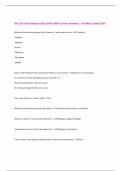
A nurse is assessing a client who has hyperkalemia. Which of the following findings should the nurse expect? A. Decreased muscle strength B. Decreased gastric motility C. Increased heart rate D. Increased blood pressue - A. Decreased muscle strength A nurse is assessing a client who is receiving hydrochlorothiazide and notes that the client is confused and lethargic. Which of the following laboratory values should the nurse report to the provider? A. Sodium 128 mEq/L B. Potassium 4.8 mEq/L C. Calcium 9.1 mg/dL D. Magnesium 2.0 mEq/L - A. Sodium 128 mEq/L A nurse is assessing a client who is using PCA following a thoracotomy. The client is short of breath, appears restless, and has respirations of 28/min. The client's ABG results are pH 7.52, PaO2 89mm hg, PaCO2 28 mmHg, and HCO3 -24 mEq/L. Which of the following actions should the nurse take? A. Instruct the client to cough forcefully. B. Assist the client with ambulation. C. Provide calming interventions. D. Discontinue the PCA. - C. Provide calming interventions. A nurse is assessing a client who has a serum calcium level of 8.1 mg/dL. Which of the following findings is the priority for the nurse to assess? A. Deep-tendon reflexes B. Cardiac rhythm C. Peripheral sensation D. Bowel sounds - B. Cardiac rhythm A nurse is caring for a client who is experiencing respiratory distress as a result of acute pulmonary edema. Which of the following actions should the nurse take first? A. Assist with intubation B. Initiate high-flow oxygen therapy C. Administer a rapid-acting diuretic D. Administer morphine IV - B. Initiate high-flow oxygen therapy A nurse is evaluating a client who is receiving IV fluids to treat isotonic dehydration. Which of the following laboratory findings indicates that the fluid therapy has been effective? A. BUN 26 mg/dL B. Serum sodium 138 mEq/L C. Hct 56% D. Urine specific gravity 1.035 - B. Serum sodium 138 mEq/L A nurse is teaching nutritional strategies to a client who has a low serum calcium level and an allergy to milk. Which of the following statements by the client indicates an understanding of the teaching? A. "I will eat extra cheese because I can't drink milk." B. "I will need to avoid foods with vitamin D because I am allergic to milk." C. "I will stop taking my calcium supplements if they irritate my stomach." D. "I will add broccoli and kale to my diet." - D. "I will add broccoli and kale to my diet." A nurse is caring for a client who has dehydration and is receiving IV fluids. When assessing for complications, the nurse should recognize which of the following manifestations as a sign of fluid overload? A. Increased urine specific gravity B. Hypoactive bowel sounds C. Bounding peripheral pulses D. Decreased respiratory rate - C. Bounding peripheral pulses A nurse is admitting a client who has status asthmaticus. The client's ABG results are pH 7.32, PaO2 74 mm Hg, PaCO2 56 mm Hg, and HCO3 -26 mEq/L. The nurse should interpret these laboratory values as which of the following imbalances? A. Respiratory acidosis B. Respiratory alkalosis C. Metabolic acidosis D. Metabolic alkalosis - A. Respiratory acidosis A nurse is admitting a client who takes 40 mg furosemide daily for heart failure and has experienced 3 days of vomiting. The nurse suspects hypokalemia. Which of the following medications should the nurse prepare to administer? A. Sodium polystyrene sulfonate 30 g/day B. 0.9% sodium chloride with 10 mEq/L of potassium chloride at 100 mL/hr C. Bumetanide 8 mg/day D. 100 mL of dextrose 10% in water with 10 units of insulin - B. 0.9% sodium chloride with 10 mEq/L of potassium chloride at 100 mL/hr A nurse is providing teaching for a client who has venous insufficiency of the lower extremities. Which of the following statements made by the client indicates an understanding of the instructions? A. "If my stockings feel tight, I'll just roll them down for a while." B. "I'll put on my elastic stockings at the first sign of swelling." C. "When I sit down to watch television, I'll be sure to put my feet up." D. "It's okay to cross my legs as long as it's for less than an hour." - C. "When I sit down to watch television, I'll be sure to put my feet up." A nurse is reviewing the laboratory data on four clients. Which of the following serum laboratory values should the nurse expect off for the client who is experiencing 2+ pitting ankle edema? A. Sodium 138 mEq/L B. Hematocrit 34% C. BUN 22 mg/dL D. Protein 9 g/L - B. Hematocrit 34% A nurse is caring for a client who has a serum sodium level of 155 mEq/L. Which of the following IV fluid prescriptions should the nurse anticipate administering? A. 1,000 mL 0.9% sodium chloride B. 1,000 mL dextrose 5% in water C. 1,000 mL dextrose 10% in water D. 1,000 mL 0.225% sodium chloride - D. 1,000 mL 0.225% sodium chloride A nurse is providing teaching for a client who is at risk for developing respiratory acidosis following surgery. Which of the following statements by the client indicates an understanding of the teaching? A. "I should conserve energy by limiting my physical activity." B. "I will wait until my pain is at least 6 out of 10 before I use the PCA." C. "I will limit my daily fluid intake to 2 to 3 glasses." D. "I will use the incentive spirometer every hour." - D. "I will use the incentive spirometer every hour." A nurse is planning dietary teaching for a client who has hypermagnesemia. Which of the following food choices contains the most magnesium and is, therefore, a food the nurse should plan to instruct the client to avoid? A. Hard-boiled eggs B. Cheddar cheese C. Raw rhubarb D. Raw spinach - D. Raw spinach A nurse is preparing to administer oral potassium for a client who has a potassium level of 5.5 mEq/L. Which of the following actions should the nurse take first? A. Administer a hypertonic solution B. Repeat the potassium level C. Withhold the medication D. Monitor for paresthesia - C. Withhold the medication
Written for
- Institution
- RN ATI - Fluid & Electrolytes
- Course
- RN ATI - Fluid & Electrolytes
Document information
- Uploaded on
- October 4, 2023
- Number of pages
- 22
- Written in
- 2023/2024
- Type
- Exam (elaborations)
- Contains
- Questions & answers
Subjects
-
rn ati fluid electrolytes exam 2023
-
rn ati fluid electrolytes exam 2024
-
rn ati fluid electrolytes
-
a nurse is assessing a client who has hyperkalemia