
Chapter 1
Types of variables
Qualitative
- Nominal scores are only intended to distinguish between different categories
o Hair colour, sex, disease.
- Ordinal scores are ordered
o Size coffee.
Quantitative
- Interval differences between scores can be meaningfully interpreted. No natural zero.
o Weight, income.
- Ratio natural zero.
o People in ER, age
Mean average
Median middle number
Mode score with highest frequency
Variation = n * var(x)
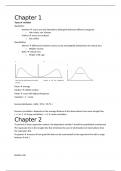
Normal distribution | 68% / 95% / 99,7% |
Pearson correlation r depends on the average distance of the observations from some straight line.
r = 1 or -1 strong correlation, r = 0 weak correlation.
Chapter 2
To perform a linear regression analysis, the dependent variable Y should be quantitative (continuous)
The regression line is the straight line that minimizes the sum of all deviations of observations from
the regression line.
R-squared measure of how good the data can be summarized by the regression line with a range
between 0 and 1.
Relative risk:
Types of variables
Qualitative
- Nominal scores are only intended to distinguish between different categories
o Hair colour, sex, disease.
- Ordinal scores are ordered
o Size coffee.
Quantitative
- Interval differences between scores can be meaningfully interpreted. No natural zero.
o Weight, income.
- Ratio natural zero.
o People in ER, age
Mean average
Median middle number
Mode score with highest frequency
Variation = n * var(x)
Normal distribution | 68% / 95% / 99,7% |
Pearson correlation r depends on the average distance of the observations from some straight line.
r = 1 or -1 strong correlation, r = 0 weak correlation.
Chapter 2
To perform a linear regression analysis, the dependent variable Y should be quantitative (continuous)
The regression line is the straight line that minimizes the sum of all deviations of observations from
the regression line.
R-squared measure of how good the data can be summarized by the regression line with a range
between 0 and 1.
Relative risk:


