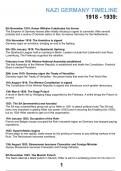
NAZI GERMANY TIMELINE
1918 - 1939:
9th November 1918: Kaiser Wilhelm II abdicates his throne
The Emperor of Germany leaves after initially refusing to agree to surrender. After several
protests and a mutiny of German sailors in Kiel, he leaves Germany for the Netherlands.
11th November 1918: The Armistice is signed
Germany signs an armistice, bringing an end to the fighting.
5th-12th January 1919: The Spartacist Uprising
The Spartacist League held an uprising in Berlin. Leaders include Karl Liebknecht and Rosa
Luxemburg. The Freikorps suppress the rebellion.
February-June 1919: Weimar National Assembly established
The first Assembly of the Weimar Republic is established and drafts the Constitution. Friedrich
Ebert is elected President.
28th June 1919: Germany signs the Treaty of Versailles
Germany signs the Treaty of Versailles - the peace treaty that ends the First World War.
11th August 1919: The Weimar Constitution is signed
The Constitution of the Weimar Republic is signed and introduces much greater democracy.
13th March 1920: The Kapp Putsch
A revolt in Berlin led by Wolfgang Kapp supported by the Freikorps. A strike brings the Putsch to
an end.
1921: The SA (brownshirts) was founded
The SA was a paramilitary group set up by Hitler in 1921 to attack political rivals.The SA had
been very important in getting Hitler into power (1933) and in securing the Enabling Act (1933)
but by 1934 Hitler wanted to get rid of this organisation.
11th January 1923: Occupation of the Ruhr
French and Belgian troops occupied the Ruhr industrial region as Germany had stopped paying
reparations.
1923: Hyperinflation begins
Prices begin to rise rapidly, made worse by the printing of money to pay striking workers in the
Ruhr. The Reichsmark becomes worthless.
13th August 1923: Stresemann becomes Chancellor and Foreign Minister
Gustav Stresemann becomes Chancellor and Foreign Minister.
8th November 1923: The Munich Putsch
The Nazis attempt a failed putsch in Munich. Hitler is sent to Landsberg prison for his role in it.
1
1918 - 1939:
9th November 1918: Kaiser Wilhelm II abdicates his throne
The Emperor of Germany leaves after initially refusing to agree to surrender. After several
protests and a mutiny of German sailors in Kiel, he leaves Germany for the Netherlands.
11th November 1918: The Armistice is signed
Germany signs an armistice, bringing an end to the fighting.
5th-12th January 1919: The Spartacist Uprising
The Spartacist League held an uprising in Berlin. Leaders include Karl Liebknecht and Rosa
Luxemburg. The Freikorps suppress the rebellion.
February-June 1919: Weimar National Assembly established
The first Assembly of the Weimar Republic is established and drafts the Constitution. Friedrich
Ebert is elected President.
28th June 1919: Germany signs the Treaty of Versailles
Germany signs the Treaty of Versailles - the peace treaty that ends the First World War.
11th August 1919: The Weimar Constitution is signed
The Constitution of the Weimar Republic is signed and introduces much greater democracy.
13th March 1920: The Kapp Putsch
A revolt in Berlin led by Wolfgang Kapp supported by the Freikorps. A strike brings the Putsch to
an end.
1921: The SA (brownshirts) was founded
The SA was a paramilitary group set up by Hitler in 1921 to attack political rivals.The SA had
been very important in getting Hitler into power (1933) and in securing the Enabling Act (1933)
but by 1934 Hitler wanted to get rid of this organisation.
11th January 1923: Occupation of the Ruhr
French and Belgian troops occupied the Ruhr industrial region as Germany had stopped paying
reparations.
1923: Hyperinflation begins
Prices begin to rise rapidly, made worse by the printing of money to pay striking workers in the
Ruhr. The Reichsmark becomes worthless.
13th August 1923: Stresemann becomes Chancellor and Foreign Minister
Gustav Stresemann becomes Chancellor and Foreign Minister.
8th November 1923: The Munich Putsch
The Nazis attempt a failed putsch in Munich. Hitler is sent to Landsberg prison for his role in it.
1