ADVANCED HEALTH ASSESSMENT - EXAM #2
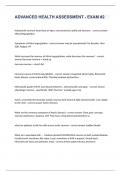
Holosystolic murmur heard best at Apex, may transmit to axilla and sternum. - correct answer Mitral Regurgitation Symptoms of Mitral regurgitation - correct answer may be asymptomatic for decades, then SOB, Fatigue, HF What increases the murmur of Mitral regurgitation, what decreases the murmur? - correct answer Decrease murmur = stand up Increase murmur = clench fist Common causes of mitral regurgitation - correct answer Congenital abnormality, Rheumatic Heart disease, acute endocarditis, Chordae tendinae dysfunction... Mid-systolic grade II-III/VI, best heard between L. sternal border and apex. - correct answer physiologic murmur - specifically "Still's Murmur" (usually ages 3-6) Harsh, crescendo-decrescendo systolic murmur best heard at right sternal border. Can radiate to the neck - correct answer Aortic Stenosis What are the common symptoms of Aortic Stenosis - correct answer Chest pain, syncope, exercise intolerance, dyspnea, CHF. May have a long latent period before sx. what are patients at risk for with severe aortic stenosis - correct answer Sudden Death! What am I associated with .... Medium pitched CONTINUOUS murmur in both systole/diastole. Usually harsh, machinery like noise. Loud, sometimes a thrill is present. (heard best L infraclavicular fossa and pulmonic area) - correct answer patent ductus arteriosus Mid-to late systolic murmur, may have a mid-systolic click best heard over the lower left sternal border. - correct answer Mitral Valve Prolapse what are the symptoms associated with MVP? - correct answer Most people are asymptomatic. May have chest pain, palpitation, mild dyspnea, fatigue, anxiety. Loud, blowing, high pitched diastolic murmur best heard Lower Left Sternal Border.. - correct answer Aortic insufficiency / Aortic regurgitation What are symptoms associated with severe aortic regurgitation? - correct answer Dyspnea, fatigue, CHF, widened pulse pressure. Water-hammer pulse Low pitched, mid-diastolic rumble best heard at the apex in the Left Lateral position. May also hear an "opening Snap" - correct answer Mitral Stenosis What is the most common cause for mitral stenosis - correct answer Rheumatic Heart Disease What are the sx associated with Mitral stenosis? - correct answer DYSPNEA, fatigue, palpitations, hemoptysis, angina-like chest pain. A-fib is common What are patients with Mitral Stenosis at risk for? (2 things) - correct answer Thromboembolization & pulmonary hypertension Which murmurs are louder during inspiration? (left or right) - correct answer Right Which murmurs are louder during expiration? (left or right) - correct answer Left Early, mid, or late systolic OR pansystolic Medium pitched murmur best heard at the lower left sternal border. Can radiate to the right sternal border? - correct answer Tricuspid Regurgitation/Insufficiency What is associated with a Pansystolic, louder in midsystole. best heard at LSB with radiation to the RSB. May have systolic THRILL at LLSB. Increased murmur with Valsalva. - correct answer Ventricular Septal Defect In a fetus, blood flows from the right atrium to the left atrium through the __________. - correct answer Foramen ovale In a fetus, the connection between the pulmonary artery and aorta is the ___________. - correct answer Ductus arteriosus _________ brings blood back from the fetus to the placenta - correct answer umbilical artery ________ brings blood from the placenta to the fetus - correct answer umbilical vein Which 3 CHD are associated with INCREASED pulmonary blood flow - correct answer PDA, ASD, VSD What are symptoms associated with Patent Ductus arteriosus? - correct answer may be asymptomatic, or CHF, bounding peripheral pulses, WIDE pulse pressure, II-V Harsh machinery like CONTINUOUS murmur best heard left clavicle, 1st/2nd L ICS. What is the treatment for PDA? - correct answer Indomethacin to effect closure Blood flows from Left to Right Atrium through an opening. Can result in R atrium and ventricle distention, and increased pulmonary blood flow. - correct answer Atrial Septal Defect Symptoms of ASD? - correct answer fatigue, exertional dyspnea, RARELY CHF.. may see pulmonary symptoms later in life if unrepaired. Shunt between the Left and Right Ventricle - correct answer Ventricular Septal defect What are the 4 associated defects of Tetralogy of Fallot? - correct answer 1. Pulmonic stenosis 2. Large VSD 3. Overriding aorta 4. Right Ventricular hypertrophy 2 CHD with DECREASED Pulmonary blood flow (CYANOTIC) - correct answer Tetrology of fallot and tricuspid atresia Symptoms of Tetralogy of Fallot? - correct answer cyanosis with feeding, hypercyanotic spells, squatting improves pulmonary blood flow. Grade III-VI harsh systolic ejection murmur. chest xray of tetralogy of Fallot - correct answer boot shaped heart lack of connection between right atrium and right ventricle - correct answer Tricuspid atresia (TA) Symptoms of Tricuspid atresia? - correct answer cyanosis at birth or a fews days after, difficulty feeding, week suck, clubbing, tachycardia, tachypnea, crackles.. Treatment for Tricuspid atresia? - correct answer IV PGE1 (prostoglandin) to keep the PDA open. then surgery. Position for Tet spell to help relieve cyanotic episode - correct answer cradled in knee position Obstructive blood flow disorders (three) - correct answer 1. coarctation of the aorta 2. Aortic stenosis 3. pulm stenosis Narrowing/constriction of the aorta is ____________. symptoms include: __________ - correct answer Coartication of the aorta. BP is increased in heart and upper portions of the body, decreased BP in lower portions of the body. Sx: tachypnea, poor feeding, cool lower extremities, older children leg pain, dizziness, syncope. *BOUNDING pulses in upper extremities, weak pulses in lower extremities. Coartication of aorta are at high risk for - correct answer hypertension, rupture aorta, AA, Stroke Narrowing of the aortic valve is ____________. Sx associated with it include __________ in pediatrics. - correct answer Aortic stenosis. SX: dif. feeding, fatigue, CP with activity, faint pulses, CHF, shock in AS newborns (severe), sudden death r/t dysrhythmias. Are there activity restrictions for children/adolescents with aortic stenosis? - correct answer Must have cardiac exam often (at least annually).. for mod/severe AS. avoid competitive intense sports - b/c of risk for sudden death from V. dysrhythmias. Narrowing of the subpulmonic, valvular, or supravaluvular area. sx assoc with it include _______ in pediatrics - correct answer pulmonary stenosis sx: asymptomatic until murmur is hear. exertional dyspnea, fatigue. Newborn cyanosis, right sided CHF CHD where the aorta and pulmonary vessels are switched - correct answer Transposition of the Great vessels. Underdevelopment of the Left side of the heart. (CHD) - correct answer Hypoplastic Left Heart Syndrome - often a very small L. ventricle and very narrow aortic valve. -usually fatal in first few months if not surgically treated. TX: prostaglandin to maintain ductal patency. then surgery or transplant. NORMALLY, the ________ side of the heart has higher pressure than the _________ side of the heart - correct answer Left side has higher pressure than the Right side Left to Right sided CHD are (ASD, VSD, PDA) are ______________. (cyanotic or acyanotic) - correct answer Acyanotic Right to Left disorders are acyanotic or cyanotic? - correct answer Cyanotic (blue) Leading ACQUIRED caused of heart disease in children? - correct answer Kawasaki Disease Criteria for diagnosis of Kawasaki disease - correct answer 1. fever 5 days unresponsive to Abt. 2. bilateral conjunctival injection (no exudate) 3. inflammatory changes to oral mucosa (erythema of lips or oropharynx, STRAWBERRY TONGUE, fissuring of lips 4. peripheral extremity edema, erythema, periungual desquamation 5. polymorphous rash (urticarial or pruritic) 6. cervical lymphadenopathy (unilateral, anterior cervical) heart sound that represents increase force of ATRIAL contraction and ventricular distention. - correct answer s4 - always pathologic "TENNESSEE" heart sound associated with rapid ventricular filling. best heard in lateral decubitus position. -Can be normal ages 40 - correct answer s3 - "kentucky" condition where fungal or bacteria invade traumatized endocardial surfaces, most common the valves. most commonly occurs with underlying structural defects - correct answer Infective endocarditis 80% of all IE in children is Staph (gram+) 3 Gram postive organisms - correct answer Staph, Strep, Enterococcus flat nontender lesion on palms and soles - associated with IE - correct answer Janeway lesions painful raised lesions on pads of fingers and toes - associated with IE - correct answer Osler Nodes retinal hemmorhags with a central white spot associated with IE - correct answer Roth Spots covers most of the anterior eyeball surface - correct answer balbar conjunctiva lines the eyelids - correct answer palpebral conjunctiva clear liquid that fills the anterior and posterior chambers of the eye. it is produced by the ciliary body - correct answer Aqueous humor visual receptive layer where light waves changed into nerve impulses - correct answer Retina Creamy yellow, sharply demarcated structure in funduscopic exam - correct answer optic disk A:V ratio - normal - correct answer 2:3 or 3:4 ophthalmoscope question. which color do you use to see near objects; and to use for farsighted eyes - correct answer Black opthalmoscope question: which color diopter would you use to see far/distant objects and to use with nearsighted eyes - correct answer Red What does 20/200 mean? - correct answer At 20 ft a patient can read what a person with normal vision can reat at 200 ft. the larger the second number the worse the vision.. 20/200 is also considered legally blind. myopia - correct answer impaired far vision "nearsightedness" Presbyopia - correct answer impaired near vision symptoms associated with ACUTE angle closure glaucoma - correct answer severe pain, N/V, halos around lights, photophobia, cornea cloudy. pupil mid dilated and fixed. Tx: Urgent referral Lateral rectus muscle of the eye is controlled by which Cranial nerve? - correct answer VI Inferior oblique (up/out), superior rectus (up/in), medial rectus is controlled by which cranial nerve? - correct answer III The superior oblique (down/out)muscle is controlled by which cranial nerve? - correct answer IV edema of the bulbar conjunctiva. - correct answer Chemosis microscopic or visible blood layering in the anterior chamber of the eye. usually after blunt trauma. Urgent referral necessary - correct answer Hyphema eye pain, conjunctival hyperemia, corneal cloudiness with stomal involvement. Urgent referral. - correct answer Keratitis normal intraocular pressure - correct answer 10-20mmHg opacification of the lens of the eye - correct answer Cataracts inflammation of the eyelids - correct answer blepharitis chronic sterile inflammation of the meibomian gland. it is self limited. - correct answer Chalazion an acute infection of one of the glands in the eyelid, painful. - correct answer Hordeolum obstruction that occurs at any point along the lacrimal drainage pathway. - correct answer dacryocystitis acute onset of floaters - correct answer retinal detachment blindspot around area of normal vision or decreased vision - correct answer scotoma - associated with glaucoma, optic nerve disorder, or visual pathway disorder. deviation in the anteroposterior axis of the eye - correct answer Strabismus an involuntary, rapid and repetitive movement of the eyes. Usually the movement is side-to-side - correct answer nystagmus double vision - correct answer diplopia leading cause of IRREVERSIBLE vision loss in the industrialized world - correct answer Macular degeneration which part of vision is lost in macular degeneration? - correct answer primarily central vision Eye exam findings of a pt with Hypertension - correct answer Copper wiring, silver wiring, AV nicking, tapering, banking, cotton wool (soft exudates), hard exudates, superficial retinal "flame shaped" hemorrhages Eye exam findings of a pt with diabetic retinopathy - correct answer microaneurysms (first sign), dot blot hemorrhages, , retinal edema and hard exudate, neovascularization (proliferative retinopathy). enlargement of the globe of the eye - correct answer bupthalmos what can bupthalmos be a sign of in infants - correct answer glaucoma, increased IOP OU means ____ - correct answer both eyes OD means _____ - correct answer right eye OS means_______ - correct answer left eye common organisms that cause otitis externa "swimmers ear" - correct answer pseudomonas aeriginosa, Staph epidermimidis, Staph Aureus Treatment for otitis externa - correct answer antibiotic ear gtts - Neomycin/polymyxin/hydrocortisone. Quinolones are the only non-ototoxic med that is safe for perforated TM Common organism for acute otitis media - correct answer Strep pneumoniae, H. influenzae, Moraxella catarrhalis, Strep pyogenes Treatment for Acute otitis media if bacterial is suspected... - correct answer First line - Amoxicillin 40-90mg/kg/day divided BID x10 #2 : --cephalosporin for nontype 1 hypersensitivity to pen. --Azithro, ceftriaxone, clindamycin for type 1 hypersens. #3. if failure - step up to augmentin decreased TM mobility, fluid level or bubbles. Often asymptomatic and afebrile.. what am I? - correct answer otitis media with EFFUSION What is the risk of otitis media with effusion - correct answer hearing loss Treatment for effusion - correct answer document each visit presence and duration of effusion. watchful waiting.. usually resolves in about 3 months. Referral if at high risk for having dev. delays. most common pathogen for acute bacterial sinusitis? - correct answer #1 Strep pneumoniae. other causes include: H. influenza, Moraxella catarrhalis. clamydia pneum. and strep pyogenes Antiobiotic treatment for acute BACTERIAL rhinosinusitis? - correct answer ---mild/mod ABRS with no risk of resistance is Amoxicillin/clavulanate 45mg/kg/day divided BID. ---with increased risk of resistance Amox/clavulanate 90mg/kg/day divided BID. Why is Augmentin given for ABRS rather than just Amoxicillin? - correct answer cluvulanate is used to treat H. flu and M. cattarrhalis - common causes of ABRS. Amoxillicin covers strep pneumo What are alternative treatments for ABRS if there is a penicillin allergy? - correct answer Doxycycline OR Clindamycin + 3rd gen cephalosporin OR respiratory quinolone First line treatment for acute strep Pharyngitis (GABHS) - correct answer Penicillin Penicillin V = oral x10 dyas Penicillin G = IM single dose Treatment of Group A Strep pharyngitis for a pt with penicillin allergy. - correct answer Clindamycin, azithromycin, clarithromycin characteristic symptom is a barking cough. what am I - correct answer Laryngotracheitis "croup" what is the treatment for croup with stridor at rest - correct answer Hospitilization. racemic epi nebulizer, steroids, mist with oxygen sudden onset sore throat, difficulty swallowing, fever, drooling, muffled voice, tripod position... Diagnosis? - correct answer Epiglottis - send to ED! which cranial nerve is responsible for taste in the posterior third of the tongue? - correct answer CN IX - glossopharyngeal which cranial nerve facilitates facial movement? - correct answer CN VII - facial which CN is responsible for visual acuity? - correct answer II- optic which CN is responsible for swallowing - correct answer X - vagus
Document information
- Uploaded on
- October 2, 2023
- Number of pages
- 13
- Written in
- 2023/2024
- Type
- Exam (elaborations)
- Contains
- Questions & answers