Davenport & Hannahs summary
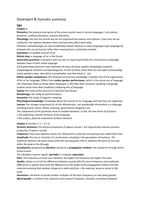
D&H
Chapter 1
Phonetics: the physical description of the actual sounds used in human languages / articulatory
phonetics, auditory phonetics, acoustic phonetics.
Phonology: the way the sounds we use are organized into patters and systems / how they can be
combined, the relations between them and how they affect each other.
Phonetics and phonology are only accidentally related, because in some languages (sign language for
example) the use of manual rather than vocal gestures is primarily involved.
Aspiration: an audible outrush of air.
Glottal stop: a stoppage of air in the throat.
Generative grammar: a discipline with the aim of capturing formally the unconscious knowledge
speakers have of their native language.
A full generative grammar must represent all areas of native speaker knowledge (syntactic,
morphological, semantic and phonological). In each of these areas there are two types of knowledge
native speakers have: that which is predictable, and that which is not.
Native speaker competence: the idealized unconscious knowledge a speaker has of the organization
of his or her language. Differs from native speaker performance, which is the actual use of language.
One important thing we know about languages is that they have structure; speaking a language
involves much more than randomly combining bits of language.
Syntax: the study of the structure of phrases and clauses.
Morphology: the study of word formation.
Semantics: the study of linguistic meaning.
Phonological knowledge: knowledge about the sounds of our language and how they are organized.
Lexicon: the storage component for all the idiosyncratic, non-predictable information in a language,
including words, stems, affixes, meaning, grammatical categories, etc.
The components of the grammar serve to mediate between, or link, the two levels of structure:
1 the underlying, mental elements of the language
2 the surface, physical realizations of these elements
Chapter 5 (sections 5.1 – 5.2.1)
Acoustic phonetics: the physical properties of speech sounds + the linguistically relevant acoustic
properties of speech sounds.
Frequency: how close together waves are. Measured in cycles per second (cps) also called Hertz (Hz).
Amplitude: the size or intensity of a sound wave, resulting in the perception of loudness. The
maximum distance the wave moves from the starting point, that is, between the point of rest and
either the peak or the through.
Soundwaves: produced by vibration carried by a propagation medium, the substance through which
sound travels.
The vibrations may be regular (periodic) or irregular (aperiodic).
Pitch: the frequency of vocal cord vibration; the higher the frequency the higher the pitch.
Quality: allows us to tell the difference between sounds with the same frequency and amplitude.
Differences in quality arise from the differences in the shape of the propagation medium and the
material enclosing that medium (shape of a violin and flute + the material, wood or metal in this
case).
Harmonics: vibrations at whole number multiples of the basic frequency or note being played.
Spectrograph: a machine that measures and analyzes frequency, duration, transitions between
D&H
Chapter 1
Phonetics: the physical description of the actual sounds used in human languages / articulatory
phonetics, auditory phonetics, acoustic phonetics.
Phonology: the way the sounds we use are organized into patters and systems / how they can be
combined, the relations between them and how they affect each other.
Phonetics and phonology are only accidentally related, because in some languages (sign language for
example) the use of manual rather than vocal gestures is primarily involved.
Aspiration: an audible outrush of air.
Glottal stop: a stoppage of air in the throat.
Generative grammar: a discipline with the aim of capturing formally the unconscious knowledge
speakers have of their native language.
A full generative grammar must represent all areas of native speaker knowledge (syntactic,
morphological, semantic and phonological). In each of these areas there are two types of knowledge
native speakers have: that which is predictable, and that which is not.
Native speaker competence: the idealized unconscious knowledge a speaker has of the organization
of his or her language. Differs from native speaker performance, which is the actual use of language.
One important thing we know about languages is that they have structure; speaking a language
involves much more than randomly combining bits of language.
Syntax: the study of the structure of phrases and clauses.
Morphology: the study of word formation.
Semantics: the study of linguistic meaning.
Phonological knowledge: knowledge about the sounds of our language and how they are organized.
Lexicon: the storage component for all the idiosyncratic, non-predictable information in a language,
including words, stems, affixes, meaning, grammatical categories, etc.
The components of the grammar serve to mediate between, or link, the two levels of structure:
1 the underlying, mental elements of the language
2 the surface, physical realizations of these elements
Chapter 5 (sections 5.1 – 5.2.1)
Acoustic phonetics: the physical properties of speech sounds + the linguistically relevant acoustic
properties of speech sounds.
Frequency: how close together waves are. Measured in cycles per second (cps) also called Hertz (Hz).
Amplitude: the size or intensity of a sound wave, resulting in the perception of loudness. The
maximum distance the wave moves from the starting point, that is, between the point of rest and
either the peak or the through.
Soundwaves: produced by vibration carried by a propagation medium, the substance through which
sound travels.
The vibrations may be regular (periodic) or irregular (aperiodic).
Pitch: the frequency of vocal cord vibration; the higher the frequency the higher the pitch.
Quality: allows us to tell the difference between sounds with the same frequency and amplitude.
Differences in quality arise from the differences in the shape of the propagation medium and the
material enclosing that medium (shape of a violin and flute + the material, wood or metal in this
case).
Harmonics: vibrations at whole number multiples of the basic frequency or note being played.
Spectrograph: a machine that measures and analyzes frequency, duration, transitions between