Political Science 144
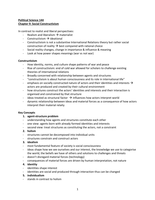
Chapter 9: Social Constructivism
In contrast to realist and liberal perspectives:
- Realism and liberalism materialist
- Constructivism ideational
- Constructivism is not a substantive International Relations theory but rather social
construction of reality best compared with rational choice
- Social reality changes, change in importance & influence & meaning
- Look at how power shapes meanings (war vs not war)
Constructivism
- How identity, norms, and culture shape patterns of war and peace
- Rise of constructivism: end of cold war allowed for scholars to challenge existing
theories of international relations
- Broadly concerned with relationship between agents and structures
- “constructivism is about human consciousness and its role in international life”
- emphasis on socially constructed nature of actors and their identities and interests
actors are produced and created by their cultural environment
- how structures construct the actors’ identities and interests and their interaction is
organised and constrained by that structure
- ideas treated as structural factor influences how actors interpret world
- dynamic relationship between ideas and material forces as a consequence of how actors
interpret their material relaity
Key Concepts
1. agent-structure problem
- understanding how agents and structures constitute each other
- one view: agents born with already formed identities and interests
- second view: treat structures as constituting the actors, not a constraint
2. holism
- structures cannot be decomposed into individual units
- structures constrain and construct actors
3. idealism
- most fundamental feature of society is social consciousness
- ideas shape how we see ourselves and our interest, the knowledge we use to categorise
the world, the beliefs we have of others and solutions to challenges and threats
- doesn’t disregard material forces (technology)
- consequences of material forces are driven by human interpretation, not nature
4. identity
- identities shape interest
- identities are social and produced through interaction thus can be changed
5. individualism
- stands in contrast to holism
1
Chapter 9: Social Constructivism
In contrast to realist and liberal perspectives:
- Realism and liberalism materialist
- Constructivism ideational
- Constructivism is not a substantive International Relations theory but rather social
construction of reality best compared with rational choice
- Social reality changes, change in importance & influence & meaning
- Look at how power shapes meanings (war vs not war)
Constructivism
- How identity, norms, and culture shape patterns of war and peace
- Rise of constructivism: end of cold war allowed for scholars to challenge existing
theories of international relations
- Broadly concerned with relationship between agents and structures
- “constructivism is about human consciousness and its role in international life”
- emphasis on socially constructed nature of actors and their identities and interests
actors are produced and created by their cultural environment
- how structures construct the actors’ identities and interests and their interaction is
organised and constrained by that structure
- ideas treated as structural factor influences how actors interpret world
- dynamic relationship between ideas and material forces as a consequence of how actors
interpret their material relaity
Key Concepts
1. agent-structure problem
- understanding how agents and structures constitute each other
- one view: agents born with already formed identities and interests
- second view: treat structures as constituting the actors, not a constraint
2. holism
- structures cannot be decomposed into individual units
- structures constrain and construct actors
3. idealism
- most fundamental feature of society is social consciousness
- ideas shape how we see ourselves and our interest, the knowledge we use to categorise
the world, the beliefs we have of others and solutions to challenges and threats
- doesn’t disregard material forces (technology)
- consequences of material forces are driven by human interpretation, not nature
4. identity
- identities shape interest
- identities are social and produced through interaction thus can be changed
5. individualism
- stands in contrast to holism
1