Principles of Advanced English Composition DSST fully solved 2023
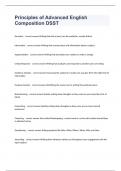
Principles of Advanced English Composition DSSTNarrative - correct answer Writing that tells a story (can be nonfiction, usually fiction) Informative - correct answer Writing that conveys ideas and information about a subject Argumentative - correct answer Writing that persuades your readers to make a change Critical Response - correct answer Writing that analyzyes and responds to another piece of writing Audience Analysis - correct answer Assessing the audience to make sure you give them the right level of information Purpose Analysis - correct answer Identifying the reason you're writing this particular piece Brainstorming - correct answer Quickly writing down thoughts as they come to you (more like a list of ideas) Freewriting - correct answer Quickly writing down thoughts as they come to you (more formal sentences) Clustering - correct answer Also called Mindmapping - central word in a circle with related words/ideas in attached circles Questioning - correct answer Asking questions like Who, What, Where, When, Why, and How Journaling - correct answer Writing down whatever strikes you throughout your engagement with the topic/subject
Written for
- Institution
- DSST
- Course
- DSST
Document information
- Uploaded on
- September 21, 2023
- Number of pages
- 2
- Written in
- 2023/2024
- Type
- Exam (elaborations)
- Contains
- Questions & answers
Subjects
-
principles of advanced english composition dsst

Also available in package deal