BEK Chapter 30: Judicial review of administrative action I
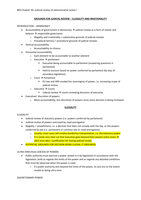
GROUNDS FOR JUDICIAL REVIEW – ILLEGALITY AND IRRATIONALITY
INTRODUCTION – DEMOCRACY
Accountability of government in democracy judicial review as a form of checks and
balance responsible governance
o Illegality and irrationality = substantive grounds of judicial reviews
o Procedural fairness = procedural grounds of judicial reviews
Vertical accountability
o Accountability to citizens
Horizontal accountability
o Each element to be accountable to another element
o Executive parliament
Executive being accountable to parliament (answering questions in
parliament)
Held to account based on power conferred by parliament (by way of
secondary legislation)
o Court Parliament
EU law and HRA eroded the sovereignty of power, i.e. increasing scope of
judicial review
o Executive Courts
Judicial review courts reviewing decisions of executive
Executives’ discretion of powers
o More accountability, less discretion of powers since every decision is being reviewed
ILLEGALITY
ILLEGALITY
Judicial review of statutory powers (i.e. powers conferred by parliament)
Judicial review of powers exercised by royal prerogative
Illegality = unlawfulness, i.e. a decision that does not comply with the law, or the powers
conferred by law (i.e. parliament or common law or royal prerogative)
o Usually, most cases will involve borderline interpretation, i.e. discretionary power
o It is rarely very clear cut that executive goes beyond their powers (ultra vires)
ultra vires idea = justification for having judicial review
POTENTIAL GROUNDS FOR DECISION BEING ILLEGAL (7 GROUNDS)
ULTRA VIRES RULE (EXCESS OF POWER)
Public authority must exercise a power vested in it by legislation in accordance with the
legislation, both as regards the limits of the power and as regards any detailed conditions
that must be observed when the power is used.
o If a public authority acts beyond the limits of the power, its acts are to the extent
invalid as being ultra vires
DISCRETIONARY POWER
GROUNDS FOR JUDICIAL REVIEW – ILLEGALITY AND IRRATIONALITY
INTRODUCTION – DEMOCRACY
Accountability of government in democracy judicial review as a form of checks and
balance responsible governance
o Illegality and irrationality = substantive grounds of judicial reviews
o Procedural fairness = procedural grounds of judicial reviews
Vertical accountability
o Accountability to citizens
Horizontal accountability
o Each element to be accountable to another element
o Executive parliament
Executive being accountable to parliament (answering questions in
parliament)
Held to account based on power conferred by parliament (by way of
secondary legislation)
o Court Parliament
EU law and HRA eroded the sovereignty of power, i.e. increasing scope of
judicial review
o Executive Courts
Judicial review courts reviewing decisions of executive
Executives’ discretion of powers
o More accountability, less discretion of powers since every decision is being reviewed
ILLEGALITY
ILLEGALITY
Judicial review of statutory powers (i.e. powers conferred by parliament)
Judicial review of powers exercised by royal prerogative
Illegality = unlawfulness, i.e. a decision that does not comply with the law, or the powers
conferred by law (i.e. parliament or common law or royal prerogative)
o Usually, most cases will involve borderline interpretation, i.e. discretionary power
o It is rarely very clear cut that executive goes beyond their powers (ultra vires)
ultra vires idea = justification for having judicial review
POTENTIAL GROUNDS FOR DECISION BEING ILLEGAL (7 GROUNDS)
ULTRA VIRES RULE (EXCESS OF POWER)
Public authority must exercise a power vested in it by legislation in accordance with the
legislation, both as regards the limits of the power and as regards any detailed conditions
that must be observed when the power is used.
o If a public authority acts beyond the limits of the power, its acts are to the extent
invalid as being ultra vires
DISCRETIONARY POWER