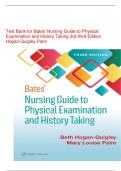
Test Bank for Bates' Nursing Guide to Physical
Examination and History Taking 3rd third Edition
Hogan-Quigley Palm
, Chapter 1: Theory & Nursing Practice for Community/Public
Health Nursing-CEIN BS
1. For which of the following clients would a detailed health history be most suitable?
A) A new client presenting with “I sprained my ankle”
B) A returning client with “I have an upper respiratory infection”
C) A new client stating, “I am here to establish care”
D) A new client saying, “I cut my hand”
THE RIGHT ANS: C
Chapter: 01
Page & Section: 4, Client Assessment: Comprehensive or Focused
Explanation: Since this client is new and seeking to establish care, a comprehensive health history is
necessary.
2. Which of the following is not a component of a health history?
A) Review of systems
B) Thorax and lungs
C) Present illness
D) Personal and social history
THE RIGHT ANS: B
Chapter: 01
Explanation: The thorax and lungs are assessed during a physical examination, not in the health history. The
other options are integral parts of a complete health history.
3. Is the following information subjective or objective?
"Mr. M. reports experiencing shortness of breath for the past 10 days, which worsens with activity but
improves with rest."
A) Subjective
B) Objective
THE RIGHT ANS: A
Chapter: 01
, 4. Is the following information subjective or objective?
"Mr. M. has a respiratory rate of 32 and a pulse rate of 120."
A) Subjective
B) Objective
THE RIGHT ANS: B
Chapter: 01
Explanation: This data is obtained through direct measurement by the examiner, making it objective. The
client cannot provide these figures independently.
5. The following information appears in a client’s health history:
"The client has experienced abdominal pain for one week. Each episode lasts approximately 30 minutes,
occurring intermittently. The pain intensity is rated 7 to 9 out of 10 and is accompanied by nausea and
vomiting. The pain is localized in the mid-epigastric region."
Which category does this information fall under?
A) Chief complaint
B) Present illness
C) Personal and social history
D) Review of systems
THE RIGHT ANS: B
Chapter: 01
Explanation: This description details the client’s current issue, making it part of the present illness. While it
includes elements from the review of systems, it primarily belongs in the history of present illness. Additional
details, such as pain quality, aggravating or relieving factors, and contextual triggers, should still be gathered.
6. The following details appear in a client’s health history:
"The client completed eighth grade. He lives with his wife and two children, works on cars as a hobby
on weekends, and has a full-time job in a glass factory during the week."
Which category does this belong to?
THE RIGHT ANS: C (Personal and social history)
Chapter: 01
Explanation: Personal and social history includes education, living situation, occupation, hobbies, family
background, religious beliefs, military history, and lifestyle factors (e.g., diet, exercise, substance use, and
sexual history).
7. The following information is recorded in the health history:
"I feel really tired."
Which category does it belong to?
, A) Chief complaint
B) Present illness
C) Personal and social history
D) Review of systems
THE RIGHT ANS: A
Chapter: 01
Explanation: The chief complaint is a brief statement of the client’s main concern, often documented in their
own words. More details about the issue should be recorded under the present illness.
8. The following is noted in the health history:
"Client denies chest pain, palpitations, orthopnea, and paroxysmal nocturnal dyspnea."
Which category does this belong to?
A) Chief complaint
B) Present illness
C) Personal and social history
D) Review of systems
THE RIGHT ANS: D
Chapter: 01
Explanation: The review of systems documents the presence or absence of common symptoms related to
various organ systems.
9. Where should the following information be categorized?
"The client has undergone three cesarean sections."
A) Adult illnesses
B) Surgeries
C) Obstetrics/gynecology
D) Psychiatric
THE RIGHT ANS: B
Chapter: 01
Explanation: A cesarean section is a surgical procedure, so it should be recorded under the surgeries category.
Dates or the client’s age at the time of each surgery should also be documented.
10. Where should the following information be categorized?
"A stent was placed in the client's left anterior descending artery (LAD) in 1999."
A) Adult illnesses
B) Surgeries
C) Obstetrics/gynecology
D) Psychiatric
,THE RIGHT ANS: A
Chapter: 01
Explanation: The category of adult illnesses includes chronic conditions, significant hospitalizations, major
injuries, and notable medical procedures. Although placing a stent is a significant intervention, it is not
classified as a surgical procedure.
11. Where should the following information be categorized?
"The client was hospitalized last year for an asthma exacerbation but has never required intubation."
A) Adult illnesses
B) Surgeries
C) Obstetrics/gynecology
D) Psychiatric
THE RIGHT ANS: A
Chapter: 01
Explanation: This falls under adult illnesses, as it refers to a major health condition requiring hospitalization. If
the asthma attack were directly related to the current chief complaint, this information could also be
documented under the present illness section.
Chapter 2 Critical Thinking in Health Assessment Multiple-Choice Questions
1. When conducting a physical assessment, which technique should the RN always use first?
a) Palpation
b) Inspection
c) Percussion
d) Auscultation
THE RIGHT ANS: B
Explanation: Physical examination techniques follow this order: inspection, palpation, percussion, and
auscultation, except for the abdominal exam, where auscultation is done before palpation and
, percussion. Every body system assessment starts with inspection, which is a detailed process that
provides significant information.
2. Before performing a physical assessment, which statement about the inspection phase is correct?
a) It provides minimal information.
b) It takes time and can yield a wealth of information.
c) It may feel awkward for even experienced practitioners.
THE RIGHT ANS: B
Explanation: A thorough inspection requires time and can reveal a significant amount of information.
While it may initially feel uncomfortable for the examiner to observe a client without performing other
tasks, a focused assessment involves more than just a quick glance.
3. While assessing a client's skin temperature, which part of the hand and technique should the RN use?
a) Fingertips, as they detect small temperature changes.
b) The back of the hand (dorsal surface), where the skin is thinner.
c) The ulnar side of the hand, due to increased blood supply.
d) The palm, as it has more nerve endings sensitive to temperature.
THE RIGHT ANS: B
Explanation: The back of the hand is ideal for assessing temperature because its skin is thinner, making
it more sensitive to changes. Fingertips are best for fine tactile discrimination rather than temperature
detection.
4. Which technique relies on touch to evaluate texture, temperature, moisture, and swelling during a client
assessment?
a) Palpation
b) Inspection
c) Percussion
d) Auscultation
THE RIGHT ANS: A
5. When preparing to palpate a client’s abdomen, what is the correct approach?
a) Avoid palpating tender areas to prevent discomfort.
b) Quickly palpate tender areas to minimize pain.
c) Start with deep palpation while instructing the client to relax.
d) Begin with light palpation to assess surface characteristics and help the client get comfortable.
Examination and History Taking 3rd third Edition
Hogan-Quigley Palm
, Chapter 1: Theory & Nursing Practice for Community/Public
Health Nursing-CEIN BS
1. For which of the following clients would a detailed health history be most suitable?
A) A new client presenting with “I sprained my ankle”
B) A returning client with “I have an upper respiratory infection”
C) A new client stating, “I am here to establish care”
D) A new client saying, “I cut my hand”
THE RIGHT ANS: C
Chapter: 01
Page & Section: 4, Client Assessment: Comprehensive or Focused
Explanation: Since this client is new and seeking to establish care, a comprehensive health history is
necessary.
2. Which of the following is not a component of a health history?
A) Review of systems
B) Thorax and lungs
C) Present illness
D) Personal and social history
THE RIGHT ANS: B
Chapter: 01
Explanation: The thorax and lungs are assessed during a physical examination, not in the health history. The
other options are integral parts of a complete health history.
3. Is the following information subjective or objective?
"Mr. M. reports experiencing shortness of breath for the past 10 days, which worsens with activity but
improves with rest."
A) Subjective
B) Objective
THE RIGHT ANS: A
Chapter: 01
, 4. Is the following information subjective or objective?
"Mr. M. has a respiratory rate of 32 and a pulse rate of 120."
A) Subjective
B) Objective
THE RIGHT ANS: B
Chapter: 01
Explanation: This data is obtained through direct measurement by the examiner, making it objective. The
client cannot provide these figures independently.
5. The following information appears in a client’s health history:
"The client has experienced abdominal pain for one week. Each episode lasts approximately 30 minutes,
occurring intermittently. The pain intensity is rated 7 to 9 out of 10 and is accompanied by nausea and
vomiting. The pain is localized in the mid-epigastric region."
Which category does this information fall under?
A) Chief complaint
B) Present illness
C) Personal and social history
D) Review of systems
THE RIGHT ANS: B
Chapter: 01
Explanation: This description details the client’s current issue, making it part of the present illness. While it
includes elements from the review of systems, it primarily belongs in the history of present illness. Additional
details, such as pain quality, aggravating or relieving factors, and contextual triggers, should still be gathered.
6. The following details appear in a client’s health history:
"The client completed eighth grade. He lives with his wife and two children, works on cars as a hobby
on weekends, and has a full-time job in a glass factory during the week."
Which category does this belong to?
THE RIGHT ANS: C (Personal and social history)
Chapter: 01
Explanation: Personal and social history includes education, living situation, occupation, hobbies, family
background, religious beliefs, military history, and lifestyle factors (e.g., diet, exercise, substance use, and
sexual history).
7. The following information is recorded in the health history:
"I feel really tired."
Which category does it belong to?
, A) Chief complaint
B) Present illness
C) Personal and social history
D) Review of systems
THE RIGHT ANS: A
Chapter: 01
Explanation: The chief complaint is a brief statement of the client’s main concern, often documented in their
own words. More details about the issue should be recorded under the present illness.
8. The following is noted in the health history:
"Client denies chest pain, palpitations, orthopnea, and paroxysmal nocturnal dyspnea."
Which category does this belong to?
A) Chief complaint
B) Present illness
C) Personal and social history
D) Review of systems
THE RIGHT ANS: D
Chapter: 01
Explanation: The review of systems documents the presence or absence of common symptoms related to
various organ systems.
9. Where should the following information be categorized?
"The client has undergone three cesarean sections."
A) Adult illnesses
B) Surgeries
C) Obstetrics/gynecology
D) Psychiatric
THE RIGHT ANS: B
Chapter: 01
Explanation: A cesarean section is a surgical procedure, so it should be recorded under the surgeries category.
Dates or the client’s age at the time of each surgery should also be documented.
10. Where should the following information be categorized?
"A stent was placed in the client's left anterior descending artery (LAD) in 1999."
A) Adult illnesses
B) Surgeries
C) Obstetrics/gynecology
D) Psychiatric
,THE RIGHT ANS: A
Chapter: 01
Explanation: The category of adult illnesses includes chronic conditions, significant hospitalizations, major
injuries, and notable medical procedures. Although placing a stent is a significant intervention, it is not
classified as a surgical procedure.
11. Where should the following information be categorized?
"The client was hospitalized last year for an asthma exacerbation but has never required intubation."
A) Adult illnesses
B) Surgeries
C) Obstetrics/gynecology
D) Psychiatric
THE RIGHT ANS: A
Chapter: 01
Explanation: This falls under adult illnesses, as it refers to a major health condition requiring hospitalization. If
the asthma attack were directly related to the current chief complaint, this information could also be
documented under the present illness section.
Chapter 2 Critical Thinking in Health Assessment Multiple-Choice Questions
1. When conducting a physical assessment, which technique should the RN always use first?
a) Palpation
b) Inspection
c) Percussion
d) Auscultation
THE RIGHT ANS: B
Explanation: Physical examination techniques follow this order: inspection, palpation, percussion, and
auscultation, except for the abdominal exam, where auscultation is done before palpation and
, percussion. Every body system assessment starts with inspection, which is a detailed process that
provides significant information.
2. Before performing a physical assessment, which statement about the inspection phase is correct?
a) It provides minimal information.
b) It takes time and can yield a wealth of information.
c) It may feel awkward for even experienced practitioners.
THE RIGHT ANS: B
Explanation: A thorough inspection requires time and can reveal a significant amount of information.
While it may initially feel uncomfortable for the examiner to observe a client without performing other
tasks, a focused assessment involves more than just a quick glance.
3. While assessing a client's skin temperature, which part of the hand and technique should the RN use?
a) Fingertips, as they detect small temperature changes.
b) The back of the hand (dorsal surface), where the skin is thinner.
c) The ulnar side of the hand, due to increased blood supply.
d) The palm, as it has more nerve endings sensitive to temperature.
THE RIGHT ANS: B
Explanation: The back of the hand is ideal for assessing temperature because its skin is thinner, making
it more sensitive to changes. Fingertips are best for fine tactile discrimination rather than temperature
detection.
4. Which technique relies on touch to evaluate texture, temperature, moisture, and swelling during a client
assessment?
a) Palpation
b) Inspection
c) Percussion
d) Auscultation
THE RIGHT ANS: A
5. When preparing to palpate a client’s abdomen, what is the correct approach?
a) Avoid palpating tender areas to prevent discomfort.
b) Quickly palpate tender areas to minimize pain.
c) Start with deep palpation while instructing the client to relax.
d) Begin with light palpation to assess surface characteristics and help the client get comfortable.