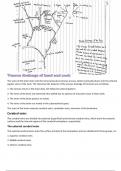
The veins of the brain drain into the intracranial dural venous sinuses, which eventually drains into the internal
jugular veins of the neck. The characteristic features of the venous drainage of the brain are as follows:
1. The venous return in the brain does not follow the arterial pattern.
2. The veins of the brain are extremely thin walled due to absence of muscular tissue in their walls.
3. The veins of the brain possess no valves.
4. The veins of the brain run mainly in the subarachnoid space.
The veins of the brain comprise cerebral veins, cerebellar veins, and veins of the brainstem.
Cerebral veins
The cerebral veins are divided into external (superficial) and internal cerebral veins, which drain the external
surfaces and the internal regions of the cerebral hemisphere, respectively.
The external cerebral veins
The external cerebral veins drain the surface (cortex) of the hemisphere and are divided into three groups, viz.
1. Superior cerebral veins
2. Middle cerebral veins
3. Inferior cerebral veins
, Superior cerebral veins: The superior cerebral veins are about 8–12 and drain the upper parts of the
superolateral and medial surfaces of the cerebral hemisphere. They ascend upwards, pierce the arachnoid
mater, and traverse the subdural space to enter the superior sagittal sinus. The anterior veins open at right
angle, while the posterior open obliquely against the flow of bloodstream in the superior sagittal sinus,
thereby preventing their collapse by increased CSF pressure.
Middle cerebral veins: The middle cerebral veins are four, two on each side: superficial middle cerebral vein
and deep middle cerebral vein. The superficial middle cerebral vein lies superficially in the lateral sulcus.
Anteriorly, it runs forwards to drain into the cavernous sinus while posteriorly, it communicates with the
superior sagittal sinus via superior
Inferior cerebral veins: The inferior cerebral veins are many in number but smaller in size. They drain the
inferior surface and lower parts of medial and superolateral surfaces of the cerebral hemisphere into nearby
intracranial dural venous sinuses, e.g., transverse sinus.
jugular veins of the neck. The characteristic features of the venous drainage of the brain are as follows:
1. The venous return in the brain does not follow the arterial pattern.
2. The veins of the brain are extremely thin walled due to absence of muscular tissue in their walls.
3. The veins of the brain possess no valves.
4. The veins of the brain run mainly in the subarachnoid space.
The veins of the brain comprise cerebral veins, cerebellar veins, and veins of the brainstem.
Cerebral veins
The cerebral veins are divided into external (superficial) and internal cerebral veins, which drain the external
surfaces and the internal regions of the cerebral hemisphere, respectively.
The external cerebral veins
The external cerebral veins drain the surface (cortex) of the hemisphere and are divided into three groups, viz.
1. Superior cerebral veins
2. Middle cerebral veins
3. Inferior cerebral veins
, Superior cerebral veins: The superior cerebral veins are about 8–12 and drain the upper parts of the
superolateral and medial surfaces of the cerebral hemisphere. They ascend upwards, pierce the arachnoid
mater, and traverse the subdural space to enter the superior sagittal sinus. The anterior veins open at right
angle, while the posterior open obliquely against the flow of bloodstream in the superior sagittal sinus,
thereby preventing their collapse by increased CSF pressure.
Middle cerebral veins: The middle cerebral veins are four, two on each side: superficial middle cerebral vein
and deep middle cerebral vein. The superficial middle cerebral vein lies superficially in the lateral sulcus.
Anteriorly, it runs forwards to drain into the cavernous sinus while posteriorly, it communicates with the
superior sagittal sinus via superior
Inferior cerebral veins: The inferior cerebral veins are many in number but smaller in size. They drain the
inferior surface and lower parts of medial and superolateral surfaces of the cerebral hemisphere into nearby
intracranial dural venous sinuses, e.g., transverse sinus.