

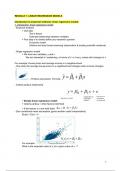
fMODULE 1: LINEAR REGRESSION MODELS
Introduction to empirical methods: linear regression models
1. Introduction: linear regression model
- Empirical analysis
> Use data
Test a theory
Estimate relationship between variables
> First step is to clearly define your research question
Economic model
Intuitive and less formal reasoning (observation & existing scientific evidence)
- Single regression model
> We have two variables, y and x
We are interested in ‘explaining y in terms of x’ or ‘how y varies with changes in x’
For example: House prices and average income in a neighbourhood
- How does the average house prices in a neighbourhood changes when income changes
Positive association. Formula:
- Ceteris paribus relationship
> Simple linear regression model:
> Ceteris paribus = other factors held fixed
> If the factors in u are held fixed:
- Zero conditional mean assumption (gives another useful interpretation)
E(u|x) = E(u) = 0
For example:
What is the expected value of y, for a given value of x ^^
1
,Keep asking yourself…
- Can we draw ceteris paribus conclusions about how x affects y in our example?
> We need to assume E(u|x) = E(u) = 0
>> Zero conditional mean assumption
>> What does it mean in our example?
>>> Assume u is the same as amenities
>>> Then, amenities are the same regardless of average income
*E(amenities | income = 10,000) = E(amenities | income = 100,000)
Means: amenities (voorzieningen) is same regardless incomes
* If we think that the amount and quality of amenities is different in
richer than in poorer neighbourhoods then previous assumption
does not hold
* We cannot observe u, so we have no way of knowing whether or not
amenities are the same for all levels of x
2. Estimation and interpretation
- Given graph: each dot is a neighbourhood, positively related
- Estimate by ordinary least square estimates (OLS)
> Select a random sample of the population of interest
Using stata to add the values
> In stata
Income was in 1000 €, when average income increases by 1000, the average
houseprice increases by about 16000 €, ceteris paribus
Output tell us that expected houseprice = equal to -95000 when the income is 0
Does not make sense, cause we do not have negative prices but that is
cause income can not be 0 (> this way good interpretation)
2
,- Multiple regression model
> Difficult to draw ceteris paribus conclusions using simple regression analysis
is 2nd cp? Depends; if error is not correlated
> Multiple regression model:
> Multiple regression analysis allows us to control for many other factors that
simultaneously affect the dependent variable (better predictions also)
3. OLS assumptions for unbiasedness
- Unbiasedness of OLS = Expected value of estimator = population parameter
- Assumptions needed:
MLR1: Linear in parameters
MLR2: Random sampling
MLR3: No perfect collinearity
MLR4: Zero conditional mean, i.e., E(u|x)=0
> Assumption MLR1: Linearity in parameters
> Assumption MLR2: Random sampling
* We have a random sample of size n, following the population model
* If sample is not random, selection bias
> Assumption MLR3: No perfect collinearity = no perfect linear relationships
* In the sample (and therefore in the population):
None of the independent variables is constant, and
There are no exact linear relationships among the independent variables
Example:
3
, Perfect collinearity
- Estimation simply does not work
- Some softwares give error message and no/strange results
- Stata drops one variable automatically/arbitrarily and then estimates a
model that does not suffer from this problem:
But it may not be the variable you would prefer to drop, so i) start by
defining model properly and, only then, ii) estimate it
Imperfect collinearity
- Model works but is problematic, imprecise estimates
- Beware of x’s with high correlation
- Symptoms of imperfect collinearity (for example, between x1 & x2):
Big F-stat (x1, x2 jointly significant) but
small t-statistics (for example x1 and x2 individually insignificant)
> Assumption MLR4: Zero conditional mean (important and complicated)
Next step is to do hypothesis testing: do we need additional assumptions to do inference?
YES:
4. Assumptions for inference (gevolgtrekking/conclusie)
- Inference - hypothesis testing
> We make two additional assumptions:
MLR5: Homoskedasticity
MLR6: Normality
> MLR1 - MLR6: OLS estimator is the minimum variance unbiased estimator
- Assumption MLR5: homoskedasticity
> Variance of error term is the same regardless of the values of the independent
Variables:
> Importance of error term same for all individuals
> Magnitude of uncertainty in the outcome of y is the same at all levels of x’s
Example: in which figure is the homoskedasticy assumption most likely to be satisfied?
B less variation for small x, more for large x
So in figure A the assumption is most likely to be satisfied
> If assumption does not hold, then we have heteroskedasticity:
> In case of heteroskedasticity:
* SE and statistics used for inference can easily be adjusted
→ ALWAYS use heteroskedasticity-robust standard errors
4
Introduction to empirical methods: linear regression models
1. Introduction: linear regression model
- Empirical analysis
> Use data
Test a theory
Estimate relationship between variables
> First step is to clearly define your research question
Economic model
Intuitive and less formal reasoning (observation & existing scientific evidence)
- Single regression model
> We have two variables, y and x
We are interested in ‘explaining y in terms of x’ or ‘how y varies with changes in x’
For example: House prices and average income in a neighbourhood
- How does the average house prices in a neighbourhood changes when income changes
Positive association. Formula:
- Ceteris paribus relationship
> Simple linear regression model:
> Ceteris paribus = other factors held fixed
> If the factors in u are held fixed:
- Zero conditional mean assumption (gives another useful interpretation)
E(u|x) = E(u) = 0
For example:
What is the expected value of y, for a given value of x ^^
1
,Keep asking yourself…
- Can we draw ceteris paribus conclusions about how x affects y in our example?
> We need to assume E(u|x) = E(u) = 0
>> Zero conditional mean assumption
>> What does it mean in our example?
>>> Assume u is the same as amenities
>>> Then, amenities are the same regardless of average income
*E(amenities | income = 10,000) = E(amenities | income = 100,000)
Means: amenities (voorzieningen) is same regardless incomes
* If we think that the amount and quality of amenities is different in
richer than in poorer neighbourhoods then previous assumption
does not hold
* We cannot observe u, so we have no way of knowing whether or not
amenities are the same for all levels of x
2. Estimation and interpretation
- Given graph: each dot is a neighbourhood, positively related
- Estimate by ordinary least square estimates (OLS)
> Select a random sample of the population of interest
Using stata to add the values
> In stata
Income was in 1000 €, when average income increases by 1000, the average
houseprice increases by about 16000 €, ceteris paribus
Output tell us that expected houseprice = equal to -95000 when the income is 0
Does not make sense, cause we do not have negative prices but that is
cause income can not be 0 (> this way good interpretation)
2
,- Multiple regression model
> Difficult to draw ceteris paribus conclusions using simple regression analysis
is 2nd cp? Depends; if error is not correlated
> Multiple regression model:
> Multiple regression analysis allows us to control for many other factors that
simultaneously affect the dependent variable (better predictions also)
3. OLS assumptions for unbiasedness
- Unbiasedness of OLS = Expected value of estimator = population parameter
- Assumptions needed:
MLR1: Linear in parameters
MLR2: Random sampling
MLR3: No perfect collinearity
MLR4: Zero conditional mean, i.e., E(u|x)=0
> Assumption MLR1: Linearity in parameters
> Assumption MLR2: Random sampling
* We have a random sample of size n, following the population model
* If sample is not random, selection bias
> Assumption MLR3: No perfect collinearity = no perfect linear relationships
* In the sample (and therefore in the population):
None of the independent variables is constant, and
There are no exact linear relationships among the independent variables
Example:
3
, Perfect collinearity
- Estimation simply does not work
- Some softwares give error message and no/strange results
- Stata drops one variable automatically/arbitrarily and then estimates a
model that does not suffer from this problem:
But it may not be the variable you would prefer to drop, so i) start by
defining model properly and, only then, ii) estimate it
Imperfect collinearity
- Model works but is problematic, imprecise estimates
- Beware of x’s with high correlation
- Symptoms of imperfect collinearity (for example, between x1 & x2):
Big F-stat (x1, x2 jointly significant) but
small t-statistics (for example x1 and x2 individually insignificant)
> Assumption MLR4: Zero conditional mean (important and complicated)
Next step is to do hypothesis testing: do we need additional assumptions to do inference?
YES:
4. Assumptions for inference (gevolgtrekking/conclusie)
- Inference - hypothesis testing
> We make two additional assumptions:
MLR5: Homoskedasticity
MLR6: Normality
> MLR1 - MLR6: OLS estimator is the minimum variance unbiased estimator
- Assumption MLR5: homoskedasticity
> Variance of error term is the same regardless of the values of the independent
Variables:
> Importance of error term same for all individuals
> Magnitude of uncertainty in the outcome of y is the same at all levels of x’s
Example: in which figure is the homoskedasticy assumption most likely to be satisfied?
B less variation for small x, more for large x
So in figure A the assumption is most likely to be satisfied
> If assumption does not hold, then we have heteroskedasticity:
> In case of heteroskedasticity:
* SE and statistics used for inference can easily be adjusted
→ ALWAYS use heteroskedasticity-robust standard errors
4


