CON & AD LAW: HRA ARTS 2, 3, 5, 6
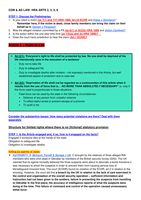
STEP 1: Discuss the Preliminaries
1. Is your client a victim (ss 7(1) and 7(7) HRA 1998, Art.34 ECHR and Klass v Germany)?
- Remember here, if the victim is dead, close family members can bring the claim on their
behalf as in Osman v Ferguson
2. Was the alleged violation committed by a PA (ss 6(1) or 6(3)(b) HRA 1998 and Aston Cantlow)?
3. Is the action within the one year time limit (ss 7(5)(a) and (b) HRA 1998)?
4. Does the court have jurisdiction to hear the claim (Art.1 ECHR)?
Article 2 – Right to Life
Art 2(1): ‘Everyone’s right to life shall be protected by law. No one shall be deprived of his
life intentionally save in the execution of a sentence’
- Duty not to take life
- Duty to safeguard life
- Duty to investigate deaths after incident – not expressly mentioned in the Article, but well
established aspect of protection due to case law
Art 2(2): ‘Deprivation of life shall not be regarded as a contravention of this article when it
results from the use of force that is… NO MORE THAN ABSOLUTELY NECESSARY’ i.e. only if
the force used is proportionate in those situations.
- Fatal force can be used by the state in the following circumstances:
Defence of any person from unlawful violence
To effect lawful arrest or prevent escape of a prisoner
To quell a riot
Consider the substantive issues: How many potential violations are there? Deal with them
separately
Structure for limited rights where there is no (fictional) statutory provision
STEP 1: Is the Article engaged and, if so, how is it engaged on the facts?
Engaged if someone dies at the hands of the state
Obligation to safeguard life
Obligation to investigate deaths
Killing by agents of state:
AUTHORITY McCann, Farrell & Savage v UK; C brought by the relatives of three alleged IRA
members who were shot dead in Gibraltar by members of the British security forces (SAS). The UK
claimed that its agents honestly believed the three suspects were about to detonate a bomb therefore it
was necessary to shoot the suspects in order to prevent them from causing serious loss of
life/safeguard innocent lives. The court (ECtHR) found no violation of the ECHR, art 2 in relation to the
shooting. However, the court did find a breach by the UK in relation to the lack of care exercised in
the control and organisation of the overall security operation – sufficient information and
instruction had not been given to the soldiers, failure in preventing the suspects from travelling
to Gibraltar in the first place, the accuracy of intelligence reports of what the suspects were
doing at the time. This failure of command and control of the operation caused unnecessary
lethal force.
STEP 1: Discuss the Preliminaries
1. Is your client a victim (ss 7(1) and 7(7) HRA 1998, Art.34 ECHR and Klass v Germany)?
- Remember here, if the victim is dead, close family members can bring the claim on their
behalf as in Osman v Ferguson
2. Was the alleged violation committed by a PA (ss 6(1) or 6(3)(b) HRA 1998 and Aston Cantlow)?
3. Is the action within the one year time limit (ss 7(5)(a) and (b) HRA 1998)?
4. Does the court have jurisdiction to hear the claim (Art.1 ECHR)?
Article 2 – Right to Life
Art 2(1): ‘Everyone’s right to life shall be protected by law. No one shall be deprived of his
life intentionally save in the execution of a sentence’
- Duty not to take life
- Duty to safeguard life
- Duty to investigate deaths after incident – not expressly mentioned in the Article, but well
established aspect of protection due to case law
Art 2(2): ‘Deprivation of life shall not be regarded as a contravention of this article when it
results from the use of force that is… NO MORE THAN ABSOLUTELY NECESSARY’ i.e. only if
the force used is proportionate in those situations.
- Fatal force can be used by the state in the following circumstances:
Defence of any person from unlawful violence
To effect lawful arrest or prevent escape of a prisoner
To quell a riot
Consider the substantive issues: How many potential violations are there? Deal with them
separately
Structure for limited rights where there is no (fictional) statutory provision
STEP 1: Is the Article engaged and, if so, how is it engaged on the facts?
Engaged if someone dies at the hands of the state
Obligation to safeguard life
Obligation to investigate deaths
Killing by agents of state:
AUTHORITY McCann, Farrell & Savage v UK; C brought by the relatives of three alleged IRA
members who were shot dead in Gibraltar by members of the British security forces (SAS). The UK
claimed that its agents honestly believed the three suspects were about to detonate a bomb therefore it
was necessary to shoot the suspects in order to prevent them from causing serious loss of
life/safeguard innocent lives. The court (ECtHR) found no violation of the ECHR, art 2 in relation to the
shooting. However, the court did find a breach by the UK in relation to the lack of care exercised in
the control and organisation of the overall security operation – sufficient information and
instruction had not been given to the soldiers, failure in preventing the suspects from travelling
to Gibraltar in the first place, the accuracy of intelligence reports of what the suspects were
doing at the time. This failure of command and control of the operation caused unnecessary
lethal force.