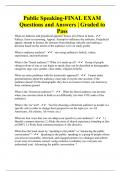
Public Speaking-FINAL EXAM Questions and Answers | Graded to Pass
What are fallacies and prejudicial appeals? Know all of these in book - Fallacy: Error in reasoning. Appeal: Attempt to influence the audience. Prejudicial appeal: attempt to distract the listeners from thinking critically and making a decision based on the merits of the audience. (ex's on study guide) What is audience analysis? - surveying audience's beliefs, values, experiences, and motivations What is the "literal audience"? What is it made up of? - Group of people sitting in front of you as you begin to speak; they can be described in demographic categories (age, race, gender, class status, religious beliefs) What are some problems with the democratic approach? - Cannot make generalizations about the audience; must take everyone into account; if the audience doesn't fit the demographic they have no reason to listen; can lead away from common ground What is the "rhetorical audience"? - What the literal audience can become when you convince them to think or act differently (its what YOU make of the audience) What is the "as" test? - Tool for choosing a rhetorical audience as people is a specific role in order to change their perspective on the topic (ex: we AS Americans, AS citizens, AS voters, etc.) What are four ways that you can adapt your speech to your audience? - 1.) Identify common interests 2.) Make the most of shared experience (standing in line at DMV) 3.) Work from common premises 4.) Be directive What does the book mean by "speaking to the public" or "advancing the public conversation"? - Speaking to the public: speaking to a group of people whom you treat as reasonable, interested, and engaged partners in a dialogue and inform on an issue of common concert, using common vocabulary (so everyone can understand you). Advancing the public conversation: ? What are some of the responsibilities that you have to your audience? - You have a responsibility for the connections you are inviting the audience to make, responsible for the world their choices create. 1. Your speech creates a benefit for everyone 2. Your speech is responsible to your audience and its context What are the three types of listening? Define them. - 1. Passive: Listening that does not actively engage the ideas and arguments of the speaking (ex: a sponge) 2. Active: Listening attentively for the meaning and relevance of the speech 3. Critical: Listening to evaluate what is well done and poorly done What are the five ethics of listening that the book lists? - 1. Be ready to listen 2. Visibly pay attention 3. Eliminate potential distractions for yourself and others 4. Respect the forum 5. Practice good turn-taking What are the two biggest obstacles to good listening? - 1. Distractions (outside, stereotypes, lack of focus from speech to speaker) 2. Mental Zone (thinking of your own life, preconceptions of the topic, internal objections (ya, but..)) Why is note-taking important to good listening? and what are some strategies the book discusses? - Note taking is a way of translating the words being said into ideas. To translate, you need to pay careful attention not just to word but to their meaning and context. Strategies from the book? Make an outline, indicate the relationship between ideas with arrow and lines, comment on the concept and arguments in the speech with the 2 Column Cornell System, use a concept map or an idea cloud to diagram connections among concepts or arguments. What are some of the guidelines that the book lists to give constructive useful feedback? - Critical feedback: substantiated opinion about what worked and what didn't in a speech. Constructive criticism: Specific feedback about strengths and weaknesses, with specific suggestions for improvement (Criticize speeches, not people) (Be specific with criticism) (Focus on what can be changed) (Be communication sensitive) What are "proofs" according to the book? - Three kinds of persuasive appeals: ethos, pathos, logos What is ethos? define and have examples - Appeals based on speaker's trustworthiness and credibility/ expertise. i.e. Explain competence, common ground with audience, cite sources What is pathos? define and have examples - Appeal to emotions (positive and negative) of the audience i.e. tell a story, powerful vivid examples What is Logos? define and have examples - Appeal based on reasoning a logic i.e. stats, examples, data
Written for
- Institution
- Public Speaking
- Course
- Public Speaking
Document information
- Uploaded on
- September 19, 2023
- Number of pages
- 4
- Written in
- 2023/2024
- Type
- Exam (elaborations)
- Contains
- Questions & answers
Subjects
- public speaking
-
public speaking final exam questions and answers
-
public speaking final exam

Also available in package deal