Biology Specification Led Revision
Chapter 3 - Nucleotides and Nucleic Acids
a) the structure of a nucleotide as the monomer from which nucleic acids are made
- To include the differences between RNA and DNA nucleotides, the identification of the
purines and pyrimidines, the type of pentose sugar.
- An opportunity to use computer modelling to investigate nucleic acid structure.
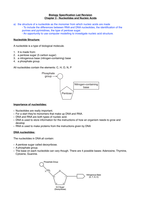
Nucleotide Structure:
A nucleotide is a type of biological molecule.
1. It is made from:
2. a pentose sugar (5 carbon sugar)
3. a nitrogenous base (nitrogen-containing) base
4. a phosphate group.
All nucleotides contain the elements: C, H, O, N, P
Importance of nucleotides:
• Nucleotides are really important.
• For a start they're monomers that make up DNA and RNA.
• DNA and RNA are both types of nucleic acid.
• DNA is used to store information for the instructions of how an organism needs to grow and
develop
• RNA is used to make proteins from the instructions given by DNA
DNA nucleotides:
The nucleotides in DNA all contain:
• A pentose sugar called deoxyribose.
• A phosphate group.
• The base on each nucleotide can vary though. There are 4 possible bases: Adenosine, Thymine,
Cytosine, Guanine.
,A DNA molecule contains two polynucleotide chains - each chain is made up of lots of DNA
nucleotides joined together.
RNA Nucleotides:
RNA (ribonucleic acid) contains nucleotides with a ribose sugar (not deoxyribose). Like DNA, RNA
contains:
• A phosphate
• A ribose Sugar
• One of 4 bases (replaces Thymine with Uracil)
An RNA molecule is made up of a single polynucleotide chain:
Purines and Pyrimidines:
There are two types of bases present in DNA and RNA nucleotides - there are purines and
pyrimidines
• Adenine and guanine are both purines
• Thymine (Uracil) and Cytosine are pyrimidines
The difference is the stricture of these bases, A purine has 2 carbon-nitrogen rings where
pyrimidine only has one C-N rings.
So a pyrimidine is a smaller base than purine
, (b) The synthesis and breakdown of polynucleotides by the formation and breakage of
phosphodiester bonds
Polynucleotide structure:
Nucleotides can join together to form polynucleotides.
The nucleotides join up by forming a bond between the phosphate group of one nucleotide and the
pentose sigher of another nucleotide.
The bond between the phosphate group and the sugar is called a phosphodiester bond.
The chain of sugars and phosphates is known as the sugar-phosphate backbone. Polynucleotides
can be broken down into nucleotides again by breaking the phosphodiester bonds.
Chapter 3 - Nucleotides and Nucleic Acids
a) the structure of a nucleotide as the monomer from which nucleic acids are made
- To include the differences between RNA and DNA nucleotides, the identification of the
purines and pyrimidines, the type of pentose sugar.
- An opportunity to use computer modelling to investigate nucleic acid structure.
Nucleotide Structure:
A nucleotide is a type of biological molecule.
1. It is made from:
2. a pentose sugar (5 carbon sugar)
3. a nitrogenous base (nitrogen-containing) base
4. a phosphate group.
All nucleotides contain the elements: C, H, O, N, P
Importance of nucleotides:
• Nucleotides are really important.
• For a start they're monomers that make up DNA and RNA.
• DNA and RNA are both types of nucleic acid.
• DNA is used to store information for the instructions of how an organism needs to grow and
develop
• RNA is used to make proteins from the instructions given by DNA
DNA nucleotides:
The nucleotides in DNA all contain:
• A pentose sugar called deoxyribose.
• A phosphate group.
• The base on each nucleotide can vary though. There are 4 possible bases: Adenosine, Thymine,
Cytosine, Guanine.
,A DNA molecule contains two polynucleotide chains - each chain is made up of lots of DNA
nucleotides joined together.
RNA Nucleotides:
RNA (ribonucleic acid) contains nucleotides with a ribose sugar (not deoxyribose). Like DNA, RNA
contains:
• A phosphate
• A ribose Sugar
• One of 4 bases (replaces Thymine with Uracil)
An RNA molecule is made up of a single polynucleotide chain:
Purines and Pyrimidines:
There are two types of bases present in DNA and RNA nucleotides - there are purines and
pyrimidines
• Adenine and guanine are both purines
• Thymine (Uracil) and Cytosine are pyrimidines
The difference is the stricture of these bases, A purine has 2 carbon-nitrogen rings where
pyrimidine only has one C-N rings.
So a pyrimidine is a smaller base than purine
, (b) The synthesis and breakdown of polynucleotides by the formation and breakage of
phosphodiester bonds
Polynucleotide structure:
Nucleotides can join together to form polynucleotides.
The nucleotides join up by forming a bond between the phosphate group of one nucleotide and the
pentose sigher of another nucleotide.
The bond between the phosphate group and the sugar is called a phosphodiester bond.
The chain of sugars and phosphates is known as the sugar-phosphate backbone. Polynucleotides
can be broken down into nucleotides again by breaking the phosphodiester bonds.