Chapter 2 - Biological Molecules
The cells of all living organisms are composed of biological molecules. Proteins, carbohydrates
and lipids are three of the key groups of biological macromolecules that are essential for life. A
study of the structure of these macromolecules allows a better understanding of their functions in
living organisms.
(a) how hydrogen bonding occurs between water molecules, and relate this, and other properties
of water, to the roles of water for living organisms. A range of roles that relate to the properties of
water, including solvent, transport medium, coolant and as a habitat.
AND
roles illustrated using examples of prokaryotes and eukaryotes
Water
Functions of water:
Water is vital to living organisms. It makes up about 80% of a cells contents and has lots of
important function, inside and outside cells such as:
• Water is a reactant in lots of important chemical reactions, including hydrolysis.
• Water is a solvent, which means some substances dissolve in it.
• Most biological reactions take place in solution (e.g. in the cytoplasm of eukaryotic and
prokaryotic cells) so waters pretty essential.
• Water transports substances. The fact that its a liquid and a solvent means it can easily
transport all sorts of materials, like glucose and oxygen, around plants and animals.
• Water helps with temperature control because it has a high specific heat capacity and a high
latent heat of evaporation.
• Water is a habitat. The fact that it helps with temperature control, it is a solvent and becomes
less dense when it freezes means many organisms can survive and reproduce in it.
• MEMORY: Reactant, solvent, transport, temperature, habitat (Really, silly, tiny, tree, hunt)
Structure of water:
Polarity of water:
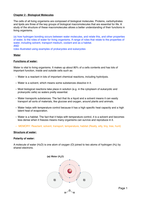
A molecule of water (H2O) is one atom of oxygen (O) joined to two atoms of hydrogen (H2) by
shared electrons.
Page 1
,• Because the shared negative hydrogen electrons are pulled towards the oxygen atom, the other
side of each hydrogen atom is left with a slight positive.
• The unshared negative electrons on the oxygen atom give it a slight negative charge.
• This makes water a polar molecule - it has a partial negative charge (δ-) on one side and a
partial positive charge (δ+) on the other.
Hydrogen Bonding:
The slightly negative-charged oxygen atoms attract the slightly positively-charged hydrogen atoms
of other water molecules. This attraction is called hydrogen bonding and it gives water some of its
useful properties.
Properties of water:
High specific heat capacity:
• Hydrogen bonds give water a high specific heat capacity - this is the energy needed to raise 1g
of a substance by 1OC
• The hydrogen bonds between water molecules can absorb a lot of energy.
• So water has a high specific heat capacity - it takes a lot of energy to heat it up
• This means water doesn't experience rapid temperature changes, which is one of the properties
that makes it a good habitat - the temperature under water is likely to be more stable that it is on
land.
Page 2
, High latent heat of evaporation:
• It takes a lot of heat to break the hydrogen bonds between the water molecules.
• So the water has a high latent heat of evaporation - a lot of energy is used up when it is
evaporated
• Useful for organisms, because it means waters greater for cooling things.
• This is why some mammas, like up, sweat when they're too hot
• When the water evaporates, it cools the surface of the skin
Very cohesive:
• Cohesion is the attraction between molecules of the same type
• Water molecules are very cohesive (they stick to each other because they are polar)
• This helps water to flow, making it great for transport substances
• It also helps water to be transported up plant stems in the transpiration stream
Lower density when solid:
• At low temperatures water freezes - it turns from a liquid to a solid
• Water molecules are held further apart in ice than they are in liquid water, because each water
molecule forms four hydrogen bonds to other water molecules, making a lattice shape.
• This makes ice less dense the liquid water - which is why it floats
• This is useful for living organisms as in cold temperatures the ice floats on top of the water and
creates an insulating layer which stops the rest of the water from freezing below
• So organisms that live in water, like fish, don't freeze and can still move around.
Good Solvent:
• A lot of important substances in biological reactions are ionic
• This means they're made form one positively-charged atom or molecule and one negatively-
charged atom or molecule
• Because water is polar, the slightly positive end of a water molecule will be attracted to the
negative ion, and the slightly negative end of a water molecule will be attracted to the positive ion
• This means the ion gets surrounded by water molecules - dissolving it.
• Water’s polarity makes it useful as a solvent in living organisms.
• E.g. in humans, important ions can dissolve in the water in blood and then be transported around
the body.
Page 3
The cells of all living organisms are composed of biological molecules. Proteins, carbohydrates
and lipids are three of the key groups of biological macromolecules that are essential for life. A
study of the structure of these macromolecules allows a better understanding of their functions in
living organisms.
(a) how hydrogen bonding occurs between water molecules, and relate this, and other properties
of water, to the roles of water for living organisms. A range of roles that relate to the properties of
water, including solvent, transport medium, coolant and as a habitat.
AND
roles illustrated using examples of prokaryotes and eukaryotes
Water
Functions of water:
Water is vital to living organisms. It makes up about 80% of a cells contents and has lots of
important function, inside and outside cells such as:
• Water is a reactant in lots of important chemical reactions, including hydrolysis.
• Water is a solvent, which means some substances dissolve in it.
• Most biological reactions take place in solution (e.g. in the cytoplasm of eukaryotic and
prokaryotic cells) so waters pretty essential.
• Water transports substances. The fact that its a liquid and a solvent means it can easily
transport all sorts of materials, like glucose and oxygen, around plants and animals.
• Water helps with temperature control because it has a high specific heat capacity and a high
latent heat of evaporation.
• Water is a habitat. The fact that it helps with temperature control, it is a solvent and becomes
less dense when it freezes means many organisms can survive and reproduce in it.
• MEMORY: Reactant, solvent, transport, temperature, habitat (Really, silly, tiny, tree, hunt)
Structure of water:
Polarity of water:
A molecule of water (H2O) is one atom of oxygen (O) joined to two atoms of hydrogen (H2) by
shared electrons.
Page 1
,• Because the shared negative hydrogen electrons are pulled towards the oxygen atom, the other
side of each hydrogen atom is left with a slight positive.
• The unshared negative electrons on the oxygen atom give it a slight negative charge.
• This makes water a polar molecule - it has a partial negative charge (δ-) on one side and a
partial positive charge (δ+) on the other.
Hydrogen Bonding:
The slightly negative-charged oxygen atoms attract the slightly positively-charged hydrogen atoms
of other water molecules. This attraction is called hydrogen bonding and it gives water some of its
useful properties.
Properties of water:
High specific heat capacity:
• Hydrogen bonds give water a high specific heat capacity - this is the energy needed to raise 1g
of a substance by 1OC
• The hydrogen bonds between water molecules can absorb a lot of energy.
• So water has a high specific heat capacity - it takes a lot of energy to heat it up
• This means water doesn't experience rapid temperature changes, which is one of the properties
that makes it a good habitat - the temperature under water is likely to be more stable that it is on
land.
Page 2
, High latent heat of evaporation:
• It takes a lot of heat to break the hydrogen bonds between the water molecules.
• So the water has a high latent heat of evaporation - a lot of energy is used up when it is
evaporated
• Useful for organisms, because it means waters greater for cooling things.
• This is why some mammas, like up, sweat when they're too hot
• When the water evaporates, it cools the surface of the skin
Very cohesive:
• Cohesion is the attraction between molecules of the same type
• Water molecules are very cohesive (they stick to each other because they are polar)
• This helps water to flow, making it great for transport substances
• It also helps water to be transported up plant stems in the transpiration stream
Lower density when solid:
• At low temperatures water freezes - it turns from a liquid to a solid
• Water molecules are held further apart in ice than they are in liquid water, because each water
molecule forms four hydrogen bonds to other water molecules, making a lattice shape.
• This makes ice less dense the liquid water - which is why it floats
• This is useful for living organisms as in cold temperatures the ice floats on top of the water and
creates an insulating layer which stops the rest of the water from freezing below
• So organisms that live in water, like fish, don't freeze and can still move around.
Good Solvent:
• A lot of important substances in biological reactions are ionic
• This means they're made form one positively-charged atom or molecule and one negatively-
charged atom or molecule
• Because water is polar, the slightly positive end of a water molecule will be attracted to the
negative ion, and the slightly negative end of a water molecule will be attracted to the positive ion
• This means the ion gets surrounded by water molecules - dissolving it.
• Water’s polarity makes it useful as a solvent in living organisms.
• E.g. in humans, important ions can dissolve in the water in blood and then be transported around
the body.
Page 3