CRNA BOARD COMPREHENSIVE EXAM QUESTIONS AND CORRECT ANSWERS
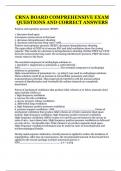
CRNA BOARD COMPREHENSIVE EXAM QUESTIONS AND CORRECT ANSWERS Positive end expiratory pressure (PEEP): 1. decreases dead space ases venous return to the heart 3. decreases intrapulmonary shunting 4. decreases extravascular lung water -ANS__________________________ Positive end expiratory pressure (PEEP): decreases intrapulmonary shunting The major effect of PEEP is to increase FRC and tidal ventilation above the closing capacity. This results in a decrease in intrapulmonary shunting. Neither PEEP nor CPAP decrease extravascular lung water. By increasing intrathoracic pressure, PEEP decreases venous return to the heart. The essential component of cardioplegia solutions is: 1. mannitol 2. magnesium 3. potassium 4. corticosteroid - ANS__________________________ The essential component of cardioplegia solutions is: potassium High concentrations of potassium (20 - 30 mEq/L) are used in cardioplegia solutions. These solutions result in an increase in extracellular potassium and reduce transmembrane potential. This progressively interferes with the normal sodium currents of depolarization and eventually the sodium channels are completely inactivated. Forms of mechanical ventilation that produce tidal volumes at or below anatomic dead space include: (Select 2) 1. high-frequency oscillation 2. inverse I:E ratio ventilation 3. airway pressure release ventilation 4. differential lung ventilation 5. high-frequency positive-pressure ventilation 6. pressure support ventilation -ANS__________________________ Forms of mechanical ventilation that produce tidal volumes at or below anatomic dead space include: high-frequency oscillation, high-frequency positive-pressure ventilation High-frequency oscillation (HFO) creates a to-and-fro gas movement in the airway at rates of 400 - 2400 times/min. High frequency positive-pressure ventilation is delivered at a rate of 60 - 120 breaths/min. Tidal volume is at or below anatomic dead space. High-frequency ventilation techniqu
Written for
- Institution
-
Medical University Of South Carolina
- Course
-
CRNA BOARD
Document information
- Uploaded on
- September 16, 2023
- Number of pages
- 50
- Written in
- 2023/2024
- Type
- Exam (elaborations)
- Contains
- Questions & answers
Subjects
-
crna board comprehensive exam questions and answer
-
positive end expiratory pressure peep
-
the essential component of cardioplegia solutions
-
forms of mechanical ventilation that produce tidal

Also available in package deal