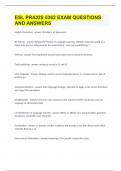
ESL PRAXIS 5362 EXAM QUESTIONS AND ANSWERS
English Phonemes 26 letters/ 44 phonemes BF Skinner Behaviorist Theory of Language Learning. Children enter the world as a blank slate and are influenced by the environment. "ope rant conditioning" Schema The framework around information that is stored in the brain. Code switching mixing of words in L1 and L2 Inter-language Strategy used by second language learner to compensate for lack of proficiency Overgeneralization Inter language strategy- attempts to apply a rule across the board w/o regard for exceptions Simplification L2 learner uses resources that requires limited vocabulary and use language at elementary level L1 Interference or Language Transfer When L1 affects L2 in pronunciation, grammar structures, vocabulary and semantics Fossilization L1 learner reaches a plateau and accepts a less than fluent level which prevents fluency in L2 Instrumental Motivation Acquiring L2 for specific reason like a job. Integrative Motivation Acquiring L2 to FULFILL a wish to communicate with another culture. Extrinsic Instrumental Motivation Motivation imposed upon the student Intrinsic Integrative Motivation Internal motivation not imposed, but longed for Trait Motivation More permanent and culturally acquired motivation State Motivation Temporary motivation that depends on rewards or penalties. Comprehensible Input The Language input or data to which a language learner has access. i + 1 Krashen defines comprehensible input as input that is just beyond a learners present ability Scaffolding Supporting ELL's through demonstrating, guiding, and teaching in a step by step process while the ELL is trying to develop language skills. Levels of Scaffolding Modeling, Shared, Interactive, Guided, Independent Phonemes speech sounds Graphemes written symbols Strategies for Development of Academic English Description, Narration, Classification, Evaluation Top Down Strategy Emphasis on the global meaning of the test. Title length, typeface, pictures are studied. Make guesses as to what's going to happen; anticipate contents of text Bottom Down Strategy Readers goes from words and phrases to general understanding; Less Preferred; May read all texts at the same speed Stages of Reading 1. Pre-Reading (Pre K/K) 2. Initial Reading or alphabet decoding (K-2) 3. Confirmation and Fluency (2-3) 4. Reading to learn(4-8) 5. Multiple pts of view(High School) 6. Construction and Reconstruction (College/Adults) Alphabet Principal 1. Logographic phase 2. Novice alphabetic phase 3. Mature alphabetic phase 4. Orthographic phase Cognates Words that mean the same in two different languages CBA/CBL Approaches (TPR) Total physical response (DOR) Delayed Oral Response (OHIC) Optimal habit Reinforcement * Natural Approach Direct Method Berlitz- Uses oral interaction but not translation or L1 Students learn grammar inductively and use L2 as it is used in everyday life. J. Asher Developed CBA Bases approach: TPR Holds that children begin to learn when situations require them to give meaningful action response Whole Language Approach Develop all 4 language skills through an integated approach LANGUAGE EXPERIENCE APPROACH students dictate their own story bases on a shared experience and then practice reading it until they achieve a firm grasp on the story. Pull Out Models 1. Grammar based ESL 2. Communication based ESL 3. Content Based ESL TESOL Teachers of English Speakers of Other Languages Sheltered Instruction Integrates content with English Language Instruction S.D.A.I.E. Sheltered instruction specially designed in English
Written for
- Institution
-
Columbia International University
- Course
-
TESOL PRAXIS
Document information
- Uploaded on
- September 16, 2023
- Number of pages
- 8
- Written in
- 2023/2024
- Type
- Exam (elaborations)
- Contains
- Questions & answers
Subjects
- esl praxis 5362
-
esl praxis 5362 exam questions and answers

Also available in package deal