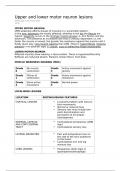
Upper and lower motor neuron lesions
Wednesday, 2 November 2022
14:30
UPPER MOTOR NEURON
UMN weakness affects groups of muscles in a 'pyramidal' pattern.
In the arm, extensors are mostly affected, whereas in the leg the flexors are
typical. Spasticity occurs in the stronger muscle groups i.e. arm flexors and leg
extensors. This presents as increased tone that is velocity dependent i.e. the
faster the muscle is moved, the greater the resistance against the muscle until t
finally gives way. Less muscle wasting than LMN. There is hyperreflexia. Upgoing
plantars (+ve babinski sign) +- clonus. Loss of skilled fine finger movements.
LOWER MOTOR NEURON
Affected muscles show wasting +-fasciculation. There is hypotonia/flaccidity
Reflexes are reduced/ absent. Plantars remain flexor. Foot drop.
MUSCLE WEAKNESS GRADING (MRC)
Grade No muscle Grade Active movement against
0 contraction 3 gravity
Grade Flicker of Grade Active movement against
1 contraction 4 resistance
Grade Some active Grade Normal power
2 movement 5
LOCALISING LESIONS
LOCATION DISTINGUISHING FEATURES
CORTICAL LESIONS Localised problem with hand or
foot movements
Normal or reduced tone
Sensory loss may include two-
point discrimination and
perception of 3d shapes
(stereognosis)
INTERNAL CAPSULE Contralateral hemiparesis (UMN
AND CORTCOSPINAL sign)
TRACT Contralateral sensory loss
LATERAL BRAINSTEM Pain and temperature loss on
the side of the face ipsilateral
to the lesion
Contralateral arm and leg
sensory loss
CORD LESIONS Paraparesis (both legs) or
quadriparesis/tetraplegia
, Power = normal ABOVE
lesion
LMN signs AT THE LEVEL
of the lesion
UMN signs BELOW the
lesion
Sensory changes
Normal above
Worse below
Dissociated sensory loss may
occur
Loss of fine touch and
proprioception with
temperature and pain
preserved
PERIPHERAL Most cause distal weakness e.g.
NEUROPATHY foot drop, weak hand
Sensory loss typically worse
distally
Sensory loss of single nerve
lesions follow dermatomes
Cerebral blood supply
Wednesday, 2 November 2022
16:23
INTERNAL CAROTID ARTERIES
Supply the majority of blood to the anterior two-thirds of the cerebral
hemispheres and the basal ganglia (via the lenticulostriate arteries). At worst,
internal carotid artery occlusion -> fatal total infarction.
THE CIRCLE OF WILLIS
An anastomotic ring at the base of the brain fed by the three arteries that supply
the brain with blood: internal carotids (anteriorly), basilar artery (posteriorly)
,CEREBRAL ARTERIES
Three pairs of arteries leaving to supply the anterior, middle, and posterior
cerebral hemispheres
Anterior cerebral artery:
o Supplies the frontal and medial part of the cerebrum
o Occlusion -> weak, numb contralateral leg+- similar but milder arm
symptoms
o Face is spared
Middle cerebral artery
o Lateral part of each hemisphere
o Occlusion -> hemiparesis, hemisensory loss (face + arm),
contralateral homonymous hemianopia, cognitive change including
dysphasia with dominant hemisphere lesions + visuospatial
disturbance with non-dominant lesions
Posterior cerebral artery
o Supplies the occipital lobe
o Occlusion -> contralateral homonymous hemianopia +- macular
sparing
VERTEBROBASILAR CIRCULATION
Supplies the cerebellum, brainstem and occipital lobes
Occlusion -> signs relating to any or all three:
o Hemianopia
o Cortical blindness
o Diplopia
o Vertigo
, o Nystagmus
o Ataxia
o Dysarthria
o Dysphasia
o Hemi- or quadriplegia
o Unilateral or bilateral sensory symptoms: hiccups, coma
Subclavian steal syndrome
o Stenosis of subclavian artery proximal to the origin of the vertebral
artery -> blood 'stolen' by retrograde flow down into the arm,
causing brainstem ischaemia after use of the arm.
o Suspect if the BP in each arm differs by >20mmHg
Dermatomes and peripheral nerves
Thursday, 3 November 2022
16:18
Wednesday, 2 November 2022
14:30
UPPER MOTOR NEURON
UMN weakness affects groups of muscles in a 'pyramidal' pattern.
In the arm, extensors are mostly affected, whereas in the leg the flexors are
typical. Spasticity occurs in the stronger muscle groups i.e. arm flexors and leg
extensors. This presents as increased tone that is velocity dependent i.e. the
faster the muscle is moved, the greater the resistance against the muscle until t
finally gives way. Less muscle wasting than LMN. There is hyperreflexia. Upgoing
plantars (+ve babinski sign) +- clonus. Loss of skilled fine finger movements.
LOWER MOTOR NEURON
Affected muscles show wasting +-fasciculation. There is hypotonia/flaccidity
Reflexes are reduced/ absent. Plantars remain flexor. Foot drop.
MUSCLE WEAKNESS GRADING (MRC)
Grade No muscle Grade Active movement against
0 contraction 3 gravity
Grade Flicker of Grade Active movement against
1 contraction 4 resistance
Grade Some active Grade Normal power
2 movement 5
LOCALISING LESIONS
LOCATION DISTINGUISHING FEATURES
CORTICAL LESIONS Localised problem with hand or
foot movements
Normal or reduced tone
Sensory loss may include two-
point discrimination and
perception of 3d shapes
(stereognosis)
INTERNAL CAPSULE Contralateral hemiparesis (UMN
AND CORTCOSPINAL sign)
TRACT Contralateral sensory loss
LATERAL BRAINSTEM Pain and temperature loss on
the side of the face ipsilateral
to the lesion
Contralateral arm and leg
sensory loss
CORD LESIONS Paraparesis (both legs) or
quadriparesis/tetraplegia
, Power = normal ABOVE
lesion
LMN signs AT THE LEVEL
of the lesion
UMN signs BELOW the
lesion
Sensory changes
Normal above
Worse below
Dissociated sensory loss may
occur
Loss of fine touch and
proprioception with
temperature and pain
preserved
PERIPHERAL Most cause distal weakness e.g.
NEUROPATHY foot drop, weak hand
Sensory loss typically worse
distally
Sensory loss of single nerve
lesions follow dermatomes
Cerebral blood supply
Wednesday, 2 November 2022
16:23
INTERNAL CAROTID ARTERIES
Supply the majority of blood to the anterior two-thirds of the cerebral
hemispheres and the basal ganglia (via the lenticulostriate arteries). At worst,
internal carotid artery occlusion -> fatal total infarction.
THE CIRCLE OF WILLIS
An anastomotic ring at the base of the brain fed by the three arteries that supply
the brain with blood: internal carotids (anteriorly), basilar artery (posteriorly)
,CEREBRAL ARTERIES
Three pairs of arteries leaving to supply the anterior, middle, and posterior
cerebral hemispheres
Anterior cerebral artery:
o Supplies the frontal and medial part of the cerebrum
o Occlusion -> weak, numb contralateral leg+- similar but milder arm
symptoms
o Face is spared
Middle cerebral artery
o Lateral part of each hemisphere
o Occlusion -> hemiparesis, hemisensory loss (face + arm),
contralateral homonymous hemianopia, cognitive change including
dysphasia with dominant hemisphere lesions + visuospatial
disturbance with non-dominant lesions
Posterior cerebral artery
o Supplies the occipital lobe
o Occlusion -> contralateral homonymous hemianopia +- macular
sparing
VERTEBROBASILAR CIRCULATION
Supplies the cerebellum, brainstem and occipital lobes
Occlusion -> signs relating to any or all three:
o Hemianopia
o Cortical blindness
o Diplopia
o Vertigo
, o Nystagmus
o Ataxia
o Dysarthria
o Dysphasia
o Hemi- or quadriplegia
o Unilateral or bilateral sensory symptoms: hiccups, coma
Subclavian steal syndrome
o Stenosis of subclavian artery proximal to the origin of the vertebral
artery -> blood 'stolen' by retrograde flow down into the arm,
causing brainstem ischaemia after use of the arm.
o Suspect if the BP in each arm differs by >20mmHg
Dermatomes and peripheral nerves
Thursday, 3 November 2022
16:18