WERKCOLLEGE 2
MASS SPECTROMETRY: PROTEOMICS & DATA BASE SEARCHING
Preparation of the sample for separation with SCX and C18-RP chromatography
The cells were broken and the proteins were collected by centrifugation. The proteins in the
sample were first incubated with dithiothreitol and then with iodoacetamide. Subsequently,
the protein was digested with trypsin.
1) Why is it necessary incubate the protein successively with DTT (dithiothreitol) and with
IAA (iodo-acetamide)? (Waarom is het noodzakelijk dat het eiwit opeenvolgend
geïncubeerd wordt met dithiothreitol (DTT) en met iodoacetamide (IAA)?
- DTT is een redox reagent, het kan disulfide bindingen reduceren door twee opeenvolgende
thioldisulfide uitwisselingsreacties. Het stopt bij chromatografie in principe de oxidatie van
eiwitten en het vormen van ongewenste disulfide bindingen. Stabilisatie van eiwitten
- IAA is een alkaliserende stof die gebruikt wordt voor het identificeren van peptide. Het
heeft een vergelijkbare werking als iodoacetaat. Het wordt vaak gebruikt om covalent te
binden met de thiolgroep van cysteïne, waardoor het eiwit geen disulfidebindingen meer
kan vormen. Bij chromatografie wordt het voornamelijk gebruikt om, nadat de disulfide
bruggen gereduceerd zijn, de vrije SH-groepen de alakaliniseren. Dit zorgt ervoor dat je
100% gemodificeerde cysteïnes. Voorkomt dat de eiwitten zwavelbruggen vormen
(binding aan cysteine)
Het uiteindelijke doel van deze twee stoffen is zodat je je thiolen volledig gereduceerd en
gealkaliseerd hebt, zodat de eiwitten ontvouwen kunnen worden. Als je IAA toevoegt
voordat je je DTT toe hebt gevoegd, kan de IAA al gereageerd hebben met de vrije
bereikbare thiolen van cysteine.
2) Describe the effect of trypsin digestion on a protein.
Knipt het eiwit in peptides. Hij knipt op de peptide bindingen. (Knipt na elke lysine en
arginine, tenzij er een proline achter zit).
The peptides were separated using the MUDPIT method, the first step consists of separation
using SCX chromatography, followed by separation of each fraction using reversed phase LC-
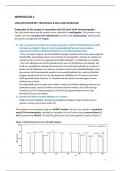
MS and performing MS/MS. The MS/MS spectrum of one of the peptides is shown in Figure 1.
Figure 1. MS/MS spectrum of one of the RBC peptides
1
, 3) See in the right upper corner of figure 1. What does it mean:
- 942.46 m/z, 2+ -> De m/z waarde is de m/z bij een lading van 2+ (2 H’tjes eraan) van een
van de peptides.
- 1882.9 Da -> De massa die bij deze m/z hoort van een van de peptides.
4) Can you calculate the peptide mass from the 2+ ion m/z-value?
m/z = (1882.9 + 2)/2= 942,45
x 2 = 1884,9 Da
The MS/MS spectrum in figure 1 contains many peaks from B-ions and Y-ions, but some of the
fragment ion peaks are missing. Indeed, not all peptide fragments have been created equally well in
the collision cell of the mass spectrometer. This occurs very often.
Still, you can identify the protein using this spectrum. How?
Table 1. Residue masses of amino acids
Amino acids 3-letter code 1-letter code Residue mass
Glycine Gly G 57.02
Alanine Ala A 71.04
Serine Ser S 87.03
Proline Pro P 97.05
Valine Val V 99.07
Threonine Thr T 101.05
Cysteine Cys C 103.01
Isoleucine Ile I 113.08
Leucine Leu L 113.08
Asparagine Asp N 114.04
Aspartic acid Asn D 115.03
Glutamine Gln Q 128.06
Lysine Lys K 128.09
Glutamic acid Glu E 129.04
Methionine Met M 131.04
Histidine His H 137.06
Methionine (oxidized) Met-ox M(ox) 147.04
Phenylalanine Phe F 147.07
Arginine Arg R 156.10
Tyrosine Tyr Y 163.06
Tryptophan Trp W 186.08
Carbamidomethyl-cysteine Cys-IAA C(IAA) 160.03
In Table 1 you can find the masses of the amino acids, when these are incorporated into a peptide.
Now you can puzzle on the spectrum in figure 1, which gives figure 2:
2
MASS SPECTROMETRY: PROTEOMICS & DATA BASE SEARCHING
Preparation of the sample for separation with SCX and C18-RP chromatography
The cells were broken and the proteins were collected by centrifugation. The proteins in the
sample were first incubated with dithiothreitol and then with iodoacetamide. Subsequently,
the protein was digested with trypsin.
1) Why is it necessary incubate the protein successively with DTT (dithiothreitol) and with
IAA (iodo-acetamide)? (Waarom is het noodzakelijk dat het eiwit opeenvolgend
geïncubeerd wordt met dithiothreitol (DTT) en met iodoacetamide (IAA)?
- DTT is een redox reagent, het kan disulfide bindingen reduceren door twee opeenvolgende
thioldisulfide uitwisselingsreacties. Het stopt bij chromatografie in principe de oxidatie van
eiwitten en het vormen van ongewenste disulfide bindingen. Stabilisatie van eiwitten
- IAA is een alkaliserende stof die gebruikt wordt voor het identificeren van peptide. Het
heeft een vergelijkbare werking als iodoacetaat. Het wordt vaak gebruikt om covalent te
binden met de thiolgroep van cysteïne, waardoor het eiwit geen disulfidebindingen meer
kan vormen. Bij chromatografie wordt het voornamelijk gebruikt om, nadat de disulfide
bruggen gereduceerd zijn, de vrije SH-groepen de alakaliniseren. Dit zorgt ervoor dat je
100% gemodificeerde cysteïnes. Voorkomt dat de eiwitten zwavelbruggen vormen
(binding aan cysteine)
Het uiteindelijke doel van deze twee stoffen is zodat je je thiolen volledig gereduceerd en
gealkaliseerd hebt, zodat de eiwitten ontvouwen kunnen worden. Als je IAA toevoegt
voordat je je DTT toe hebt gevoegd, kan de IAA al gereageerd hebben met de vrije
bereikbare thiolen van cysteine.
2) Describe the effect of trypsin digestion on a protein.
Knipt het eiwit in peptides. Hij knipt op de peptide bindingen. (Knipt na elke lysine en
arginine, tenzij er een proline achter zit).
The peptides were separated using the MUDPIT method, the first step consists of separation
using SCX chromatography, followed by separation of each fraction using reversed phase LC-
MS and performing MS/MS. The MS/MS spectrum of one of the peptides is shown in Figure 1.
Figure 1. MS/MS spectrum of one of the RBC peptides
1
, 3) See in the right upper corner of figure 1. What does it mean:
- 942.46 m/z, 2+ -> De m/z waarde is de m/z bij een lading van 2+ (2 H’tjes eraan) van een
van de peptides.
- 1882.9 Da -> De massa die bij deze m/z hoort van een van de peptides.
4) Can you calculate the peptide mass from the 2+ ion m/z-value?
m/z = (1882.9 + 2)/2= 942,45
x 2 = 1884,9 Da
The MS/MS spectrum in figure 1 contains many peaks from B-ions and Y-ions, but some of the
fragment ion peaks are missing. Indeed, not all peptide fragments have been created equally well in
the collision cell of the mass spectrometer. This occurs very often.
Still, you can identify the protein using this spectrum. How?
Table 1. Residue masses of amino acids
Amino acids 3-letter code 1-letter code Residue mass
Glycine Gly G 57.02
Alanine Ala A 71.04
Serine Ser S 87.03
Proline Pro P 97.05
Valine Val V 99.07
Threonine Thr T 101.05
Cysteine Cys C 103.01
Isoleucine Ile I 113.08
Leucine Leu L 113.08
Asparagine Asp N 114.04
Aspartic acid Asn D 115.03
Glutamine Gln Q 128.06
Lysine Lys K 128.09
Glutamic acid Glu E 129.04
Methionine Met M 131.04
Histidine His H 137.06
Methionine (oxidized) Met-ox M(ox) 147.04
Phenylalanine Phe F 147.07
Arginine Arg R 156.10
Tyrosine Tyr Y 163.06
Tryptophan Trp W 186.08
Carbamidomethyl-cysteine Cys-IAA C(IAA) 160.03
In Table 1 you can find the masses of the amino acids, when these are incorporated into a peptide.
Now you can puzzle on the spectrum in figure 1, which gives figure 2:
2