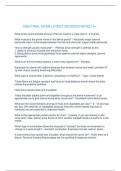
Paramedic Cardiology Questions and Answers Already Passed Updated 2023/2024
SA Node Rate 60-100 BPM AV Node Rate 40-60 BPM Bundle of His/Perkinjie Rate >40 BPM Flow of blood through the heart from the body superior and inferior vena cavas right atrium tricuspid valve right ventricle semilunar valve pulmonary artery lungs pulmonary veins left atrium bicuspid valve left ventricle semilunar valve aorta to the body Inotropic Beats Harder Chronotropic Beats Faster Dromotropic Improved contractility "P" Wave the P wave represents the electrical activity associated with the contraction of the atria, or atrial depolarization "P-R" Interval Time required for conduction from the SA node to AV node. The time between atrial and ventricular depolarization. This is normally 0.12 to 0.2 seconds. "Q" Wave The first portion of the QRS complex that is seen with a downward deflection and is usually not obvious on the EKG of the normal heart. Often the first portion of the deflection is positive, signifying no Q wave. This is the beginning of ventricular depolarization. "QRS" Complex Represents ventricle depolarization. The QRS Interval is measured from the start of the Q wave or from the beginning of the R wave if no Q wave is present. If no Q wave is present, a normal QRS interval should be less than 0.12 seconds in all leads. "ST" Segment Indicates that ventricle depolarization is complete and that repolarization is about to begin. Also called early ventricle repolarization. The ST Segment is measured from the end of the QRS to the beginning of the T wave, and represents a portion of ventricular repolarization. The normal segment is usually flat, or isoelectric. The absolute measurement of this segment is not as clinically important as is the configuration, whether depressed or elevated. "T" Wave the T wave represents the electrical recovery of the ventricles, or ventricle repolarization. the muscle cells are recovering in preparation for another impulse "R-R" Interval duration of ventricular cardiac cycle (an indicator of ventricular rate) Cardiac Output heart rate x stroke volume, Total blood volume pumped from the left ventricle per minute. Can be increased by increasing heart rate or stroke volume. SV X HR= CO
Written for
- Institution
- Paramedic Cardiology
- Course
- Paramedic Cardiology
Document information
- Uploaded on
- September 15, 2023
- Number of pages
- 13
- Written in
- 2023/2024
- Type
- Exam (elaborations)
- Contains
- Questions & answers
Subjects
- paramedic cardiology 2024
-
paramedic cardiology questions and answers
-
paramedic cardiology exam 2023