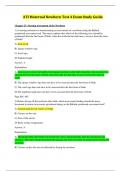
ATI Maternal Newborn Test 4 Exam Study Guide
1) A nursing instructor is demonstrating an assessment on a newborn using the Ballard gestational assessment tool. The nurse explains that which of the following tests should be performed after the first hour of birth, when the newborn has had time to recover from the stress of birth? A) Arm recoil B) Square window sign C) Scarf sign D) Popliteal angle Answer: A Explanation: A) Arm recoil is slower in healthy but fatigued newborns after birth; therefore, arm recoil is best elicited after the first hour of birth, when the baby has had time to recover from the stress of birth. B) The square window sign does not have to be assessed after the first hour of birth. C) The scarf sign does not have to be assessed after the first hour of birth. D) The popliteal angle does not have to be assessed after the first hour of birth. Page Ref: 665 2) Before drying off the newborn after birth, which assessment finding should the nurse document to ensure an accurate gestational rating on the Ballard gestational assessment tool? A) Amount and area of vernix coverage B) Creases on the sole C) Size of the areola D) Body surface temperature Answer: A Explanation: A) Drying the baby after birth will disturb the vernix and potentially alter the gestational age criterion. The nurse should document the amount and areas of vernix coverage before drying the newborn. B) Creases on the sole are not affected by drying the newborn. C) The size of the areola is not affected by drying the newborn. D) Body surface temperature is not part of the Ballard gestational assessment tool. Page Ref: 664 3) A new mother is concerned about a mass on the newborn's head. The nurse assesses this to be a cephalohematoma based on which characteristics? Select all that apply. A) The mass appeared on the second day after birth. B) The mass appears larger when the newborn cries. C) The head appears asymmetrical. D) The mass appears on only one side of the head. E) The mass overrides the suture line. Answer: A, D Explanation: A) A cephalohematoma is a collection of blood resulting from ruptured blood vessels between the surface of a cranial bone and the periosteal membrane. These areas emerge as defined hematomas between the first and second days. B) A cephalohematoma does not increase in size when the newborn cries. C) Molding causes the head to appear asymmetrical because of the overriding of cranial bones during labor and birth. D) Cephalohematomas can be unilateral or bilateral, but do not cross the suture lines. E) Cephalohematomas can be unilateral or bilateral, but do not cross the suture lines. Page Ref: 675 4) The nurse is using the New Ballard Score to assess the gestational age of a newborn delivered 4 hours ago. The infant's gestational age is 33 weeks based on early ultrasound and last menstrual period. The nurse expect the infant to exhibit which of the following? A) Full sole creases, nails extending beyond the fingertips, scarf sign showing the elbow beyond the midline B) Testes located in the upper scrotum, rugae covering the scrotum, vernix covering the entire body C) Ear cartilage folded over, lanugo present over much of the body, slow recoil time D) 1 cm breast bud, peeling skin and veins not visible, rapid recoil of legs and arms to extension Answer: C Explanation: A) Full sole creases and nails beyond the fingertips are seen in term infants; a scarf sign beyond the midline is characteristic of a preterm infant. B) Testes in the upper scrotum and rugae-covered scrotum are seen in term infants. Vernix covering the body is an indication of a preterm infant. C) Ear cartilage folded over, lanugo present over much of the body, and slow recoil time are all characteristics of a preterm infant. D) 1 cm breast bud, peeling skin, the presence of adipose tissue so that veins are not visible, and rapid recoil of the legs and arms are all indications of term or post-term infants. Page Ref: 661 5) The student nurse has performed a gestational age assessment of an infant, and finds the infant to be at 32 weeks. On which set of characteristics is the nurse basing this assessment? A) Lanugo mainly gone, little vernix across the body B) Prominent clitoris, enlarging minora, anus patent C) Full areola, 5 to 10 mm bud, pinkish-brown in color D) Skin opaque, cracking at wrists and ankles, no vessels visible Answer: B Explanation: A) Lanugo and vernix disappear as the infant approaches term. B) At 30 to 32 weeks' gestation, the clitoris is prominent, and the labia majora are small and widely separated. As gestational age increases, the labia majora increase in size. At 36 to 40 weeks, they nearly cover the clitoris. At 40 weeks and beyond, the labia majora cover the labia minora and clitoris. C) Areolas develop greater size with advancing gestational age. D) The skin of a preterm infant is translucent, and vessels are visible through the skin. Page Ref: 664 6) The nurse is making an initial assessment of the newborn. Which of the following data would be considered normal? A) Chest circumference 31.5 cm, head circumference 33.5 cm B) Chest circumference 30 cm, head circumference 29 cm C) Chest circumference 38 cm, head circumference 31.5 cm D) Chest circumference 32.5 cm, head circumference 36 cm Answer: A Explanation: A) The average circumference of the head at birth is 32 to 37 cm. Average chest circumference ranges from 30 to 35 cm at birth. The circumference of the head is approximately 2 cm greater than the circumference of the chest at birth. Answer 1 is the only choice in which both the chest and head circumferences fall within the norm in terms of actual size and comparable size.
Geschreven voor
- Instelling
-
East Los Angeles College
- Vak
-
NURSING N271
Documentinformatie
- Geüpload op
- 12 september 2023
- Aantal pagina's
- 134
- Geschreven in
- 2023/2024
- Type
- Tentamen (uitwerkingen)
- Bevat
- Vragen en antwoorden
Onderwerpen
-
ati maternal newborn test 4 exam study guide
-
chapter 27 nursing assessment of the newborn

Ook beschikbaar in voordeelbundel