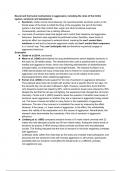
Poem title and Ode: Intimations of Immortality Initial response to poem:
poet
William Wordsworth The speaker begins by mourning the loss of
his youth and the deeper connection he used
Romantic - Spiritual and intellectual growth of to have with the natural world. The speaker
concerns (AO1/3) children into adults reflects on what it means to age and in the
- Nature fifth stanza declares that we come from a
place more heavenly than earth which we
- Industrialisation forget as we grow older. Wordsworth
- Purity of childhood concludes that he can always look to his past
and memories to remember what it was like to
- Emotional and imaginative live as a child. There are 11 stanzas of
spontaneity varying lengths. There is no singular rhyme
scheme but various patterns of rhyme within
Poet’s - The power of the natural world
each stanza. Wordsworth uses several
message(s)
- We come from a place more different metrical patterns throughout the
(AO1/3)
heavenly than earth poem, such as iambic pentameter, tetrameter
and trimeter.
- The sublime is beautiful
- Awe in terror is exciting
- Nature can heal depression
- We can look to the past for
memories
Theme 1 Nature - The speaker plainly states that ‘waters on a
starry night / are beautiful and fair’. The image
(AO2) - waters on a starry night
of a starry night creates a scene of beauty
- lovely is the rose and stars/light also symbolises God, so the
speaker is linking God to nature, known as
- moon… delight pantheism.
- sing a joyous song - The speaker plainly states that ‘lovely is the
- immortal sea rose’, these are just facts. Nature isn’t merely
lovely either, it’s aware of its loveliness the
- clouds of glory ‘moon’ looks around with ‘delight’, the birds
‘sing a joyous song’, inviting humans to share
- east
in their happiness.
- fountains, mountains, hills and
- The speaker imagines heaven as a natural
groves
landscape, an ‘immortal sea’ with ‘clouds of
glory’ and the ‘east’ where sun rises. The
sea’s eternal vastness, the ethereal glow of
the clouds and ‘glorious birth’ of the sunrise
all evoke heaven’s endless imagery.
- The speaker’s asyndetic listing of
‘Fountains, Mountains, Hills and Groves’
shows how bountiful nature is.
Theme 2 Immortality of the soul - The speaker looks back on his childhood
and recalls that everything seemed to be
(AO2) - celestial light
shining in a ‘celestial light’, implying that when
- home [in God] children are born they bring perceptions of
heavenly goodness with them.
- intimation of immortality
- The beauty of nature reminds the speaker of
poet
William Wordsworth The speaker begins by mourning the loss of
his youth and the deeper connection he used
Romantic - Spiritual and intellectual growth of to have with the natural world. The speaker
concerns (AO1/3) children into adults reflects on what it means to age and in the
- Nature fifth stanza declares that we come from a
place more heavenly than earth which we
- Industrialisation forget as we grow older. Wordsworth
- Purity of childhood concludes that he can always look to his past
and memories to remember what it was like to
- Emotional and imaginative live as a child. There are 11 stanzas of
spontaneity varying lengths. There is no singular rhyme
scheme but various patterns of rhyme within
Poet’s - The power of the natural world
each stanza. Wordsworth uses several
message(s)
- We come from a place more different metrical patterns throughout the
(AO1/3)
heavenly than earth poem, such as iambic pentameter, tetrameter
and trimeter.
- The sublime is beautiful
- Awe in terror is exciting
- Nature can heal depression
- We can look to the past for
memories
Theme 1 Nature - The speaker plainly states that ‘waters on a
starry night / are beautiful and fair’. The image
(AO2) - waters on a starry night
of a starry night creates a scene of beauty
- lovely is the rose and stars/light also symbolises God, so the
speaker is linking God to nature, known as
- moon… delight pantheism.
- sing a joyous song - The speaker plainly states that ‘lovely is the
- immortal sea rose’, these are just facts. Nature isn’t merely
lovely either, it’s aware of its loveliness the
- clouds of glory ‘moon’ looks around with ‘delight’, the birds
‘sing a joyous song’, inviting humans to share
- east
in their happiness.
- fountains, mountains, hills and
- The speaker imagines heaven as a natural
groves
landscape, an ‘immortal sea’ with ‘clouds of
glory’ and the ‘east’ where sun rises. The
sea’s eternal vastness, the ethereal glow of
the clouds and ‘glorious birth’ of the sunrise
all evoke heaven’s endless imagery.
- The speaker’s asyndetic listing of
‘Fountains, Mountains, Hills and Groves’
shows how bountiful nature is.
Theme 2 Immortality of the soul - The speaker looks back on his childhood
and recalls that everything seemed to be
(AO2) - celestial light
shining in a ‘celestial light’, implying that when
- home [in God] children are born they bring perceptions of
heavenly goodness with them.
- intimation of immortality
- The beauty of nature reminds the speaker of