WI Pesticide Applicator Test Solved 100% Correct
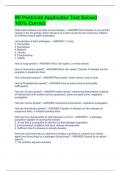
Define plant disease and what causes disease. - ANSWER-Plant disease is any harmful change in the physiology and/or structure of a plant caused by the continuous irritation of a primary causal agent (pathogen). List examples of plant pathogens. - ANSWER-1. Fungi 2. Oomycetes 3. Nematodes 4. Bacteria 5. Viruses 6. Phytoplasmas 7. Viroids How is fungi spread? - ANSWER-Wind, rain splash, or insect vectors How is Oomycetes spread? - ANSWER-Wind, rain splash, Transfer of infested soil (for example on equipment tires) How is Bacteria spread? - ANSWER-Rain splash, insect vectors, and on tools How is Phytoplasmas spread? - ANSWER-Only by insect vectors (principally leafhoppers) How are Viruses spread? - ANSWER-Insect vectors, mechanical transmission (rubbing of infected leaf onto another leaf by equipment), some are seed borne, vegetative propagation. How are Viroids spread? - ANSWER-mechanical transmission, vegetative propagation How are Nematodes spread? - ANSWER-Transfer of infested soil (for example on equipment tires), in infested planting stock What are four prerequisites for plant disease to occur? - ANSWER-1. A pathogen population capable of causing the disease. 2. A host that is susceptible to infection by that pathogen population. 3. Environmental conditions that favor disease development. 4. Sufficient time for disease to actually develop. What are clues that help you determine whether a problem is caused by an abiotic agent (non living thing) or a pathogen (living thing)? - ANSWER-Caused by an abiotic agent if... 1. The problem appears suddenly
Written for
- Institution
- WI Pesticide Applicator
- Course
- WI Pesticide Applicator
Document information
- Uploaded on
- September 11, 2023
- Number of pages
- 4
- Written in
- 2023/2024
- Type
- Exam (elaborations)
- Contains
- Questions & answers
Subjects
- wi pesticide applicator
-
wi pesticide applicator test solved 100 correct

Also available in package deal