Strategy Analytics W1 – Book chapter 1 and 2, Article Big data and article McKinsey
Lecture
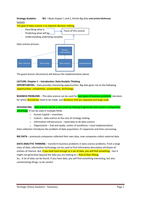
The goal of data science is to improve decision making;
- Describing what is Focus of this course
- Predicting what will be
- Understanding underlying causality
Data science process:
The guest lecture (Accenture) will discuss the implementation phase.
LECTURE: Chapter 1 – Introduction: Data-Analytic Thinking
OPPORTUNITIES – Data provides interesting opportunities. Big data gives rise to the following
opportunities: competition, sustainability, technology.
BUSINESS PROBLEMS – This data science can be used for two types of business problems: decisions
for which discoveries need to be made, and decisions that are repeated and large scale.
INTEGRATING – Data science can be a core asset by helping to generate and sustain a competitive
advantage. It can be used in multiple fields:
o Human Capital – incentives
o Culture – data science at the core of strategy making
o Information Infrastructure – need data to do data science
o Organization – hub and spoke, center of excellence + local implementation
Data collection introduces the problem of data acquisition; it’s expensive and time-consuming.
BIG DATA – previously companies collected their own data, now companies collect external data.
DATA ANALYTIC THINKING – transform business problems in data science problems. From a large
mass of data, information technology can be used to find informative descriptive attributes of
entities of interest. But, if you look hard enough at a set of data, you will find something – but it
might not generalize beyond the data you are looking at > Risk of Over-fitting.
So… A lot of data can be found. If you have data, you will find something interesting, but also
uninteresting things, so be careful.
Strategic (Data) Analytics - Summary Page 1
Lecture
The goal of data science is to improve decision making;
- Describing what is Focus of this course
- Predicting what will be
- Understanding underlying causality
Data science process:
The guest lecture (Accenture) will discuss the implementation phase.
LECTURE: Chapter 1 – Introduction: Data-Analytic Thinking
OPPORTUNITIES – Data provides interesting opportunities. Big data gives rise to the following
opportunities: competition, sustainability, technology.
BUSINESS PROBLEMS – This data science can be used for two types of business problems: decisions
for which discoveries need to be made, and decisions that are repeated and large scale.
INTEGRATING – Data science can be a core asset by helping to generate and sustain a competitive
advantage. It can be used in multiple fields:
o Human Capital – incentives
o Culture – data science at the core of strategy making
o Information Infrastructure – need data to do data science
o Organization – hub and spoke, center of excellence + local implementation
Data collection introduces the problem of data acquisition; it’s expensive and time-consuming.
BIG DATA – previously companies collected their own data, now companies collect external data.
DATA ANALYTIC THINKING – transform business problems in data science problems. From a large
mass of data, information technology can be used to find informative descriptive attributes of
entities of interest. But, if you look hard enough at a set of data, you will find something – but it
might not generalize beyond the data you are looking at > Risk of Over-fitting.
So… A lot of data can be found. If you have data, you will find something interesting, but also
uninteresting things, so be careful.
Strategic (Data) Analytics - Summary Page 1