

Organisatie voor Pre-master Book: Economic Approaches to Organisations
Chapter 1: Markets and organizations
1.1 The economic problem
An economic problem is any situation where needs would not be met as a
result of scarcity of resources – ‘resources’ being quite broadly conceived as
meaning all factors that may contribute towards the satisfaction of human needs.
Scarcity is a fact of life in the real world. Given this predicament, the economic
problem may be rephrased as the problem of how to make the best use of the
available resources. Alternatively, in economic jargon, what is the optimal
allocation of the scarce resources over the alternative uses that can be made of
them? Resources that are optimally allocated are said to be used with
efficiency.
Economics deals with parts and aspects of problems. We believe that there are
hardly any ‘purely economic’ problems.
1.2 The division of labour
Adam Smith (1776): ‘The greatest improvement in the productive powers of
labour, and the greater part of the skill, dexterity (= handigheid/vaardigheid),
and judgement with which it is anywhere directed, or applied, seem to have been
the effects of the division of labour. ‘
A tremendous increase in the productivity of the work of workers could be
achieved by splitting the work up into distinct tasks and having each worker
preform one specific task rather than making entire products.
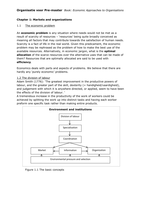
Environment and institutions
Division of labour
Specialization
Coordination
Market Information Organization
Environmental pressure and selection
Figure 1.1 The basic concepts
Chapter 1: Markets and organizations
1.1 The economic problem
An economic problem is any situation where needs would not be met as a
result of scarcity of resources – ‘resources’ being quite broadly conceived as
meaning all factors that may contribute towards the satisfaction of human needs.
Scarcity is a fact of life in the real world. Given this predicament, the economic
problem may be rephrased as the problem of how to make the best use of the
available resources. Alternatively, in economic jargon, what is the optimal
allocation of the scarce resources over the alternative uses that can be made of
them? Resources that are optimally allocated are said to be used with
efficiency.
Economics deals with parts and aspects of problems. We believe that there are
hardly any ‘purely economic’ problems.
1.2 The division of labour
Adam Smith (1776): ‘The greatest improvement in the productive powers of
labour, and the greater part of the skill, dexterity (= handigheid/vaardigheid),
and judgement with which it is anywhere directed, or applied, seem to have been
the effects of the division of labour. ‘
A tremendous increase in the productivity of the work of workers could be
achieved by splitting the work up into distinct tasks and having each worker
preform one specific task rather than making entire products.
Environment and institutions
Division of labour
Specialization
Coordination
Market Information Organization
Environmental pressure and selection
Figure 1.1 The basic concepts



