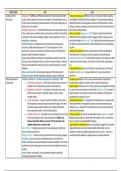
TOPIC/STUDY AO1 AO3
Caregiver-Infant Reciprocity Jaffe et al., 1973 demonstrated the infants coordinated their Testing infant behaviour Difficult as they are in constant motion, doubting
Interaction actions worth caregivers in a kind of conversation. From birth babies move a the reliability of Meltzoff and Moore findings. To overcome these problems
rhythm when interacting with an adult almost as if they were taking turns, as Meltzoff and Moore measured infant response by filming infants and then
people do in conversation. asking an observer to judge the infants behaviour from the video who had no
Interactional Synchrony Coordinated behaviour, when two people interact idea what was being imitated
theory tend to mirror what the other is doing in terms of their facial and body Failure to replicate Koepke et al. (1983) failed to replicate the findings of
movements. This includes imitating emotions as well as behaviours. This is a Meltzoff and Moore findings, but M&M suggested this was because of less
described as a synchrony. controlled condition. Marian et al. (1996) replicated the study by Murray and
Meltzoff and Moore: Conducted first systematic study of interactional Trevarthen and found that infants couldn’t distinguish live from videotaped
synchrony. Adult model displayed one of 3 facial expressions or hand reaction
movements. A dummy was placed in the infants mouth, and following the Intentionally supported Another method used to test the intentionally of
display the baby imitated the behaviour infant behaviour is to observe how they respond to inanimate objects.
Piaget: Believed that true imitation only developed towards the end of the Abravanel and DeYong (1991) found infants of aged 5 to 12 weeks made little
first year and anything before this was a kind of response training – when the response to inanimate objects, so infants do not just imitate anything they
infant is doing repeated a behaviour that was rewards. Behaviour is pseudo- see
imitation. Individual differences Security of attachment associated with interactional
Murray and Trevarthen: Infant became distressed if the mother didn’t synchrony (Isabella et al.), stronger attachment = greater interactional
interact in real time and the response was delayed, supports innateness synchrony.
The Development of Schaffer and Emerson – 60 infants and mothers from Glasgow, 1960s Unreliable data Mothers of less securely attached infants would be less
Attachment 1. Indiscriminate attachment – birth until 2 months, similar response to sensitive and possibly less accurate in their reports systematic bias
all objects, role of interactional synchrony and reciprocity Biased sample Working class form 1960s, parental care changed considerably
2. Beginnings of attachment – around age of 4 months, more social, e.g. more women in work stay at home fathers. Cohn et al. (2014) number of
prefer human company to inanimate objects, don’t yet show dads choosing to stay at home and care for their children and families has
stranger anxiety quadrupled over the past 25 years.
3. Specific attachment – around 7 months old, affinity to one person, Multiple attachments Rutter argued that all relationships are equivalent and
show separation anxiety from primary attachment figure. Also tend these attachments are integrated to produce an infants attachment type,
to display stranger anxiety, another sign of specific attachment. although Bowlby argued that one attachment forms one special emotional
More responsive mother = more strongly attached relationship (monotropy)
4. Multiple attachments – Soon after the main attachment is forced, the Cultural variations, UK and US are individualist cultures. Sagi et al., In Israeli
infant also develops a wider circle of attachment. Schaffer and Kibbutz infants closeness of attachment with mothers wasn’t as common as
Emerson found that within one month, 29% of the infants had they are cared for by multiple different figures
multiple attachments to someone else Stage theories of development May be too inflexible, suggests that normally
Role of father Changing social practices increased exposure might lead single attachments must come before multiple attachments. In some
them to primary attachments situations and cultures multiple attachments may come first. – becomes a
Biological factors Women have more hormones that encourage caringness standard by which families are judged and may be classed abnormal
Frank et al.: men can be primary attachment figures or share this role
White and Woolett: Secondary attachment, dads lack sensitivity, but it fosters
problem solving by making greater communicative and cognitive demands on
children
Gieger: Fathers more playful, active and generally better at providing
channelling situations for children
, Animal Studies of Procedure: Took a clutch of goose eggs and incubated them so the first thing Research support for imprinting There a number of other studies have
Attachment - Lorenz they saw was their either the natural mother or Lorenz and which even one demonstrated imprinting in animals supporting Lorenz research. Guiton
they saw they started following them. (1966) Chicken and yellow rubber gloves, imprinted on them and later tried
Findings: Goslings that first saw Lorenz imprinted on him and followed him to mate with them
over their natural mother Criticisms of imprinting It is irreversible (original idea), now understood for
Long-term effects Irreversible, long lasting, had an effect on mate that imprinting is a more plastic and forgiving mechanism (Hoffman, 1996).
preferences, animals will choose an object they imprinted on For example, Guiton found he could reverse the imprinting on chickens, by
Critical period imprinting doesn’t happen later. the chickens spending time with their own species they were able to engage
Animal Studies of Procedure: Harlow created two wire mothers, with a different head. One was in normal sexual behaviour
Attachment - Harlow wrapped in a soft cloth and the other had a feeding bottle attached. During Confounding variable Wire mother faces were different, so varied in more
that time measurements were made of how much time each spent with the ways than just cloth and feeding. Therefore monkeys may have preferred one
two ‘different mothers’. Observation were also made when they were head to another. Study lacks internal validity
frightened Generalising animal studies to human behaviour It may not be justified,
Findings: Monkeys spent most time with clothe covered mother, especially humans differ in important ways – perhaps more importantly because much
when frightened. Like Lorenz, Harlow also found there was a critical period for of more of their behaviour is governed by conscious decisions. But Schaffer
these effects. and Emerson, findings were similar in that infants were not most attached to
the person who fed them
Ethics of Harlow study A study such as Harlow couldn’t be conducted on
humans. The study created lasting emotional harm as the monkeys later
found it difficult to form relationships with their own species. However it may
be justified in that it has had a significant impact on our understanding of the
process of attachment – better care for infants. But benefits may outweigh
costs
Explanation of Learning Theory proposes all behaviours are learned rather than inherited Animal studies Largely based on studies with non-human animals, such as
Attachment – Learning Classical conditioning new conditioned response learned through Pavlov and Skinner, therefore lacks external validity as it suggests a far too
theory associated between NS (mother) and UCS (food), soon mother is associated simplified view of complex human attachment.
with a feeling of pleasure, as they associate with food Attachment is not based on food Harlow showed that it was contact comfort
Operant condition the reduction of discomfort created by hunger is was more important than food. There is strong evidence that feeding has
rewarding so food becomes a primary reinforcer, associated with mother who nothing to do with attachment. Schaffer and Emerson also support this
then becomes the secondary reinforcer. Learning theory can explain some aspects of attachment Infants do learn
Social learning theory: children model parents attachment behaviour (Hay through association and reinforcement, but food may not be the main
and Vespo, 1988). reinforcer. It may be that attention and responsiveness are the rewards
Drive reduction Reducing discomfort does not explain secondary reinforcers.
Drive reduction can only explain a limited number of behaviours.
Alternative explanations Bowlby’s monotropic theory has more advantages
over learning theory e.g. can explain why they might form not just how.
Learning theory offer no explanation of the advantage of attachment
Explanation of Bowlby’s attachment theory (1969): Critical period, attachments form around Attachment is adaptive Clearly important in emotional development but may
Attachment – Bowlby 3-6 months, becomes increasingly difficult afterwards. It is important for be less critical for survival. Attachments develop older than three months
protection and survival which makes it a late mechanism for survival
Primary attachment figure: Determined by caregiver sensitivity (Ainsworth) Erickson et al. (1985) supports Bowlby’s concept of secure base, when he
Social releasers e.g. big eyes, squashed noses and a large forehead, elect observed 4-5 year olds and found securely attached children were less
Caregiver-Infant Reciprocity Jaffe et al., 1973 demonstrated the infants coordinated their Testing infant behaviour Difficult as they are in constant motion, doubting
Interaction actions worth caregivers in a kind of conversation. From birth babies move a the reliability of Meltzoff and Moore findings. To overcome these problems
rhythm when interacting with an adult almost as if they were taking turns, as Meltzoff and Moore measured infant response by filming infants and then
people do in conversation. asking an observer to judge the infants behaviour from the video who had no
Interactional Synchrony Coordinated behaviour, when two people interact idea what was being imitated
theory tend to mirror what the other is doing in terms of their facial and body Failure to replicate Koepke et al. (1983) failed to replicate the findings of
movements. This includes imitating emotions as well as behaviours. This is a Meltzoff and Moore findings, but M&M suggested this was because of less
described as a synchrony. controlled condition. Marian et al. (1996) replicated the study by Murray and
Meltzoff and Moore: Conducted first systematic study of interactional Trevarthen and found that infants couldn’t distinguish live from videotaped
synchrony. Adult model displayed one of 3 facial expressions or hand reaction
movements. A dummy was placed in the infants mouth, and following the Intentionally supported Another method used to test the intentionally of
display the baby imitated the behaviour infant behaviour is to observe how they respond to inanimate objects.
Piaget: Believed that true imitation only developed towards the end of the Abravanel and DeYong (1991) found infants of aged 5 to 12 weeks made little
first year and anything before this was a kind of response training – when the response to inanimate objects, so infants do not just imitate anything they
infant is doing repeated a behaviour that was rewards. Behaviour is pseudo- see
imitation. Individual differences Security of attachment associated with interactional
Murray and Trevarthen: Infant became distressed if the mother didn’t synchrony (Isabella et al.), stronger attachment = greater interactional
interact in real time and the response was delayed, supports innateness synchrony.
The Development of Schaffer and Emerson – 60 infants and mothers from Glasgow, 1960s Unreliable data Mothers of less securely attached infants would be less
Attachment 1. Indiscriminate attachment – birth until 2 months, similar response to sensitive and possibly less accurate in their reports systematic bias
all objects, role of interactional synchrony and reciprocity Biased sample Working class form 1960s, parental care changed considerably
2. Beginnings of attachment – around age of 4 months, more social, e.g. more women in work stay at home fathers. Cohn et al. (2014) number of
prefer human company to inanimate objects, don’t yet show dads choosing to stay at home and care for their children and families has
stranger anxiety quadrupled over the past 25 years.
3. Specific attachment – around 7 months old, affinity to one person, Multiple attachments Rutter argued that all relationships are equivalent and
show separation anxiety from primary attachment figure. Also tend these attachments are integrated to produce an infants attachment type,
to display stranger anxiety, another sign of specific attachment. although Bowlby argued that one attachment forms one special emotional
More responsive mother = more strongly attached relationship (monotropy)
4. Multiple attachments – Soon after the main attachment is forced, the Cultural variations, UK and US are individualist cultures. Sagi et al., In Israeli
infant also develops a wider circle of attachment. Schaffer and Kibbutz infants closeness of attachment with mothers wasn’t as common as
Emerson found that within one month, 29% of the infants had they are cared for by multiple different figures
multiple attachments to someone else Stage theories of development May be too inflexible, suggests that normally
Role of father Changing social practices increased exposure might lead single attachments must come before multiple attachments. In some
them to primary attachments situations and cultures multiple attachments may come first. – becomes a
Biological factors Women have more hormones that encourage caringness standard by which families are judged and may be classed abnormal
Frank et al.: men can be primary attachment figures or share this role
White and Woolett: Secondary attachment, dads lack sensitivity, but it fosters
problem solving by making greater communicative and cognitive demands on
children
Gieger: Fathers more playful, active and generally better at providing
channelling situations for children
, Animal Studies of Procedure: Took a clutch of goose eggs and incubated them so the first thing Research support for imprinting There a number of other studies have
Attachment - Lorenz they saw was their either the natural mother or Lorenz and which even one demonstrated imprinting in animals supporting Lorenz research. Guiton
they saw they started following them. (1966) Chicken and yellow rubber gloves, imprinted on them and later tried
Findings: Goslings that first saw Lorenz imprinted on him and followed him to mate with them
over their natural mother Criticisms of imprinting It is irreversible (original idea), now understood for
Long-term effects Irreversible, long lasting, had an effect on mate that imprinting is a more plastic and forgiving mechanism (Hoffman, 1996).
preferences, animals will choose an object they imprinted on For example, Guiton found he could reverse the imprinting on chickens, by
Critical period imprinting doesn’t happen later. the chickens spending time with their own species they were able to engage
Animal Studies of Procedure: Harlow created two wire mothers, with a different head. One was in normal sexual behaviour
Attachment - Harlow wrapped in a soft cloth and the other had a feeding bottle attached. During Confounding variable Wire mother faces were different, so varied in more
that time measurements were made of how much time each spent with the ways than just cloth and feeding. Therefore monkeys may have preferred one
two ‘different mothers’. Observation were also made when they were head to another. Study lacks internal validity
frightened Generalising animal studies to human behaviour It may not be justified,
Findings: Monkeys spent most time with clothe covered mother, especially humans differ in important ways – perhaps more importantly because much
when frightened. Like Lorenz, Harlow also found there was a critical period for of more of their behaviour is governed by conscious decisions. But Schaffer
these effects. and Emerson, findings were similar in that infants were not most attached to
the person who fed them
Ethics of Harlow study A study such as Harlow couldn’t be conducted on
humans. The study created lasting emotional harm as the monkeys later
found it difficult to form relationships with their own species. However it may
be justified in that it has had a significant impact on our understanding of the
process of attachment – better care for infants. But benefits may outweigh
costs
Explanation of Learning Theory proposes all behaviours are learned rather than inherited Animal studies Largely based on studies with non-human animals, such as
Attachment – Learning Classical conditioning new conditioned response learned through Pavlov and Skinner, therefore lacks external validity as it suggests a far too
theory associated between NS (mother) and UCS (food), soon mother is associated simplified view of complex human attachment.
with a feeling of pleasure, as they associate with food Attachment is not based on food Harlow showed that it was contact comfort
Operant condition the reduction of discomfort created by hunger is was more important than food. There is strong evidence that feeding has
rewarding so food becomes a primary reinforcer, associated with mother who nothing to do with attachment. Schaffer and Emerson also support this
then becomes the secondary reinforcer. Learning theory can explain some aspects of attachment Infants do learn
Social learning theory: children model parents attachment behaviour (Hay through association and reinforcement, but food may not be the main
and Vespo, 1988). reinforcer. It may be that attention and responsiveness are the rewards
Drive reduction Reducing discomfort does not explain secondary reinforcers.
Drive reduction can only explain a limited number of behaviours.
Alternative explanations Bowlby’s monotropic theory has more advantages
over learning theory e.g. can explain why they might form not just how.
Learning theory offer no explanation of the advantage of attachment
Explanation of Bowlby’s attachment theory (1969): Critical period, attachments form around Attachment is adaptive Clearly important in emotional development but may
Attachment – Bowlby 3-6 months, becomes increasingly difficult afterwards. It is important for be less critical for survival. Attachments develop older than three months
protection and survival which makes it a late mechanism for survival
Primary attachment figure: Determined by caregiver sensitivity (Ainsworth) Erickson et al. (1985) supports Bowlby’s concept of secure base, when he
Social releasers e.g. big eyes, squashed noses and a large forehead, elect observed 4-5 year olds and found securely attached children were less