Research methods (Y1)
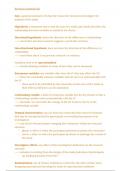
Aim; a general statement of what the researcher intends to investigate the
purpose of the study
Hypothesis; a statement that is mat the start of a study and clearly describes the
relationship between variables as stated by the theory
Directional hypothesis; states the direction of the difference or relationship
---> used when previous research suggests a particular outcome
Non-directional hypothesis; does not state the direction of the difference or
relationship
---> used when there is no previous research or evidence
Variables need to be operationalised
---> clearly defining variables in terms of how they can be measured
Extraneous variables; any variable other than the IV that may affect the DV
---> these are essentially nuisance variables that do not vary systematically with
the IV
- these need to be identified by the researcher at the start of the study so
their effects/influence can be minimised
Confounding variable; a kind of extraneous variable but the key feature is that a
confounding variable varies systematically with the IV
---> therefore we can’t tell if the change in the DV is due to the IV or the
confounding variable
Demand characteristics; any cue from the researcher/the research situation
that may be interpreted by the participants as revealing the purpose of an
investigation
---> can lead to the participant changing their behaviour within the research
situation
- please-u effect is when the participant performs to please the researcher
- screw-u effect is when the participant performs to sabotage the results of
the study
Investigator effects; any effect of the investigator’s behaviour on the research
outcome
---> includes everything from the design of the study/selection of participants
- eg. leading questions from EWT
Randomisation; use of chance methods to control for the effect of bias when
designing materials and deciding the order of experimental conditions
,Standardisation; using exactly the same formalised procedures and instructions
for all participants in a research study
Independent groups; when two separate groups of participants experience two
different conditions of the experiment
Repeated measures; all participants take part in all conditions of the experiment
Matched pairs; pairs of participants are first matched on some variable(s) that
may affect the dependant variable
---> then one member of the pair is assigned to condition A and the other to
condition B
Evaluation for experimental design;
---> Independent groups;
- doesn’t account for participant variables = lowers validity
- random allocation can rectify this
- less economical = more participants would be needed
- more time + money needed to invest
- order effects much less likely to affect the study
---> Repeated measures
- subject to order effects
- this can be rectified with counterbalancing
- participants may become bored = perform worse, or learn the material =
perform better
- participants more likely to figure out aim of study (demand
characteristics)
- participant variables controlled
- less participants needed = more economical
---> Matched pairs
- order effects controlled
- demand characteristics controlled
- participants can never be matched exactly = lowers validity
- matching may be expensive and time consuming = not economical
Laboratory experiments;
---> takes place in a controlled environment within which a researcher
manipulates the IV and records the effect on the DV, whilst maintaining strict
control of extraneous variables
Strengths;
- high control of confounding variables and extraneous variables
- can establish cause and effect (high internal validity)
, - replication more possible
Limitations;
- lack generalisability as the conditions are artificial (low external validity)
- demand characteristics = setting may cause unnatural behaviour
- low mundane realism
Field experiments;
---> an experiment that takes place in a natural setting within which the
researcher manipulates the IV and records the effect on the DV
Strengths;
- higher mundane realism than laboratory experiments
- this produces behaviour that is more natural and authentic (high external
validity)
Limitations;
- cause and effect more difficult to establish
- precise replication not always possible
- ethical issues; if participants don’t know they are being studied it can be
an invasion of privacy
Natural experiments;
---> an experiment where the change in IV is not brought about by the
researcher but would have happened even if the researcher had not been there
(the researcher records the effect on the DV)
Strengths;
- provides opportunity for things that might not have been studied
otherwise for practical reasons eg. Romanian orphan study
- high external validity; real world experience/settings
Limitations;
- naturally occurring events may be rare
- no random allocation ---> this experiment type only works for
independent groups
- harder to establish cause and effect
Quasi-experiments;
---> a study that is almost an experiment but lacks key ingredients; the IV has
not been determined by anyone and the variables simply exist
Strengths;
- carried out under controlled conditions
- can be replicated
Aim; a general statement of what the researcher intends to investigate the
purpose of the study
Hypothesis; a statement that is mat the start of a study and clearly describes the
relationship between variables as stated by the theory
Directional hypothesis; states the direction of the difference or relationship
---> used when previous research suggests a particular outcome
Non-directional hypothesis; does not state the direction of the difference or
relationship
---> used when there is no previous research or evidence
Variables need to be operationalised
---> clearly defining variables in terms of how they can be measured
Extraneous variables; any variable other than the IV that may affect the DV
---> these are essentially nuisance variables that do not vary systematically with
the IV
- these need to be identified by the researcher at the start of the study so
their effects/influence can be minimised
Confounding variable; a kind of extraneous variable but the key feature is that a
confounding variable varies systematically with the IV
---> therefore we can’t tell if the change in the DV is due to the IV or the
confounding variable
Demand characteristics; any cue from the researcher/the research situation
that may be interpreted by the participants as revealing the purpose of an
investigation
---> can lead to the participant changing their behaviour within the research
situation
- please-u effect is when the participant performs to please the researcher
- screw-u effect is when the participant performs to sabotage the results of
the study
Investigator effects; any effect of the investigator’s behaviour on the research
outcome
---> includes everything from the design of the study/selection of participants
- eg. leading questions from EWT
Randomisation; use of chance methods to control for the effect of bias when
designing materials and deciding the order of experimental conditions
,Standardisation; using exactly the same formalised procedures and instructions
for all participants in a research study
Independent groups; when two separate groups of participants experience two
different conditions of the experiment
Repeated measures; all participants take part in all conditions of the experiment
Matched pairs; pairs of participants are first matched on some variable(s) that
may affect the dependant variable
---> then one member of the pair is assigned to condition A and the other to
condition B
Evaluation for experimental design;
---> Independent groups;
- doesn’t account for participant variables = lowers validity
- random allocation can rectify this
- less economical = more participants would be needed
- more time + money needed to invest
- order effects much less likely to affect the study
---> Repeated measures
- subject to order effects
- this can be rectified with counterbalancing
- participants may become bored = perform worse, or learn the material =
perform better
- participants more likely to figure out aim of study (demand
characteristics)
- participant variables controlled
- less participants needed = more economical
---> Matched pairs
- order effects controlled
- demand characteristics controlled
- participants can never be matched exactly = lowers validity
- matching may be expensive and time consuming = not economical
Laboratory experiments;
---> takes place in a controlled environment within which a researcher
manipulates the IV and records the effect on the DV, whilst maintaining strict
control of extraneous variables
Strengths;
- high control of confounding variables and extraneous variables
- can establish cause and effect (high internal validity)
, - replication more possible
Limitations;
- lack generalisability as the conditions are artificial (low external validity)
- demand characteristics = setting may cause unnatural behaviour
- low mundane realism
Field experiments;
---> an experiment that takes place in a natural setting within which the
researcher manipulates the IV and records the effect on the DV
Strengths;
- higher mundane realism than laboratory experiments
- this produces behaviour that is more natural and authentic (high external
validity)
Limitations;
- cause and effect more difficult to establish
- precise replication not always possible
- ethical issues; if participants don’t know they are being studied it can be
an invasion of privacy
Natural experiments;
---> an experiment where the change in IV is not brought about by the
researcher but would have happened even if the researcher had not been there
(the researcher records the effect on the DV)
Strengths;
- provides opportunity for things that might not have been studied
otherwise for practical reasons eg. Romanian orphan study
- high external validity; real world experience/settings
Limitations;
- naturally occurring events may be rare
- no random allocation ---> this experiment type only works for
independent groups
- harder to establish cause and effect
Quasi-experiments;
---> a study that is almost an experiment but lacks key ingredients; the IV has
not been determined by anyone and the variables simply exist
Strengths;
- carried out under controlled conditions
- can be replicated