
SOCIAL INFLUENCE
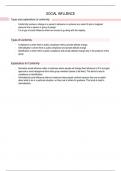
Types and explanations of conformity
Conformity involves a change in a person’s behaviour or opinions as a result of real or imagined
pressure from a person or group of people.
It is a type of social influence where we choose to go along with the majority.
Types of Conformity
Compliance is when there is public compliance without private attitude change.
Internalisation is when there is public compliance and private attitude change.
Identification is when there is public compliance and private attitude change only in the presence of the
group.
Explanations for Conformity
Normative social influence refers to instances where people will change their behaviour to fit in and gain
approval or avoid disapproval from other group members (desire to be liked). This tends to lead to
compliance or identification.
Informational social influence refers to instances where people conform because they are uncertain
about what to do in a particular situation, so they look to others for guidance. This tends to lead to
internalisation.
,Evaluation
NSI has evidence to support it as an Unclear whether it is NSI or ISI at work in
explanation for conformity. When Asch real-life situations. Asch found that
interviewed participants of his study, he conformity reduced when there was
found that some conformed as they were another non-conforming participant, as
afraid of disapproval. When the participants provide social support (NSI) or provide
wrote their answers down, conformity fell to another source of information (ISI). As both
12.5% as there was no group pressure. interpretations are possible, it is hard to
Some conformity is due to the desire to be separate ISI and NSI when both probably
liked. work together in most real-life situations.
ISI has evidence to support it. Study by NSI does not predict conformity in every
Lucas, 2006, found that participants case. Some people, called nAffiliators, are
conformed more to incorrect answers when greatly concerned with being liked by
they were difficult as the answer was others and have a strong need for
unclear and they did not want to be wrong, affiliation. McGhee and Teevan, 1967,
so they relied on the answers given. ISI is found that these students were more likely
valid as these results are what ISI would to conform. There are individual differences
predict. in conformity that cannot be fully explained
by a general theory, like NSI.
, Conformity
Asch’s research
Aimed to investigate the extent to which social pressure from a majority group could affect a person to
conform.
He tested 123 male American participants. Asch put a naïve participant in a room with seven
confederates.
Each person in the room had to state aloud which of the 3 comparison lines was most like the target
line, with the answer always being obvious.
There were 18 trials in total and the confederates gave the wrong answer on 12 trials.
36.8% of participant responses were incorrect. 75% of participants conformed on at least one trial.
Variables affecting conformity
Size of the group
- The majority group was increased or decreased.
- There was little conformity when there was only one (3%) or two confederates (13%).
- This increased to 30% when there were three confederates.
- Further increases did not increase the levels of conformity.
Unanimity
- One or more of the confederates were instructed to give the correct answer.
- Conformity dropped to 5%.
- Breaking the groups consensus was one of the main influences of conformity as it weakens the
influence of the majority.
Task difficulty
- The task difficulty was increased by making the lines look more similar.
- Conformity to the majority increased as it was harder to judge the correct answer.
- When we are uncertain, we look to others for guidance, so conformity is due to ISI.
Types and explanations of conformity
Conformity involves a change in a person’s behaviour or opinions as a result of real or imagined
pressure from a person or group of people.
It is a type of social influence where we choose to go along with the majority.
Types of Conformity
Compliance is when there is public compliance without private attitude change.
Internalisation is when there is public compliance and private attitude change.
Identification is when there is public compliance and private attitude change only in the presence of the
group.
Explanations for Conformity
Normative social influence refers to instances where people will change their behaviour to fit in and gain
approval or avoid disapproval from other group members (desire to be liked). This tends to lead to
compliance or identification.
Informational social influence refers to instances where people conform because they are uncertain
about what to do in a particular situation, so they look to others for guidance. This tends to lead to
internalisation.
,Evaluation
NSI has evidence to support it as an Unclear whether it is NSI or ISI at work in
explanation for conformity. When Asch real-life situations. Asch found that
interviewed participants of his study, he conformity reduced when there was
found that some conformed as they were another non-conforming participant, as
afraid of disapproval. When the participants provide social support (NSI) or provide
wrote their answers down, conformity fell to another source of information (ISI). As both
12.5% as there was no group pressure. interpretations are possible, it is hard to
Some conformity is due to the desire to be separate ISI and NSI when both probably
liked. work together in most real-life situations.
ISI has evidence to support it. Study by NSI does not predict conformity in every
Lucas, 2006, found that participants case. Some people, called nAffiliators, are
conformed more to incorrect answers when greatly concerned with being liked by
they were difficult as the answer was others and have a strong need for
unclear and they did not want to be wrong, affiliation. McGhee and Teevan, 1967,
so they relied on the answers given. ISI is found that these students were more likely
valid as these results are what ISI would to conform. There are individual differences
predict. in conformity that cannot be fully explained
by a general theory, like NSI.
, Conformity
Asch’s research
Aimed to investigate the extent to which social pressure from a majority group could affect a person to
conform.
He tested 123 male American participants. Asch put a naïve participant in a room with seven
confederates.
Each person in the room had to state aloud which of the 3 comparison lines was most like the target
line, with the answer always being obvious.
There were 18 trials in total and the confederates gave the wrong answer on 12 trials.
36.8% of participant responses were incorrect. 75% of participants conformed on at least one trial.
Variables affecting conformity
Size of the group
- The majority group was increased or decreased.
- There was little conformity when there was only one (3%) or two confederates (13%).
- This increased to 30% when there were three confederates.
- Further increases did not increase the levels of conformity.
Unanimity
- One or more of the confederates were instructed to give the correct answer.
- Conformity dropped to 5%.
- Breaking the groups consensus was one of the main influences of conformity as it weakens the
influence of the majority.
Task difficulty
- The task difficulty was increased by making the lines look more similar.
- Conformity to the majority increased as it was harder to judge the correct answer.
- When we are uncertain, we look to others for guidance, so conformity is due to ISI.


