Nucleic Acids Revision Notes
DNA – Deoxyribonucleic Acid
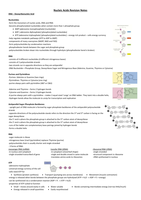
Nucleotides
-form the monomers of nucleic acids, DNA and RNA
-become phosphorylated nucleotides when contain more than 1 phosphate group.
AMP (adenosine monophosphate) [nucleotide]
ADP ( adenosine diphosphate) [phosphorylated nucleotides]
ATP (adenosine triphosphate) [phosphorylated nucleotides] – energy rich product – cells energy currency
-help regulate metabolic pathways (ATP to ADP to AMP)
-components of many coenzymes (NADP, NAD and FAD)
-form polynucleotides by condensation reactions
-phosphodiester bonds between the sugar and phosphate group
-polynucleotides broken down into nucleotides through hydrolysis (phosphodiester bond is broken)
DNA
-consists of 4 different nucleotides (4 different nitrogenous bases)
-consists of 2 polynucleotide strands
-two strands run in opposite directions so they are antiparallel
-DNA Nucleotide = Phosphate Group, Deoxyribose Sugar and Nitrogenous Base (Adenine, Guanine, Thymine or Cytosine)
Purines and Pyrimidines
-Purines: Adenine or Guanine (two rings)
-Pyrimidines: Thymine or Cytosine (one ring)
-purine always pairs with pyrimidine (A&T or C&G)
-Adenine and Thymine – forms 2 hydrogen bonds
-Cytosine and Guanine – forms 3 hydrogen bonds
-A purine always pairs with a pyrimidine – makes 2 equal sized ‘rungs’ on DNA ladder. They twist into a double helix,
-Hydrogen bonds allow the molecule to unzip for transcription and replication
Antiparallel Sugar-Phosphate Backbones
- upright part of DNA molecule is formed by sugar-phosphate backbones of the antiparallel polynucleotide
strands
-opposite directions of the polynucleotide stands refers to the direction the 3 rd and 5th carbon is facing on the
sugar deoxyribose
-the 5’ end is where the phosphate group is attached to the 5th carbon atom of deoxyribose
-the 3’ end is where the phosphate group is attached to the 3rd carbon atom of deoxyribose
-runs of the ladder are complementary base pairings joined by hydrogen bonds
-forms a double helix
RNA
-sugar molecule is ribose
-nitrogenous base Uracil (pyrimidine) replaces Thymine (purine)
-polynucleotide chain is usually shorter and single-stranded
- 3 forms of RNA:
messenger RNA (mRNA) transfer RNA (tRNA) ribosomal RNA (rRNA)
-in nucleus and cytoplasm -in cytoplasm (cloverleaf shape) -single stranded
-single-stranded transcribed of gene -single and double strand in same molecule -structural component in ribosome
-translates amino acids to ribosomes -rRNA synthesised in nucleus
ATP
-adenosine triphosphate
-universal energy currency of the cell
-cells need ATP for
Synthesis (protein synthesis) Transport (pumping ions across membrane) Movement (muscle contraction)
-energy is released when bonds between the phosphate groups are hydrolysed (ATP + H2O ADP + Pi + energy)
-can be synthesised via a condensation reaction (ADP + Pi ATP + H2O)
-properties of ATP suited to function
Small – moves around easily in cells Water soluble Bonds containing intermediate energy (not too little/much)
Energy released in small quantities Easily resynthesised
DNA – Deoxyribonucleic Acid
Nucleotides
-form the monomers of nucleic acids, DNA and RNA
-become phosphorylated nucleotides when contain more than 1 phosphate group.
AMP (adenosine monophosphate) [nucleotide]
ADP ( adenosine diphosphate) [phosphorylated nucleotides]
ATP (adenosine triphosphate) [phosphorylated nucleotides] – energy rich product – cells energy currency
-help regulate metabolic pathways (ATP to ADP to AMP)
-components of many coenzymes (NADP, NAD and FAD)
-form polynucleotides by condensation reactions
-phosphodiester bonds between the sugar and phosphate group
-polynucleotides broken down into nucleotides through hydrolysis (phosphodiester bond is broken)
DNA
-consists of 4 different nucleotides (4 different nitrogenous bases)
-consists of 2 polynucleotide strands
-two strands run in opposite directions so they are antiparallel
-DNA Nucleotide = Phosphate Group, Deoxyribose Sugar and Nitrogenous Base (Adenine, Guanine, Thymine or Cytosine)
Purines and Pyrimidines
-Purines: Adenine or Guanine (two rings)
-Pyrimidines: Thymine or Cytosine (one ring)
-purine always pairs with pyrimidine (A&T or C&G)
-Adenine and Thymine – forms 2 hydrogen bonds
-Cytosine and Guanine – forms 3 hydrogen bonds
-A purine always pairs with a pyrimidine – makes 2 equal sized ‘rungs’ on DNA ladder. They twist into a double helix,
-Hydrogen bonds allow the molecule to unzip for transcription and replication
Antiparallel Sugar-Phosphate Backbones
- upright part of DNA molecule is formed by sugar-phosphate backbones of the antiparallel polynucleotide
strands
-opposite directions of the polynucleotide stands refers to the direction the 3 rd and 5th carbon is facing on the
sugar deoxyribose
-the 5’ end is where the phosphate group is attached to the 5th carbon atom of deoxyribose
-the 3’ end is where the phosphate group is attached to the 3rd carbon atom of deoxyribose
-runs of the ladder are complementary base pairings joined by hydrogen bonds
-forms a double helix
RNA
-sugar molecule is ribose
-nitrogenous base Uracil (pyrimidine) replaces Thymine (purine)
-polynucleotide chain is usually shorter and single-stranded
- 3 forms of RNA:
messenger RNA (mRNA) transfer RNA (tRNA) ribosomal RNA (rRNA)
-in nucleus and cytoplasm -in cytoplasm (cloverleaf shape) -single stranded
-single-stranded transcribed of gene -single and double strand in same molecule -structural component in ribosome
-translates amino acids to ribosomes -rRNA synthesised in nucleus
ATP
-adenosine triphosphate
-universal energy currency of the cell
-cells need ATP for
Synthesis (protein synthesis) Transport (pumping ions across membrane) Movement (muscle contraction)
-energy is released when bonds between the phosphate groups are hydrolysed (ATP + H2O ADP + Pi + energy)
-can be synthesised via a condensation reaction (ADP + Pi ATP + H2O)
-properties of ATP suited to function
Small – moves around easily in cells Water soluble Bonds containing intermediate energy (not too little/much)
Energy released in small quantities Easily resynthesised