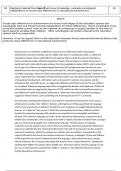
Social classes can contribute a significant amount to class differences within educational
achievement, therefore whether you are middle class (MC) or working class (WC), it is likely the
educational output will be vastly different, through the effect of both the external and internal
factors working in tandem with the educational system. This prevalence is clearly shown to be a
significant factor internally through evidence from the Longitudinal studies (2007), which stated that
by the age of 3 children from disadvantaged (primarily WC) backgrounds were already one year
behind those from more privileged homes (primarily MC), thereby suggesting the vast disparity at an
incredibly young age, where the factors externally would have been more so applied. Therefore, it
can be argued that the culmination of external factors which can take place since birth and the onset
of educational development, with factors such as the parent’s material circumstance and the
subsequent diet and health issues, as suggested by Blanden and Machin and also the way children
are socialised, leading to language deprivation as suggested by Bereiter and Engelmann (1966) and
cultural deprivation as suggested by Sugarman (1970), which have the most significant impact on
class differences within educational achievement, rather than what interactionalist sociologists
suggest as internal factors, such as labelling and streaming due to the A*-C economy.
One key factor explaining the disparity in class divide in educational achievement is the ‘ways in
which parents socialise their children’. Bereiter and Engelmann (1966) argued that the language
used in lower class homes is deficient, through the uses of gestures and single/disjointed phrases
(such as ‘oi’ in place of ‘how are you’). Which had consequently led to these children to fail to
develop the necessary language skills and grow up incapable of more thoughtful and abstract
thinking. This ‘deficient’ language can lead to lesser educational achievement, compared to their
middle-class counterparts, who are argued to be able to explain, describe or enquire from a younger
age as a result of being taught more sophisticated language. This discrepancy in language
competency can be argued to have severe effects of schooling, with those (primarily Middle Class)
using more sophisticated and ‘elaborated’ (Bernstein) code able to incorporate into the academic
cycle more seamlessly, whilst the working-class children who are unable to communicate in this
manner fall behind and receive less teacher preference. However, sociologists Troyna and Williams
(1986) argue that the school’s attitude towards the language is the predominant issue causing
inferior academia; this is because they argue that teachers have a ‘speech hierarchy’, labelling the
sophisticated middle-class speech above middle class, then black speech. Thereby arguing it is not
the way ‘in which parents socialise their children’, instead it is the attitudes held by the schools
limiting educational achievement.
achievement, therefore whether you are middle class (MC) or working class (WC), it is likely the
educational output will be vastly different, through the effect of both the external and internal
factors working in tandem with the educational system. This prevalence is clearly shown to be a
significant factor internally through evidence from the Longitudinal studies (2007), which stated that
by the age of 3 children from disadvantaged (primarily WC) backgrounds were already one year
behind those from more privileged homes (primarily MC), thereby suggesting the vast disparity at an
incredibly young age, where the factors externally would have been more so applied. Therefore, it
can be argued that the culmination of external factors which can take place since birth and the onset
of educational development, with factors such as the parent’s material circumstance and the
subsequent diet and health issues, as suggested by Blanden and Machin and also the way children
are socialised, leading to language deprivation as suggested by Bereiter and Engelmann (1966) and
cultural deprivation as suggested by Sugarman (1970), which have the most significant impact on
class differences within educational achievement, rather than what interactionalist sociologists
suggest as internal factors, such as labelling and streaming due to the A*-C economy.
One key factor explaining the disparity in class divide in educational achievement is the ‘ways in
which parents socialise their children’. Bereiter and Engelmann (1966) argued that the language
used in lower class homes is deficient, through the uses of gestures and single/disjointed phrases
(such as ‘oi’ in place of ‘how are you’). Which had consequently led to these children to fail to
develop the necessary language skills and grow up incapable of more thoughtful and abstract
thinking. This ‘deficient’ language can lead to lesser educational achievement, compared to their
middle-class counterparts, who are argued to be able to explain, describe or enquire from a younger
age as a result of being taught more sophisticated language. This discrepancy in language
competency can be argued to have severe effects of schooling, with those (primarily Middle Class)
using more sophisticated and ‘elaborated’ (Bernstein) code able to incorporate into the academic
cycle more seamlessly, whilst the working-class children who are unable to communicate in this
manner fall behind and receive less teacher preference. However, sociologists Troyna and Williams
(1986) argue that the school’s attitude towards the language is the predominant issue causing
inferior academia; this is because they argue that teachers have a ‘speech hierarchy’, labelling the
sophisticated middle-class speech above middle class, then black speech. Thereby arguing it is not
the way ‘in which parents socialise their children’, instead it is the attitudes held by the schools
limiting educational achievement.