

Lecture 1 – Introduction Part I
Strategic Decisions are intentional choices or programmed responses about issues that materially
affect the survival prospects, well-being and nature of the organization that guide the organization
into the future and shape its course.
Strategic Decisions are ill structured, non-routine, uncertain and pervasive decisions that cut across
organizational functions, entail a significant financial outlay, and have profound, long-term
implications for the organization.
The Strategic Decision Making process is the process by which a strategic decision is made and
implemented and the factors which affect it, i.e. the process that leads to the choice of goals and
means and the way in which means are effectively deployed.
The SDM process is described as a set of different characteristics, such as rational, comprehensive,
political; or as a sequence of activities that involves information gathering, developing alternatives and
choosing among alternatives.
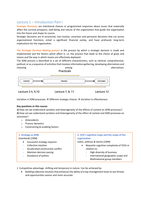
Variation in SDM processes Different strategic choices Variation in effectiveness
Key questions or this course:
1) How can we understand variation and heterogeneity of the effects of context on SDM processes?
2) How can we understand variation and heterogeneity of the effect of context and SDM processes on
outcomes?
o Antecedents
o Process dynamics
o Constraining & enabling factors
1. Strategy as SDM 2. CEO’s cognitive maps and the scope of the
Eisenhardt (1999) organization
Successful strategy requires: Calori, Johhson & Sarnin (1994)
- Collective intuition Requisite cognitive complexity of CEOs in
- Accelerated constructive conflict relation to:
- Maintain decision pacing - High diversity of business
- Avoidance of politics - International geographic scope and
Multinational group members
1. Competitive advantage: shifting and temporary in nature. Can be achieved by:
Building collective intuition that enhances the ability of a top-management team to see threats
and opportunities sooner and more accurate.
Strategic Decisions are intentional choices or programmed responses about issues that materially
affect the survival prospects, well-being and nature of the organization that guide the organization
into the future and shape its course.
Strategic Decisions are ill structured, non-routine, uncertain and pervasive decisions that cut across
organizational functions, entail a significant financial outlay, and have profound, long-term
implications for the organization.
The Strategic Decision Making process is the process by which a strategic decision is made and
implemented and the factors which affect it, i.e. the process that leads to the choice of goals and
means and the way in which means are effectively deployed.
The SDM process is described as a set of different characteristics, such as rational, comprehensive,
political; or as a sequence of activities that involves information gathering, developing alternatives and
choosing among alternatives.
Variation in SDM processes Different strategic choices Variation in effectiveness
Key questions or this course:
1) How can we understand variation and heterogeneity of the effects of context on SDM processes?
2) How can we understand variation and heterogeneity of the effect of context and SDM processes on
outcomes?
o Antecedents
o Process dynamics
o Constraining & enabling factors
1. Strategy as SDM 2. CEO’s cognitive maps and the scope of the
Eisenhardt (1999) organization
Successful strategy requires: Calori, Johhson & Sarnin (1994)
- Collective intuition Requisite cognitive complexity of CEOs in
- Accelerated constructive conflict relation to:
- Maintain decision pacing - High diversity of business
- Avoidance of politics - International geographic scope and
Multinational group members
1. Competitive advantage: shifting and temporary in nature. Can be achieved by:
Building collective intuition that enhances the ability of a top-management team to see threats
and opportunities sooner and more accurate.


