Normative Ethical Theories:
Non - Religious Approaches
Kantian Ethics
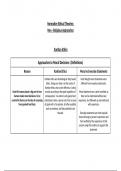
Approaches to Moral Decisions (Definitions)
Reason Kantian Ethics Moral vs Everyday Statements
Kantian ethics are deontological ‘duty based’ Kant thought moral statements were
ethics. Doing your duty is at the centre of different from everyday statements.
Kantian ethics and can be defined as ‘acting
Kant felt reason played a big part in how morally according to the good regardless of Moral statements are a priori synthetic as
humans make moral decisions. So he consequences’. An action is only good, Kant they can be understood without any
centred his theory on the idea of reasoning maintained, when a person acts from a sense experience, but followed up and evidenced
from goodwill and duty. of good will. In his opinion, all other qualities with experience.
such as emotions, had the potential to be
misused. Everyday statements are most typically
known through a person's experience and
then verified by the experience of that
person using this evidence to support the
statement.
, Is Kantian Ethics Too Reliant On Reason And Not Reliant Enough On Sympathy/Empathy
- Kant opposes moral behaviour of this type. Kant would ponder if acting emotionally for others may cause us to act immorally. By rewarding those we
like, we could end up corrupting ourselves. It's possible that our affection for someone might mislead us. We could act to impress others or win their
favour while pursuing selfish, self-interested goals. Kant argued that whilst we have a duty to act out of a sense of good will for others we could not act
for an ulterior motive such as emotional feelings towards other people. Since we all want to be helped when we are strangers in a foreign land and in
need, perhaps the world would become a much worse place if everyone just followed their impulses.
- Morals are most essential for their capacity to move us beyond family and friendship bonds - they should be focused on other people who are unlike
us. Kant regards people as rational creatures with intrinsic worth and dignity. This is the foundation of the Universal Declaration of Human Rights. This
means that actions like slavery and sex trafficking are considered immoral in and of themselves. Individual equality eliminates prejudice toward family,
friends, or country, which might impact decision-making. We would call justice corrupted if it was based on emotions, emotional appeal, or emotional
connection between the judge and jury and the defendant or accuser, rather than a consistent and impartial application of the law.
For For
Kant's deontology removes any empathy for other people and, in some Moral decisions are frequently driven by emotions, such as concern for the
situations, turns the theory cold and harsh due to its emphasis on reason and disadvantaged, or sympathy for those who are suffering. In moral
duty. Kant appears to be against interpersonal connections and advocates circumstances involving family members or friends, we may find ourselves
putting the categorical imperative first. Emotional ties with family, friends, acting with impure or confused motivations. This makes it challenging to use
and lovers are among the most significant things in life, the type of things the theory in practical situations. Because we are highly emotional beings, it is
that help you get through the difficult times. Emotions are a vital element of impossible for us to make decisions without taking into account our
the human experience. Kant appears to be rather emotionally detached from relationships with others or their emotions. Our nature is against it. Many
its significance. When faced with a serious threat, we might desire to protect people believe that we shouldn’t ignore the consequences of our actions, as
our own children first, but Kant's theory does not make it apparent that there Kant does. If the outcome of our action harms another person, we feel guilty
is any moral justification for prioritising the safety of those who are closest to about it. It feels quite challenging to behave rationally and separate ourselves
us. from these things. Therefore, Kant's theory depends too much on reason. This
indicates that the idea is challenging to adopt and apply in contemporary
society.
Non - Religious Approaches
Kantian Ethics
Approaches to Moral Decisions (Definitions)
Reason Kantian Ethics Moral vs Everyday Statements
Kantian ethics are deontological ‘duty based’ Kant thought moral statements were
ethics. Doing your duty is at the centre of different from everyday statements.
Kantian ethics and can be defined as ‘acting
Kant felt reason played a big part in how morally according to the good regardless of Moral statements are a priori synthetic as
humans make moral decisions. So he consequences’. An action is only good, Kant they can be understood without any
centred his theory on the idea of reasoning maintained, when a person acts from a sense experience, but followed up and evidenced
from goodwill and duty. of good will. In his opinion, all other qualities with experience.
such as emotions, had the potential to be
misused. Everyday statements are most typically
known through a person's experience and
then verified by the experience of that
person using this evidence to support the
statement.
, Is Kantian Ethics Too Reliant On Reason And Not Reliant Enough On Sympathy/Empathy
- Kant opposes moral behaviour of this type. Kant would ponder if acting emotionally for others may cause us to act immorally. By rewarding those we
like, we could end up corrupting ourselves. It's possible that our affection for someone might mislead us. We could act to impress others or win their
favour while pursuing selfish, self-interested goals. Kant argued that whilst we have a duty to act out of a sense of good will for others we could not act
for an ulterior motive such as emotional feelings towards other people. Since we all want to be helped when we are strangers in a foreign land and in
need, perhaps the world would become a much worse place if everyone just followed their impulses.
- Morals are most essential for their capacity to move us beyond family and friendship bonds - they should be focused on other people who are unlike
us. Kant regards people as rational creatures with intrinsic worth and dignity. This is the foundation of the Universal Declaration of Human Rights. This
means that actions like slavery and sex trafficking are considered immoral in and of themselves. Individual equality eliminates prejudice toward family,
friends, or country, which might impact decision-making. We would call justice corrupted if it was based on emotions, emotional appeal, or emotional
connection between the judge and jury and the defendant or accuser, rather than a consistent and impartial application of the law.
For For
Kant's deontology removes any empathy for other people and, in some Moral decisions are frequently driven by emotions, such as concern for the
situations, turns the theory cold and harsh due to its emphasis on reason and disadvantaged, or sympathy for those who are suffering. In moral
duty. Kant appears to be against interpersonal connections and advocates circumstances involving family members or friends, we may find ourselves
putting the categorical imperative first. Emotional ties with family, friends, acting with impure or confused motivations. This makes it challenging to use
and lovers are among the most significant things in life, the type of things the theory in practical situations. Because we are highly emotional beings, it is
that help you get through the difficult times. Emotions are a vital element of impossible for us to make decisions without taking into account our
the human experience. Kant appears to be rather emotionally detached from relationships with others or their emotions. Our nature is against it. Many
its significance. When faced with a serious threat, we might desire to protect people believe that we shouldn’t ignore the consequences of our actions, as
our own children first, but Kant's theory does not make it apparent that there Kant does. If the outcome of our action harms another person, we feel guilty
is any moral justification for prioritising the safety of those who are closest to about it. It feels quite challenging to behave rationally and separate ourselves
us. from these things. Therefore, Kant's theory depends too much on reason. This
indicates that the idea is challenging to adopt and apply in contemporary
society.