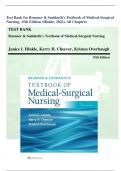
Test Bank for Brunner & Suddarth's Textbook of Medical-Surgical Nursing, 15th Edition (Hinkle, 2022), All Chapters TEST BANK Brunner & Suddarth's Textbook of Medical-Surgical Nursing Janice L Hinkle, Kerry H. Cheever, Kristen Overbaugh 15th Edition
Test Bank for Brunner & Suddarth's Textbook of Medical-Surgical Nursing, 15th Edition (Hinkle, 2022), All Chapters TEST BANK Brunner & Suddarth's Textbook of Medical-Surgical Nursing Janice L Hinkle, Kerry H. Cheever, Kristen Overbaugh 15th Edition Table of Contents Chapter 01 Professional Nursing Practice 2 Chapter 02 Medical-Surgical Nursing 17 Chapter 03 Health Education and Health Promotion 30 Chapter 04 Adult Health and Physical, Nutritional, and Cultural Assessment 45 Chapter 05 Stress and Inflammatory Responses 60 Chapter 06 Genetics and Genomics in Nursing 76 Chapter 07 Disability and Chronic Illness 92 Chapter 08 Management of the Older Adult Patient 107 Chapter 09 Pain Management 121 Chapter 10 Fluid and Electrolytes 137 Chapter 11 Shock, Sepsis, and Multiple Organ Dysfunction Syndrome 153 Chapter 12 Management of Patients with Oncologic Disorders 169 Chapter 13 Palliative and End-of-Life Care 183 Chapter 14 Preoperative Nursing Management 199 Chapter 15 Intraoperative Nursing Management 214 Chapter 16 Postoperative Nursing Management 228 Chapter 17 Assessment of Respiratory Function 243 Chapter 18 Management of Patients with Upper Respiratory Tract Disorders 258 Chapter 19 Management of Patients with Chest and Lower Respiratory Tract Disorders 272 Chapter 20 Management of Patients with Chronic Pulmonary Disease 288 Chapter 21 Assessment of Cardiovascular Function 304 Chapter 22 Management of Patients with Arrhythmias and Conduction Problems 318 Chapter 23 Management of Patients with Coronary Vascular Disorders 331 Chapter 24 Management of Patients with Structural, Infectious, and Inflammatory Cardiac Disorders 347 Chapter 25 Management of Patients with Complications from Heart Disease 361 Chapter 26 Assessment and Management of Patients with Vascular Disorders and Problems of Peripheral Circulation 375 Chapter 27 Assessment and Management of Patients with Hypertension 391 Chapter 28 Assessment of Hematologic Function and Treatment Modalities 405 Chapter 29 Management of Patients with Nonmalignant Hematologic Disorders 420 Chapter 30 Management of Patients with Hematologic Neoplasms 433 Chapter 31 Assessment of Immune Function 448 Chapter 32 Management of Patients with Immune Deficiency Disorders 462 Chapter 33 Assessment and Management of Patients with Allergic Disorders 477 Chapter 34 Assessment and Management of Patients with Inflammatory Rheumatic Disorders 492 Chapter 35 Assessment of Musculoskeletal Function 506 Chapter 36 Management of Patients with Musculoskeletal Disorders 520 Chapter 37 Management of Patients with Musculoskeletal Trauma 535 Chapter 38 Assessment of Digestive and Gastrointestinal Function 550 Chapter 39 Management of Patients with Oral and Esophageal Disorders 564 Chapter 40 Management of Patients with Gastric and Duodenal Disorders 578 Chapter 41 Management of Patients with Intestinal and Rectal Disorders 591 Chapter 42 Assessment and Management of Patients with Obesity 606 Chapter 43 Assessment and Management of Patients with Hepatic Disorders 621 Chapter 44 Management of Patients with Biliary Disorders 635 Chapter 45 Assessment and Management of Patients with Endocrine Disorders 650 Chapter 46 Management of Patients with Diabetes 665 Chapter 47 Assessment of Kidney and Urinary Function 680 Chapter 48 Management of Patients with Kidney Disorders 695 Chapter 49 Management of Patients with Urinary Disorders 710 Chapter 50 Assessment and Management of Patients with Female Physiologic Processes 725 Chapter 51 Management of Patients with Female Reproductive Disorders 741 Chapter 52 Assessment and Management of Patients with Breast Disorders 757 Chapter 53 Assessment and Management of Patients with Male Reproductive Disorders 771 Chapter 54 Assessment and Management of Patients Who Are LGBTQ 786 Chapter 55 Assessment of Integumentary Function 794 Chapter 56 Management of Patients with Dermatologic Disorders 808 Chapter 57 Management of Patients with Burn Injury 822 Chapter 58 Assessment and Management of Patients with Eye and Vision Disorders 837 Chapter 59 Assessment and Management of Patients with Hearing and Balance Disorders 851 Chapter 60 Assessment of Neurologic Function 866 Chapter 61 Management of Patients With Neurologic Dysfunction 881 Chapter 62 Management of Patients With Cerebrovascular Disorders 895 Chapter 63 Management of Patients with Neurologic Trauma 911 Chapter 64 Management of Patients with Neurologic Infections, Autoimmune Disorders, and Neuropathies 926 Chapter 65 Management of Patients with Oncologic or Degenerative Neurologic Disorders 940 Chapter 66 Management of Patients with Infectious Diseases 955 Chapter 67 Emergency Nursing 968 Chapter 68 Disaster Nursing 977 Test Bank - Brunner & Suddarth's Textbook of Medical-Surgical Nursing, 15e (Hinkle, 2022) 1 | P a g e Chapter 1: Professional Nursing Practice Hinkle: Brunner & Suddarth's Textbook of Medical-Surgical Nursing, 15th Edition MULTIPLE CHOICE 1. A nurse has been offered a position on an obstetric unit and has learned that the unit offers therapeutic abortions, a procedure that contradicts the nurse's personal beliefs. What is the nurse's ethical obligation to these clients? A. The nurse should adhere to professional standards of practice and offer service to these clients. B. The nurse should make the choice to decline this position and pursue a different nursing role. C. The nurse should decline to care for the client’s considering abortion. D. The nurse should express alternatives to women considering terminating their pregnancy. ANS: B Rationale: To avoid facing the ethical dilemma of providing care that contradicts the nurse’s personal beliefs, the nurse should consider working in an area of nursing that would not pose this dilemma. The nurse should not provide care to the client because it is a conflict of personal values. The nurse should not deny care to these clients as this would be a breach in the Code of Ethics for nurses. If the client is not requesting information for alternatives to abortions, then the nurse should not be providing this information. PTS: 1 REF: p. 27 NAT: Client Needs: Safe, Effective Care Environment: Management of Care TOP: Chapter 1: Professional Nursing Practice KEY: Integrated Process: Caring BLM: Cognitive Level: Apply NOT: Multiple Choice 2. An 80-year-old client is admitted with a diagnosis of community-acquired pneumonia. During admission the client states, "I have a living will." What implication of this should the nurse recognize? A. This document is always honored, regardless of circumstances. B. This document specifies the client's wishes before hospitalization. C. This document is binding for the duration of the client's life. D. This document has been drawn up by the client's family to determine DNR status. ANS: B Rationale: A living will is one type of advance directive. In most situations, living wills are limited to situations in which the client's medical condition is deemed terminal. The other answers are incorrect because living wills are not always honored in every circumstance, they are not binding for the duration of the client's life, and they are not drawn up by the client's family. PTS: 1 REF: p. 29 NAT: Client Needs: Safe, Effective Care Environment: Management of Care TOP: Chapter 1: Professional Nursing Practice KEY: Integrated Process: Communication and Documentation BLM: Cognitive Level: Analyze NOT: Multiple Choice 3. A nurse has been providing ethical care for many years and is aware of the need to maintain the ethical principle of nonmaleficence. Which of the following actions would be considered a violation of this principle? A. Discussing a DNR order with a terminally ill client B. Assisting a semi-independent client with ADLs C. Refusing to administer pain medication as prescribed Test Bank - Brunner & Suddarth's Textbook of Medical-Surgical Nursing, 15e (Hinkle, 2022) 2 | P a g e D. Providing more care for one client than for another ANS: C Rationale: The duty not to inflict as well as prevent and remove harm is termed nonmaleficence. Discussing a DNR order with a terminally ill client and assisting a client with ADLs would not be considered contradictions to the nurse's duty of nonmaleficence. Some clients justifiably require more care than others. PTS: 1 REF: p. 25 NAT: Client Needs: Safe, Effective Care Environment: Management of Care TOP: Chapter 1: Professional Nursing Practice KEY: Integrated Process: Nursing Process BLM: Cognitive Level: Analyze NOT: Multiple Choice 4. A nurse has begun creating a client's plan of care shortly after the client's admission. The nurse knows that it is important that the wording of the chosen nursing diagnoses falls within the taxonomy of nursing. Which organization is responsible for developing the taxonomy of a nursing diagnosis? A. American Nurses Association (ANA) B. North American Nursing Diagnosis Association (NANDA) C. National League for Nursing (NLN) D. Joint Commission ANS: B Rationale: NANDA International is the official organization responsible for developing the taxonomy of nursing diagnoses and formulating nursing diagnoses acceptable for study. The ANA, NLN, and Joint Commission are not charged with the task of developing the taxonomy of nursing diagnoses. PTS: 1 REF: p. 15 NAT: Client Needs: Safe, Effective Care Environment: Management of Care TOP: Chapter 1: Professional Nursing Practice KEY: Integrated Process: Nursing Process BLM: Cognitive Level: Understand NOT: Multiple Choice 5. A medical nurse has obtained a new client's health history and has completed the admission assessment. The nurse followed this by documenting the results and creating a care plan for the client. Which of the following is the most important rationale for documenting the client's care? A. It provides continuity of care. B. It creates a teaching log for the family. C. It verifies appropriate staffing levels. D. It keeps the client fully informed. ANS: A Rationale: This record provides a means of communication among members of the health care team and facilitates coordinated planning and continuity of care. It serves as the legal and business record for a health care agency and for the professional staff members who are responsible for the client's care. Documentation is not primarily a teaching log; it does not verify staffing; and it is not intended to provide the client with information about treatments. PTS: 1 REF: p. 14 NAT: Client Needs: Safe, Effective Care Environment: Management of Care TOP: Chapter 1: Professional Nursing Practice KEY: Integrated Process: Communication and Documentation BLM: Cognitive Level: Understand NOT: Multiple Choice Test Bank - Brunner & Suddarth's Textbook of Medical-Surgical Nursing, 15e (Hinkle, 2022) 3 | P a g e 6. The nurse has been assigned to care for a client admitted with an opportunistic infection secondary to AIDS. The nurse informs the clinical nurse leader that the nurse refuses to care for a client with AIDS. The nurse has an obligation to this client under which of the following? A. Good Samaritan Act B. Nursing Interventions Classification (NIC) C. The nurse practice act in the nurse's jurisdiction D. International Council of Nurses (ICN) Code of Ethics for Nurses ANS: D Rationale: The ethical obligation to care for all clients is included in the Code of Ethics for Nurses. The Good Samaritan Act relates to lay people helping others in need. The NIC is a standardized classification of nursing treatment that includes independent and collaborative interventions. Nurse practice acts primarily address scope of practice. PTS: 1 REF: p. 27 NAT: Client Needs: Safe, Effective Care Environment: Management of Care TOP: Chapter 1: Professional Nursing Practice KEY: Integrated Process: Nursing Process BLM: Cognitive Level: Understand NOT: Multiple Choice 7. The nurse, in collaboration with the client's family, is determining priorities related to the care of the client. The nurse explains that it is important to consider the urgency of specific problems when setting priorities. What should the nurse adopt as the best framework for prioritizing client problems? A. Availability of hospital resources B. Family member statements C. Maslow hierarchy of needs D. The nurse's skill set ANS: C Rationale: The Maslow hierarchy of needs provides a useful framework for prioritizing problems, with the first level given to meeting physical needs of the client. Availability of hospital resources, family member statements, and nursing skill do not provide a framework for prioritization of client problems, though each may be considered. PTS: 1 REF: p. 6 NAT: Client Needs: Safe, Effective Care Environment: Management of Care TOP: Chapter 1: Professional Nursing Practice KEY: Integrated Process: Nursing Process BLM: Cognitive Level: Apply NOT: Multiple Choice 8. A medical nurse is caring for a client who is receiving palliative care following cancer metastasis. The nurse is aware of the need to uphold the ethical principle of beneficence. How can the nurse best exemplify this principle in the care of this client? A. The nurse tactfully regulates the number and timing of visitors as per the client's wishes. B. The nurse stays with the client during their death. C. The nurse ensures that all members of the care team are aware of the client's DNR order. D. The nurse collaborates with members of the care team to ensure continuity of care. ANS: A Rationale: Beneficence is the duty to do good and the active promotion of benevolent acts. Enacting the client's wishes regarding visitors is an example of this. Each of the other nursing actions is consistent with ethical practice, but none directly exemplifies the principle of beneficence. PTS: 1 REF: p. 25 NAT: Client Needs: Safe, Effective Care Environment: Management of Care Test Bank - Brunner & Suddarth's Textbook of Medical-Surgical Nursing, 15e (Hinkle, 2022) 4 | P a g e TOP: Chapter 1: Professional Nursing Practice KEY: Integrated Process: Caring BLM: Cognitive Level: Apply NOT: Multiple Choice 9. In the process of planning a client's care, the nurse has identified a nursing diagnosis of Ineffective Health Maintenance related to alcohol use. What must precede the determination of this nursing diagnosis? A. Establishing of a plan to address the underlying problem B. Assigning a positive value to each consequence of the diagnosis C. Collecting and analyzing data that corroborate the diagnosis D. Evaluating the client's chances of recovery ANS: C Rationale: In the diagnostic phase of the nursing process, the client's nursing problems are defined through analysis of client data. Establishing a plan comes after collecting and analyzing data; evaluating a plan is the last step of the nursing process; and assigning a positive value to each consequence is not done. PTS: 1 REF: p. 16 NAT: Client Needs: Safe, Effective Care Environment: Management of Care TOP: Chapter 1: Professional Nursing Practice KEY: Integrated Process: Nursing Process BLM: Cognitive Level: Apply NOT: Multiple Choice 10. The provider has recommended an amniocentesis for an 18-year-old primiparous client. The client is at 34 weeks' gestation and does not want this procedure, but the health care provider arranges for the amniocentesis to be performed. The nurse should recognize that the provider is in violation of which ethical principle? A. Veracity B. Beneficence C. Nonmaleficence D. Autonomy ANS: D Rationale: The principle of autonomy specifies that individuals have the ability to make a choice free from external constraints. The provider's actions in this case violate this principle. This action may or may not violate the principle of beneficence. Veracity centers on truth-telling, and nonmaleficence is avoiding the infliction of harm. PTS: 1 REF: p. 25 NAT: Client Needs: Safe, Effective Care Environment: Management of Care TOP: Chapter 1: Professional Nursing Practice KEY: Integrated Process: Nursing Process BLM: Cognitive Level: Analyze NOT: Multiple Choice 11. During a discussion with the client and the client's spouse, the nurse discovers that the client has a living will. How does the presence of a living will influence the client's care? A. The client is legally unable to refuse basic life support. B. The health care provider can override the client's desires for treatment if desires are not evidence based. C. The client may nullify the living will during the hospitalization. D. Power of attorney may change while the client is hospitalized. ANS: C Test Bank - Brunner & Suddarth's Textbook of Medical-Surgical Nursing, 15e (Hinkle, 2022) 5 | P a g e Rationale: Because living wills are often written when the person is in good health, it is not unusual for the client to nullify the living will during illness. A living will does not make a client legally unable to refuse basic life support. The health care provider may disagree with the client's wishes but is ethically bound to carry out those wishes. A power of attorney is not synonymous with a living will. PTS: 1 REF: p. 29 NAT: Client Needs: Safe, Effective Care Environment: Management of Care TOP: Chapter 1: Professional Nursing Practice KEY: Integrated Process: Communication and Documentation BLM: Cognitive Level: Apply NOT: Multiple Choice 12. The nurse is providing care for a client who has a diagnosis of pneumonia due to Streptococcus pneumonia infection. What aspect of nursing care would constitute part of the planning phase of the nursing process? A. Achieve SaO2 92% at all times. B. Auscultate chest q4h. C. Administer oral fluids q1h and PRN. D. Avoid overexertion at all times. ANS: A Rationale: The planning phase entails specifying the immediate, intermediate, and long-term goals of nursing action, such as maintaining a certain level of oxygen saturation in a client with pneumonia. Providing fluids and avoiding overexertion are parts of the implementation phase of the nursing process. Chest auscultation is an assessment. PTS: 1 REF: p. 12 NAT: Client Needs: Safe, Effective Care Environment: Management of Care TOP: Chapter 1: Professional Nursing Practice KEY: Integrated Process: Nursing Process BLM: Cognitive Level: Analyze NOT: Multiple Choice 13. A recent nursing graduate is aware of the differences between nursing actions that are independent and nursing actions that are interdependent. A nurse performs an interdependent nursing intervention when performing which of the following actions? A. Auscultating a client's apical heart rate during an admission assessment B. Providing mouth care to a client who is unconscious following a cerebrovascular accident C. Administering an IV bolus of normal saline to a client with hypotension D. Providing discharge teaching to a postsurgical client about the rationale for a course of oral antibiotics ANS: C Rationale: Although many nursing actions are independent, others are interdependent, such as carrying out prescribed treatments; administering medications and therapies; collaborating with other health care team members to accomplish specific, expected outcomes; and to monitor and manage potential complications. Irrigating a wound, administering pain medication, and administering IV fluids are interdependent nursing actions and require a health care provider's order. An independent nursing action occurs when the nurse assesses a client's heart rate, provides discharge education, or provides mouth care. PTS: 1 REF: p. 19 NAT: Client Needs: Safe, Effective Care Environment: Management of Care TOP: Chapter 1: Professional Nursing Practice KEY: Integrated Process: Nursing Process BLM: Cognitive Level: Analyze NOT: Multiple Choice Test Bank - Brunner & Suddarth's Textbook of Medical-Surgical Nursing, 15e (Hinkle, 2022) 6 | P a g e 14. A hospital audit reveals that four clients in the hospital have current orders for restraints. The nurse knows that restraints are an intervention of last resort, and that it is inappropriate to apply restraints to which of the following clients? A. A postlaryngectomy client who is attempting to pull out the tracheostomy tube B. A client in hypovolemic shock trying to remove the dressing over a central venous catheter C. A client with urosepsis who is ringing the call bell incessantly to use the bedside commode D. A client with depression who has just tried to commit suicide and whose medications are not achieving adequate symptom control ANS: C Rationale: Restraints should never be applied for staff convenience. The client with urosepsis who is frequently ringing the call bell is requesting assistance to the bedside commode; this is appropriate behavior that will not result in client harm. The other described situations could plausibly result in client harm; therefore, it is more appropriate to apply restraints in these instances. PTS: 1 REF: p. 28 NAT: Client Needs: Safe, Effective Care Environment: Safety and Infection Control TOP: Chapter 1: Professional Nursing Practice KEY: Integrated Process: Nursing Process BLM: Cognitive Level: Analyze NOT: Multiple Choice 15. A client agreed to be a part of a research study involving migraine headache management. The client asks the nurse if a placebo was given for pain management or if the new drug that is undergoing clinical trials was given. After discussing the client's distress, it becomes evident to the nurse that the client did not fully understand the informed consent document that was signed at the start of the research study. What is the best response by the nurse A. "The research study is in place and there is no way to know now." B. "I have no idea what is being given for your migraine." C. "What difference does it make? How is your headache?" D. "You signed the informed consent documents prior to the treatment." ANS: A Rationale: Telling the truth (veracity) is one of the basic principles of nursing culture. Three ethical dilemmas in clinical practice that can directly conflict with this principle are the use of placebos (nonactive substances used for treatment), not revealing a diagnosis to a client, and revealing a diagnosis to persons other than the client with the diagnosis. The nurse is following the guidelines of the research study, so re-educating the client about the study is the best the nurse can do. Saying "What difference does it make?" or "You signed informed consent documents" is not helpful because these statements are not supportive. While it is true that the nurse does not know what treatment the client received, this statement is also not supportive. PTS: 1 REF: p. 28 NAT: Client Needs: Safe, Effective Care Environment: Management of Care TOP: Chapter 1: Professional Nursing Practice KEY: Integrated Process: Communication and Documentation | Integrated Process: Nursing Process BLM: Cognitive Level: Analyze NOT: Multiple Choice 16. A care conference has been organized for a client with complex medical and psychosocial needs. When applying the principles of c
Written for
- Institution
- Test-Bank for Brunner & Suddarth\'s Textbook of Med
- Course
- Test-Bank for Brunner & Suddarth\'s Textbook of Med
Document information
- Uploaded on
- September 4, 2023
- Number of pages
- 994
- Written in
- 2023/2024
- Type
- Exam (elaborations)
- Contains
- Questions & answers
Subjects
- brunner suddarths
- textbook of med
-
test bank for brunner suddarths textbook of med
-
for brunner suddarths textbook of med
-
test bank
-
brunner suddarths textbook of med
Also available in package deal