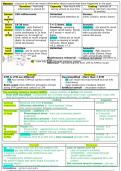
Memory – process by which we retain information about events that have happened in the past.
Duration – how long Capacity – how much info Coding – process of
information is stored for can be stored at one time converting info from one from
to another
Sensor 250 milliseconds. Unlimited Senses.
y anything paid attention to Iconic (vision), echoic (hear)
registe
r
Short 18-30 secs. 7+/-2 items. Miller Acoustic
term Peterson - ppts flashed 3 Chunking – grouping Baddeley - pts asked to recall
memor letters & digits. Asked to makes recall easier. Recall words immediately. Those
y count backwards in 3s from of 5 words = recall of 5 with acoustically similar
(STM) random no, for length of digits. words did worse
time, asked to recall original Jacobs - Asked pts to recall
digits. As interval increased digits increasing in length
recall decreased. correctly. Mean digits
=9.3, letters =7.3
Long Lifetime Unlimited. Semantic
term Bahrick - pts to recall names Baddeley - Ppts asked to
memor from a sch photo from 50yrs recall after 20mins, those
y ago. Many did well. with semantically similar
(LTM) Maintenance rehearsal – repetition
words of
didmaterial
worse transfers to
LTM.
Multi-store model (MSM) – how info flows through memory system
Retrieval – transferring info from LTM to STM to recall.
Strength Weakness
STM & LTM are different Oversimplified - More than 1 STM
- HM has normal STM but cannot create new - KF can recall info read himself but not info
LTM read aloud.
Brain scans show different activation of brain - Case studies lack mundane realism
doing STM (prefrontal cortex) vs LTM Artificial stimuli - ↓mundane realism.
(hippocampus). Meaningless.
The working memory model (WMM) – argues memory is active not passive.
- Dual shift paradigm - components are a limited resource which brain competes for. Tasks with
dual performance in one area are unable to be done effectively. (2 verbal).
Coding Capacity
Central Receives info from 5 senses Limited
executive Allocates attention to ‘slave systems’ below.
The communication between components.
Phonologic Acoustic – auditory info. What can be said
al loop - Phonological store – inner ear, processes speech in 2 seconds.
production - (fewer recall of
- Articulatory process – inner voice, processes speech long words).
perception (reading) & used for maintenance rehearsal of
words.
Visuospati Visual info. Limited– 3/ 4
al - Visual cache – appearance e.g. colour, shape objects.
sketchpad - Inner scribe – spatial info e.g. arrangement.
Episodic Baddeley added later. Limited – 4
buffer Combines from PL & VSS into a time stamped episodic LTM. chunks (store for
CE)
Strength Weakness
KF - can process visual info but not auditory info. Lack of clarity over CE
Baddeley pts had difficulty doing 2 visual tasks but in - Lack of research evidence
1 visual & 1 auditory task performance was - Unfalsifiable – only tested through
unaffected. Types of Long Term Memoryvisual/ verbal tasks
Episodic – ability
- Competing forto recall resource.
limited life events from out lives. - Brain scans have suggested CE is not
Pts- asked
Complex & inhad
if object detail.
same Time-stamped. Conscious
shape & location of effort to recall.
unitary.
Semantic – knowledge
previous object of world (facts) Not account muscle memory – pts can
- Not -time
Peterson brainstamped. Lessdiff
scans found personal.
regions of brain listen to music & still complete other verbal
Procedural – actions and skills.
Duration – how long Capacity – how much info Coding – process of
information is stored for can be stored at one time converting info from one from
to another
Sensor 250 milliseconds. Unlimited Senses.
y anything paid attention to Iconic (vision), echoic (hear)
registe
r
Short 18-30 secs. 7+/-2 items. Miller Acoustic
term Peterson - ppts flashed 3 Chunking – grouping Baddeley - pts asked to recall
memor letters & digits. Asked to makes recall easier. Recall words immediately. Those
y count backwards in 3s from of 5 words = recall of 5 with acoustically similar
(STM) random no, for length of digits. words did worse
time, asked to recall original Jacobs - Asked pts to recall
digits. As interval increased digits increasing in length
recall decreased. correctly. Mean digits
=9.3, letters =7.3
Long Lifetime Unlimited. Semantic
term Bahrick - pts to recall names Baddeley - Ppts asked to
memor from a sch photo from 50yrs recall after 20mins, those
y ago. Many did well. with semantically similar
(LTM) Maintenance rehearsal – repetition
words of
didmaterial
worse transfers to
LTM.
Multi-store model (MSM) – how info flows through memory system
Retrieval – transferring info from LTM to STM to recall.
Strength Weakness
STM & LTM are different Oversimplified - More than 1 STM
- HM has normal STM but cannot create new - KF can recall info read himself but not info
LTM read aloud.
Brain scans show different activation of brain - Case studies lack mundane realism
doing STM (prefrontal cortex) vs LTM Artificial stimuli - ↓mundane realism.
(hippocampus). Meaningless.
The working memory model (WMM) – argues memory is active not passive.
- Dual shift paradigm - components are a limited resource which brain competes for. Tasks with
dual performance in one area are unable to be done effectively. (2 verbal).
Coding Capacity
Central Receives info from 5 senses Limited
executive Allocates attention to ‘slave systems’ below.
The communication between components.
Phonologic Acoustic – auditory info. What can be said
al loop - Phonological store – inner ear, processes speech in 2 seconds.
production - (fewer recall of
- Articulatory process – inner voice, processes speech long words).
perception (reading) & used for maintenance rehearsal of
words.
Visuospati Visual info. Limited– 3/ 4
al - Visual cache – appearance e.g. colour, shape objects.
sketchpad - Inner scribe – spatial info e.g. arrangement.
Episodic Baddeley added later. Limited – 4
buffer Combines from PL & VSS into a time stamped episodic LTM. chunks (store for
CE)
Strength Weakness
KF - can process visual info but not auditory info. Lack of clarity over CE
Baddeley pts had difficulty doing 2 visual tasks but in - Lack of research evidence
1 visual & 1 auditory task performance was - Unfalsifiable – only tested through
unaffected. Types of Long Term Memoryvisual/ verbal tasks
Episodic – ability
- Competing forto recall resource.
limited life events from out lives. - Brain scans have suggested CE is not
Pts- asked
Complex & inhad
if object detail.
same Time-stamped. Conscious
shape & location of effort to recall.
unitary.
Semantic – knowledge
previous object of world (facts) Not account muscle memory – pts can
- Not -time
Peterson brainstamped. Lessdiff
scans found personal.
regions of brain listen to music & still complete other verbal
Procedural – actions and skills.