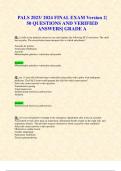
PALS 2023/ 2024 FINAL EXAM Version 2| 50 ACTUAL QUESTIONS AND VERIFIED ANSWERS| GRADE A
PALS 2023/ 2024 FINAL EXAM Version 2| 50 ACTUAL QUESTIONS AND VERIFIED ANSWERS| GRADE A Q: A child in the pediatric intensive care unit displays the following ECG waveform. The child has no pulse. The resuscitation team interprets this as which arrhythmia? Torsades de pointes Ventricular fibrillation Asystole Monomorphic pulseless ventricular tachycardia Answer: Monomorphic pulseless ventricular tachycardia Q: An 11-year-old child develops ventricular tachycardia with a pulse with inadequate perfusion. The PALS team would prepare the child for which intervention? Select the correct answer to this question. Transthoracic pacing Vagal maneuvers Synchronized electrical cardioversion Sedation Answer: Synchronized electrical cardioversion Q: A 6-year-old patient is brought to the emergency department after a bicycle accident. Assessment reveals chest pain on inspiration, diminished breath sounds on the right side, and respiratory distress. The provider suspects obstructive shock caused by what condition? Select the correct answer to this question. Obstructive cardiac lesion Cardiac tamponade Pulmonary embolism Tension pneumothorax Answer: Tension pneumothorax Q: What is the correct IV/IO dose of epinephrine for a pediatric patient in cardiac arrest? Select the correct answer to this question. 0.01 mg/kg every 3 to 5 min (max single dose 1 mg) 10 mg/kg every 3 to 5 min (max single dose 20 mg) 5 mg/kg every 3 to 5 min (max single dose 10 mg) 1 mg/kg every 3 to 5 min (max single dose 2 mg) Answer: 0.01 mg/kg every 3 to 5 min (max single dose 1 mg) Q: A 12-year-old child being evaluated in the pediatric intensive care unit displays the following ECG waveform. The team interprets this as which arrhythmia? Select the correct answer to this question. Second-degree atrioventricular (AV) block, type II First-degree atrioventricular (AV) block Third-degree (complete) atrioventricular (AV) block Second-degree atrioventricular (AV) block, type I Answer: Second-degree atrioventricular (AV) block, type I Q: While performing a rapid assessment and formulating an initial impression using the Pediatric Assessment Triangle (PAT), the provider assesses the child's circulation. Which information would be important to consider? Select all correct options that apply. Evidence of bleeding Skin pallor (or gray/dusky color) Nasal flaring Accessory muscle use Flushing of the skin Answer: Evidence of bleeding Skin pallor (or gray/dusky color) Flushing of the skin Q: A 7-year-old patient with septic shock has received three balanced/buffered crystalloid fluid boluses (60-mL/kg) and reassessment reveals capillary refill of 3 seconds, diminished pulses, narrow pulse pressure and cool, mottled extremities. The emergency response team interprets these findings as indicating which type of septic shock? Select the correct answer to this question. Fluid-responsive Hypertensive Fluid-refractory Mild Answer: Fluid-refractory Q: A child is experiencing shock. The emergency response team prepares for imminent cardiac arrest when assessment reveals which finding(s)? Select all correct options that apply. Hypotension Diminished central pulses Atrial flutter Bradycardia Cool extremities Answer: Hypotension Diminished central pulses Bradycardia Q: A 12-year-old is being treated in the urgent care clinic. The mother reports that the child came home from school yesterday with a high fever, vomiting and multiple episodes of watery
Written for
- Institution
- PALS
- Course
- PALS
Document information
- Uploaded on
- September 1, 2023
- Number of pages
- 19
- Written in
- 2023/2024
- Type
- Exam (elaborations)
- Contains
- Questions & answers
Subjects
- pals certification exam
-
pals 2023 2024 final exam version 2 50 actual qu
-
child in the pediatric intensive care unit displa
-
pediatric advance life support exam
-
palspals final exampals red cross final e

Also available in package deal