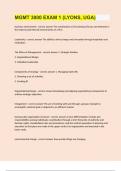
MGMT 3000 EXAM 1 (LYONS, UGA)|UPDATED&VERIFIED|100% SOLVED|GUARANTEED SUCCESS
business environment The combination of all contextual forces and elements in the external and internal environments of a firm. Leadership The ability to drive change and innovation through inspiration and motivation The Pillars of Management 1. Strategic Position 2. Organizational Design 3. Individual Leadership Components of strategy 1. Managing trade offs 2. Choosing a set of activities 3. Creating fit Organizational Design Developing and aligning organizational components to achieve strategic objectives Mangement The act of working with and through a group of people to accomplish a desired goal or objected in an efficient manner bureaucratic organization structure A clear differentiation of tasks and responsibilities among individuals; coordination through a strict hierarchy of authority and decision rights; standardized rules and procedures; and the vertical separation of planning and execution so that plans are made in the upper ranks of an organization and executed in the lower ranks. environmental change how quickly things are changing environmental complexity number of contextual factors in the environment contextual intelligence The ability to understand the impact of environmental factors on a firm and the ability to understand how to influence those same factors. Building Contextual Intelligence 1. Develop appreciation and awareness of history 2. Stay attuned to trends in environment 3. Seize firsthand experiences 4. Engage in scenario assessment and contingency planning contingency planning The systematic assessment of the external environment to prepare for a possible range of alternative futures for the organization. environmental scanning A tool that managers use to scan the business horizon for key events and trends that will affect the business in the future. Includes trend analysis, contextual intelligence, and stakeholder mapping contingent view A view of the firm where effective organizational structure is based on fit or alignment between the organization and various aspects in its environment. human relations movement The belief that organizations must be understood as systems of interdependent human beings who share a common interest in the survival and effective functioning of the firm. managerial view A business framework where the firm is seen as a mechanism for converting raw materials into products to sell to customers. Outside parties not considered scenario building Forecasting the likely result that might occur when several events and stakeholders are linked together. scientific management A focus on how jobs, work, and incentive schemes could be designed to improve productivity using industrial engineering methods. shareholder view A business framework where the job of top managers is to produce the highest possible stock market valuation of the firm's assets. Stakeholder Mapping Steps 1. Map stakeholder relationships within firm 2. Identify subsets within stakeholders 3. Determine stakes for each stakeholder 4. Define connections between stakeholders Multinational Strategy The parent company organizes local subsidiaries and gives them autonomy to develop products tailored to local tastes Global Strategy focus on developing overall scale economies and global efficiency instead of catering to local tastes International Strategy Combine elements of multinational and global strategies by using foreign subsidiaries to produce and distribute products Transnational Strategy Balance a firm's international activities among efficiency, local responsiveness, and organizational learning stakeholder view A business framework that identifies and analyzes multiple groups that interact with the firm and attempts to align organizational practices to satisfy the needs of these various groups. strategic review process The process by which senior leaders of a corporation meet with business unit managers to review progress toward specific goals. Core Competencies a network of unique activities that strategically fit together and are difficult to replicate trend analysis A tool where key variables are monitored and modeled to help predict a change that might occur in the environment. VUCA An acronym for volatile, uncertain, complex, and ambiguous that captures the context in which today's organizations compete
Written for
- Institution
- MGMT
- Course
- MGMT
Document information
- Uploaded on
- August 31, 2023
- Number of pages
- 15
- Written in
- 2023/2024
- Type
- Exam (elaborations)
- Contains
- Questions & answers
Subjects
-
mgmt 3000 exam 1 lyons ugaupdatedverified100

Also available in package deal