School Law WGU D017 Latest 2023 Rated A+
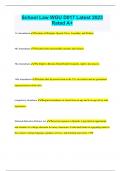
School Law WGU D017 Latest 2023 Rated A+ 1st Amendment Freedom of Religion, Speech, Press, Assembly, and Petition 4th Amendment Freedom from unreasonable searches and seizures 5th Amendment The Right to Remain Silent/Double Jeopardy, right to due process 14th Amendment Declares that all persons born in the U.S. are citizens and are guaranteed equal protection of the laws compulsory attendance Required attendance at school from an age and to an age set by state legislatures. National Education Defense Act Passed in response to Sputnik, it provided an oppurtunity and stimulus for college education for many Americans. It allocated funds for upgrading funds in the sciences, foreign language, guidance services, and teaching innovation. 1958 Elementary and Secondary Education Act of - Provided federal funding for primary and secondary education and was meant to improve the education of poor people. This was the first federal program to fund education. Improving America's Schools Act 1994 provides for social workers to receive interdisciplinary training with others on the professional helping team NCLB No Child Left Behind - 2001 Pres. Bush designed to promote "standards-based education reform" via assessments that measure progress; results often affect funding and administration control ESSA The Every Student Succeeds Act is a US law passed in December 2015 that governs the United States K-12 public education policy. The law replaced its predecessor, the No Child Left Behind Act, and modified but did not eliminate provisions relating to the periodic standardized tests given to students. CAPTA Child Abuse Prevention and Treatment Act of 1974 FERPA (Family Educational Rights and Privacy Act) A federal law that regulates the management of student records and disclosure of information from those records. The Act has its own administrative enforcement mechanism. HIPAA Health Insurance Portability and Accountability Act of 1996 Title IX A United States law enacted on June 23, 1972 that states: "No person in the United States shall, on the basis of sex, be excluded from participation in, be denied the benefits of, or be subjected to discrimination under any education program or activity receiving Federal financial assistance." FMLA (Family and Medical Leave Act) Federal law requiring organizations with 50 or more employees to provide up to 12 weeks of unpaid leave after childbirth or adoption; to care for a seriously ill family member or for an employee's own serious illness; or to take care of urgent needs that arise when a spouse, child, or parent in the National Guard or Reserve is called to active duty Title VII of the Civil Rights Act of 1964 forbids discrimination in all areas of the employment relationship ADA The Americans with Disabilities Act of 1990 is a civil rights law that prohibits discrimination based on disability Section 504 of the Rehabilitation Act A federal law that protects the civil rights of individuals with disabilities. This law is closely intertwined with IDEA. Children with disabilities who are not eligible for special education may qualify for accommodations under Section 504. PL 94-142 Education for all Handicapped Children Act-1975 mandated FAPE, ensured due process, IEP and LRE IDEA Individuals with Disabilities Education Act Plessy v. Ferguson a 1896 Supreme Court decision which legalized state ordered segregation so long as the facilities for blacks and whites were equal Brown v. Board of Education 1954 - The Supreme Court overruled Plessy v. Ferguson, declared that racially segregated facilities are inherently unequal and ordered all public schools desegregated. Swann v. Charlotte-Mecklenburg Board of Education In this 1971 Supreme Court Decision, the court ruled that, even though the schools in the district worked out to be only minimally integrated because of the full black or white neighborhood, the schools had to be intergraded based on the percentage of blacks in the whole district, meaning that blacks had to be bussed over great distances to integrate schools that naturally sat in all white neighborhoods. This cause a great push-back from middle America, who saw the end of the neighborhood school Lemon v. Kurtzman The 1971 Supreme Court decision that established that aid to church-related schools must (1) have a secular legislative purpose; (2) have a primary effect that neither advances nor inhibits religion; and (3) not foster excessive government entanglement with religion. Wallace v. Jaffree 1985 SuCo: Schools cannot hold moments of silence with religious intentions. Good News Club v. Milford Central School Religious clubs that engage in religious activities can meet after school. Lee v. Wiseman (1992) Ruled that a graduation prayer violated the Establishment Clause Santa Fe Independent School District v. Doe (2000) Students may not lead prayers before the start of a football game at a public school Plyer v. Doe Some Texas education laws allowed for the withholding of state funds to educate children of illegal aliens. Result: The law violates the 14th A. because, although illegal aliens, are people and enjoy such protections. Aliens have the right to public education. Laws violated the 14th A. Lau v. Nichols (1974) If a substantial number of non-English speaking students reside in the district, the district must provide for these students with classes in English. Castenada vs. Pickard school is obliged to guarantee ELD and core content access to the students even if parents request exemption from an SEI program Hazelwood v. Kuhlmeier School newspapers can be censored by teachers and administrators Tinker v. Des Moines (1969) Public school students may wear armbands to class protesting against America's war in Vietnam when such display does not disrupt classes Morse v. Frederick (2007) Upholds the authority of public school administrators to suspend students for promoting illegal drugs at a school event (Bong Hits for Jesus) New Jersey v. TLO Supreme court case in which it was decided that a student may be searched if there is "reasonable ground" for doing so. Horton v. Goose Creek Independent School District Before school officials can search a student, they must have a reasonable suspicion. Dogs can sniff the lockers and cars, but not the students. The courts ruled that the dogs could sniff the lockers and cars without violating the students' Fourth Amendment rights because the lockers and cars were unattended and in public view, therefore it was not technically a search. They ruled that it was unconstitutional, and unreasonable, for the dogs to sniff the students because the officials did not have an individual suspicion that the student or students were carrying an illegal substance. Vernonia School District v. Acton Random drug testing of athletes does not violate the search and seizure clause of the fourth amendment Dixon v. Alabama Supreme Court rules that due process requires a student to receive notice and some opportunity for a hearing before being expelled for misconduct. Gonzaga University v Doe 2002 held that individuals cannot sue universities that disclose information protected under FERPA, but the school will face sanctions from the government People v. Dukes Washington Irving, which is in Manhattan, was one of several schools selected for periodic scanning. The students at these schools had been told at the beginning of the year that searches would take place but they were not given any specific dates in advance. The entire procedure was governed by written guidelines adopted a few years earlier by former Chancellor Richard E. Green. The stated purpose of the search is to prevent students from bringing weapons into the schools. Ingraham v. Wright Corporal punishment (students can't be paddled without a hearing) Pickering v. Board of Education Teacher First Amendment Rights- Dismissal of a teacher for public statements regarding issues of public importance without showing that the statements are recklessly false violate the 1st amendment. Connick v. Myers public employee speaks NOT as a citizen upon matters of PUBLIC CONCERN (Conn. teacher - My Space) Garcetti v. Ceballos (2006) Richard Ceballos, an employee of the Los Angeles District Attorney's office, found that a sheriff misrepresented facts in a search warrant affidavit. Ceballos notified the attorneys prosecuting the case stemming from that arrest and all agreed that the affidavit was questionable, but the D.A.'s office refused to dismiss the case. Ceballos then told the defense he believed the affidavit contained false statements, and defense counsel subpoenaed him to testify. Seeking damages in federal district court, Ceballos alleged that D.A.s in the office retaliated against him for his cooperation with the defense, which he argued was protected by the First Amendment. The district court ruled that the district attorneys were protected by qualified immunity, but the Ninth Circuit reversed and ruled for Ceballos, holding that qualified immunity was not available to the defendants because Ceballos had been engaged in speech that addressed matters of public concern and was thus protected by the First Amendment. Decision: The Supreme Court held that speech by a public official is only protected if it is engaged in as a private citizen, not if it is expressed as part of the official's public duties. Ceballos's employers were justified in taking action against him based on his testimony and cooperation with the defense, therefore, because it happened as part of his official duties. Mt. Healthy District v. Doyle Upheld a nontenured teacher's freedom of expression. District has "burden of proof" to show he would have been fired regardless of action protected under First Amendment (calling radio station). (Teacher was still fired in this case.)
Written for
- Institution
- School Law WGU D017
- Course
- School Law WGU D017
Document information
- Uploaded on
- August 30, 2023
- Number of pages
- 10
- Written in
- 2023/2024
- Type
- Exam (elaborations)
- Contains
- Questions & answers
Subjects
-
school law wgu d017 latest 2023 rated a

Also available in package deal