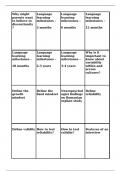
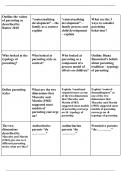
Why might Language Language Language
parents want learning learning learning
to believe in milestones – milestones – milestones –
discontinuity
? 3 months 6 months 12 months
Language Language Language Why is it
learning learning learning important to
milestones – milestones – milestones – know about
variability
18 months 2-3 years 3-4 years within and
across
cultures?
Define the Define the Neuropsychol Define
growth fixed mindset ogist findings reliability
mindset on Romanian
orphan study
Define validity How to test How to test Features of an
reliability? validity? interview
,Responds to their own name Watches speakers face and Maes different noises • One of the reasons
makes noises in response that discontinuous stages are
Understands common words Looks for the source of sound appealing to people is because
and gestures such as cookie, Volizes or gestures for attention people like to track change e.g.
eat, bye bye and ha a variety of cries for Reacts to loud or new sounds tracking child’s new skills such
different purposes as smiling.
Understands simple o Parents often see this
instructions such as “sit down’ as a qualitative change.
• Infants usually learn
Babbles – e.g. “baba” “mama” skills along certain trajectories.
• Not all infants show
these shifts at the exact same
period of time.
- It is important to Understands over 5000 words Understands 2000-3000 words Understands about 200 words
know about these differences to (including basic vacab or body and uses 200-600 words and uses 10-50 words
know whether something is arts, clothing, colours, shapes)
within the normal range of Understands simple commands
variability – if we don’t know Produces mostly complete Combining 2-4 words into such as “no””in” “on”
what s typical then its hard to sentences with greater phrases or sentences and asking
identify developmental delays complexity simple questions Makes gesture or askes for
and intervene. “more”
Able to tell simple stories
Uses simple conjunctions, Enjoys listening to simple
negation, common opposites stories.
and adjectives
Asks “why” “when” and “how”
questions
informs the fact we
should not be separating people believe their basic - Children are not set
children form their parents – qualities, like their intelligence in the way they are
immigration. or talent, are simply fixed - if you give them a
■ Reliability: the - Cold and emotional traits. They spend their time growth mindset (they can
degree to which independent caregiving leads to sever documenting their intelligence change their abilities) then they
measures of a given behavior developmental problems or talent instead of developing are more likely to learn. – more
are consistent - Their coming from an them. They also believe that motivated to learn.
area of violent and traumatic talent alone creates success— - E.g. “that feeling of
experiences + traumatic without effort. math being hard I the feeling of
journey to the border = your brain growing”
sensitising
- Young children also
have a language barrier and are
unable to understand that
separation may be temporary.
Children answer questions – Interrater and test- Validity: the degree to
asked either in person or on a Internal and external retest which a test measures what
questionnaire it is intended to measure
,Features of a Features of a Advantages of Disadvantages
naturalistic structured an interview of an
observation observation interview
Advantages of Disadvantages Advantages of Disadvantages
a naturalistic of a a structured a structured
observation naturalistic observation observation
observation
Define Define clinical Define Define
structured interviews naturalistic structured
interviews observation observation
What are the What are the What are the Name some of
essential characteristic characteristic the ethical
characteristic s of s of cross- guidelines (7
s of longitudinal sectional total)
experimental design? designs?
designs?
, Reports are often biased to Can reveal children’s Children are brought to lab and Activities of children in
reflect favourably on the subjective experience presented prearranged tasks everyday setting are observed.
interviewee
Structured interviews are
Memories f interviewees are inexpensive means for
often inaccurate and collecting in-depth data about
incomplete individuals
Prediction of future behaviour Clinical interviews allow
often is inaccurate flexibility for following up
unexpected comments.
Context is less natural than in Insures that all children’s Difficult to know which aspects Useful for describing behaviour
naturalistic observation behaviours are observed in of situation are most influential in everyday settings.
same context
Reveals less about subjective
experience than interviews. Allows controlled comparison
of childrens behaviour in
different situations.
Naturalistic observation • Clinical interviews: • Structured
Structured observation Useful for obtaining in-depth interviews: Useful when goal is
• Method that presents • Examination of information about an individual to collect self-reports on same
identical situations to each ongoing behavior in an child topics from everyone being
child and records child's environment not controlled by studied
behavior the researcher
• Particularly useful for
understanding everyday social
interactions (Patterson, 1982)
•
• Do no harm • Children of different • Same children are • Random assignment
• Obtain informed ages studied at same time studied twice or more over a of participants to groups
consent • Useful for examining substantial length of time • Experimental control
• Preserve participant differences between different • Useful for revealing • Inference about
anonymity age groups stability and change over time causes and effects allowed
• Discuss with parents • Uninformative about • Large investment of
relevant research information stability & change over time in time & energy
• Work to counteract individual
unforeseen negative
consequences
• Correct inaccurate
child impressions
• Explain main finding
at developmentally appropriate
level
Main Main Main Main
parents want learning learning learning
to believe in milestones – milestones – milestones –
discontinuity
? 3 months 6 months 12 months
Language Language Language Why is it
learning learning learning important to
milestones – milestones – milestones – know about
variability
18 months 2-3 years 3-4 years within and
across
cultures?
Define the Define the Neuropsychol Define
growth fixed mindset ogist findings reliability
mindset on Romanian
orphan study
Define validity How to test How to test Features of an
reliability? validity? interview
,Responds to their own name Watches speakers face and Maes different noises • One of the reasons
makes noises in response that discontinuous stages are
Understands common words Looks for the source of sound appealing to people is because
and gestures such as cookie, Volizes or gestures for attention people like to track change e.g.
eat, bye bye and ha a variety of cries for Reacts to loud or new sounds tracking child’s new skills such
different purposes as smiling.
Understands simple o Parents often see this
instructions such as “sit down’ as a qualitative change.
• Infants usually learn
Babbles – e.g. “baba” “mama” skills along certain trajectories.
• Not all infants show
these shifts at the exact same
period of time.
- It is important to Understands over 5000 words Understands 2000-3000 words Understands about 200 words
know about these differences to (including basic vacab or body and uses 200-600 words and uses 10-50 words
know whether something is arts, clothing, colours, shapes)
within the normal range of Understands simple commands
variability – if we don’t know Produces mostly complete Combining 2-4 words into such as “no””in” “on”
what s typical then its hard to sentences with greater phrases or sentences and asking
identify developmental delays complexity simple questions Makes gesture or askes for
and intervene. “more”
Able to tell simple stories
Uses simple conjunctions, Enjoys listening to simple
negation, common opposites stories.
and adjectives
Asks “why” “when” and “how”
questions
informs the fact we
should not be separating people believe their basic - Children are not set
children form their parents – qualities, like their intelligence in the way they are
immigration. or talent, are simply fixed - if you give them a
■ Reliability: the - Cold and emotional traits. They spend their time growth mindset (they can
degree to which independent caregiving leads to sever documenting their intelligence change their abilities) then they
measures of a given behavior developmental problems or talent instead of developing are more likely to learn. – more
are consistent - Their coming from an them. They also believe that motivated to learn.
area of violent and traumatic talent alone creates success— - E.g. “that feeling of
experiences + traumatic without effort. math being hard I the feeling of
journey to the border = your brain growing”
sensitising
- Young children also
have a language barrier and are
unable to understand that
separation may be temporary.
Children answer questions – Interrater and test- Validity: the degree to
asked either in person or on a Internal and external retest which a test measures what
questionnaire it is intended to measure
,Features of a Features of a Advantages of Disadvantages
naturalistic structured an interview of an
observation observation interview
Advantages of Disadvantages Advantages of Disadvantages
a naturalistic of a a structured a structured
observation naturalistic observation observation
observation
Define Define clinical Define Define
structured interviews naturalistic structured
interviews observation observation
What are the What are the What are the Name some of
essential characteristic characteristic the ethical
characteristic s of s of cross- guidelines (7
s of longitudinal sectional total)
experimental design? designs?
designs?
, Reports are often biased to Can reveal children’s Children are brought to lab and Activities of children in
reflect favourably on the subjective experience presented prearranged tasks everyday setting are observed.
interviewee
Structured interviews are
Memories f interviewees are inexpensive means for
often inaccurate and collecting in-depth data about
incomplete individuals
Prediction of future behaviour Clinical interviews allow
often is inaccurate flexibility for following up
unexpected comments.
Context is less natural than in Insures that all children’s Difficult to know which aspects Useful for describing behaviour
naturalistic observation behaviours are observed in of situation are most influential in everyday settings.
same context
Reveals less about subjective
experience than interviews. Allows controlled comparison
of childrens behaviour in
different situations.
Naturalistic observation • Clinical interviews: • Structured
Structured observation Useful for obtaining in-depth interviews: Useful when goal is
• Method that presents • Examination of information about an individual to collect self-reports on same
identical situations to each ongoing behavior in an child topics from everyone being
child and records child's environment not controlled by studied
behavior the researcher
• Particularly useful for
understanding everyday social
interactions (Patterson, 1982)
•
• Do no harm • Children of different • Same children are • Random assignment
• Obtain informed ages studied at same time studied twice or more over a of participants to groups
consent • Useful for examining substantial length of time • Experimental control
• Preserve participant differences between different • Useful for revealing • Inference about
anonymity age groups stability and change over time causes and effects allowed
• Discuss with parents • Uninformative about • Large investment of
relevant research information stability & change over time in time & energy
• Work to counteract individual
unforeseen negative
consequences
• Correct inaccurate
child impressions
• Explain main finding
at developmentally appropriate
level
Main Main Main Main