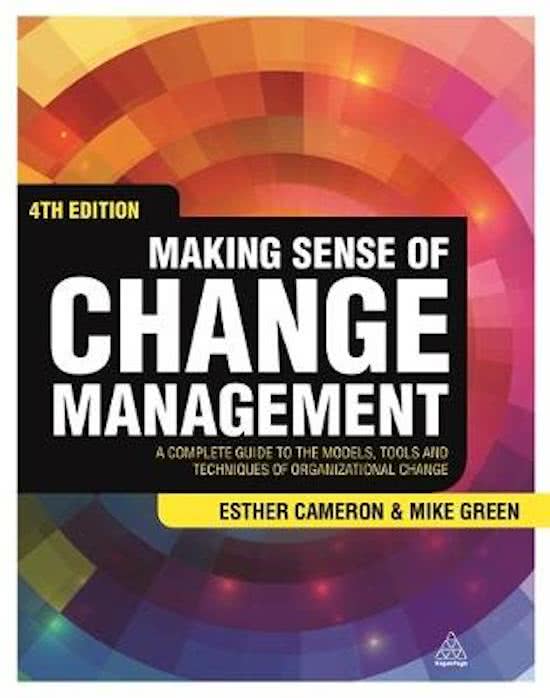
Making sense of Change Management
by Esther Cameron and Mike Green
3rd pressing, 2014
This summary does not include Chapter 8 and 9 as I did not have to study these
chapters and was unable to motivate myself in summarising these “Just for fun”.
All the information in this summary comes directly from the book that was way,
way (seriously; waaaaay) too long and elaborate to be pleasant too read. I tried
summarising it as properly as possible, but failed to keep it short and snappy.
There are just too many different models and approaches to simply skip ahead.
Fair warning:
This is the third pressing as I do not want to buy a new book each year. I checked
and all the chapters still hold up. There may, however, be minor changes within
these chapters. Hope you can use it to your advance.
1. Individual Change
“Learning to do something new usually involves a temporary dip in performance”
Our consciousness during change
We are unconsciously incompetent beforehand.
When learning something new, we focus on it and become very conscious of our
performance. We become consciously incompetent.
After a successful change we become consciously competent.
Only then, after using and knowing a lot, we can become unconsciously
competent.
The four main approaches
Behavioural
Is about changing behaviour through punishment and reward. This leads to
behavioural analysis and use of reward strategies
For managers: “Get your reward strategies right”
1
by Esther Cameron and Mike Green
3rd pressing, 2014
This summary does not include Chapter 8 and 9 as I did not have to study these
chapters and was unable to motivate myself in summarising these “Just for fun”.
All the information in this summary comes directly from the book that was way,
way (seriously; waaaaay) too long and elaborate to be pleasant too read. I tried
summarising it as properly as possible, but failed to keep it short and snappy.
There are just too many different models and approaches to simply skip ahead.
Fair warning:
This is the third pressing as I do not want to buy a new book each year. I checked
and all the chapters still hold up. There may, however, be minor changes within
these chapters. Hope you can use it to your advance.
1. Individual Change
“Learning to do something new usually involves a temporary dip in performance”
Our consciousness during change
We are unconsciously incompetent beforehand.
When learning something new, we focus on it and become very conscious of our
performance. We become consciously incompetent.
After a successful change we become consciously competent.
Only then, after using and knowing a lot, we can become unconsciously
competent.
The four main approaches
Behavioural
Is about changing behaviour through punishment and reward. This leads to
behavioural analysis and use of reward strategies
For managers: “Get your reward strategies right”
1