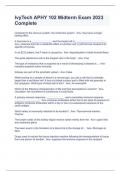
IvyTech APHY 102 Midterm Exam 2023 Complete
IvyTech APHY 102 Midterm Exam 2023 Complete What is a hormone and how does it act? - Hormones are chemical messengers that are responsible for regulation. They are secreted into body fluids, mainly blood. It has specific actions on target tissues, which are any tissue that has specific receptors for that particular hormone. What is a paracrine gland? - a secretion that enters interstitial fluid but affects only neighboring cells What is an autocrine gland? - A secretion that only affects the secreting cell. What is an endocrine gland? - A gland that secretes a substance (a hormone) into the bloodstream and act on target cells What is an exocrine gland? - A ducted gland that produces a secretion onto a body surface. Where is the thymus located? - mediastinum; behind the sternum Where is the pineal gland located? - center of brain Where are the reproductive organs located? - abdomen; pelvic Where is the pituitary gland located? - sella turcica of the sphenoid bone; base of the brain Where are the adrenal glands located? - on top of each kidney Where is the pancreas located? - posterior to the stomach What are the two steroid hormones? - Sex hormones and adrenal cortex hormones; estrogen and testosterone Describe steroid hormones - -diffuse through cell membranes into cytoplasm or nucleus -combine with a receptor molecule binding to DNA -promote transcription of mRNA -mRNA enters cytoplasm directing protein synthesis Describe non-steroid hormones. - Amines, proteins, peptides, and glycoproteins. The endocrine gland secretes nonsteroid hormones, which body fluid carries hormone to its target cell. Hormone combines with receptor site on membrane of its target cell, activating G protein. Cellular changes produce the hormone's effects. How is the anterior pituitary gland different than the posterior pituitary gland? - The anterior pituitary becomes an endocrine gland producing and secreting hormones for the body and connects to the posterior pituitary when fully formed. Meanwhile, the posterior pituitary remains connected to the hypothalamus, functioning as a repository for hormones produced by the hypothalamus and receiving messages from it that regulate when hormones are to be released to and through the anterior pituitary What regulates pituitary gland secretion? - Hypothalamus Describe tropic hormones - stimulate other endocrine glands to release hormones anterior pituitary hormones - ACTH - controls manufacture and secretion of certain hormones from the outer layer of the adrenal gland. FSH - controls growth and development of follicles that house egg cells in ovaries and stimulate production of sperm cells in the testes. GH - stimulates cells to enlarge and more rapidly divide LH - promotes secretion of sex hormones and allows release of egg cells from ovaries PRL - promotes milk production TSH - controls secretion of certain hormones from the thyroid posterior pituitary hormones - ADH - reduces volume of water that kidneys secrete Oxytocin - smooth muscle contraction and allows contraction of the uterus during childbirth and may stimulate the movement of certain fluids in the male reproductive tract during sexual activity Thyroid hormones - Calcitonin - controls blood calcium and phosphate ion concentration Thyroxine(T4) - more prevalent in circulation Triiodothyronine(T3) - more potent than T4 Parathyroid hormones - PTH - increases blood calcium ion concentration and decreases blood phosphate ion concentration through actions in the bones, kidneys, and intestines adrenal medulla hormones - epinephrine and norepinephrine - increase heart rate, BP, breathing, decrease digestion adrenal cortex hormones - Aldosterone - helps regulate concentration of sodium and potassium ions Cortisol - affects glucose metabolism and influences proteins and fat metabolism Pancreas hormones - Glucagon - stimulates liver to break down glycogen into glucose Insulin - stimulates the liver to form glycogen from glucose Somatostatin - helps regulate glucose metabolism by inhibiting secretion of glucagon and insulin pineal gland hormone - Melatonin - made from serotonin and regulates circadian rhythms Thymus Gland Hormones - Thymosins - affect production and differentiation of T lymphocytes How are glucagon and insulin alike? - Both work to keep blood glucose concentration constant How are glucagon and insulin different? - Glucagon stimulates the liver to break down glycogen into glucose and insulin promotes the formation of glycogen from glucose How is diabetes insipitus different from diabetes mellitus? - Diabetes insipitus - a person is insatiably thirsty and has large amounts of urine output Diabetes mellitus - two types (type 1 and type 2). Type 1 occurs when body makes no insulin. Type 2 occurs when the body reaches insulin resistance How are pheromones different than hormones? - Pheromones are a type of hormone that are released in small quantities and play a big role in physical attraction between people. How does aging affect the endocrine system? - As people get older, their endocrine glands decrease in size, muscular strength decreases as GH levels decrease, ADH levels increase due to slower breakdown in liver & kidneys. Calcitonin levels decrease, and insulin resistance may develop. Describe normal blood: number of each cell type, pH. - Blood is about 8% of body weight. Adult blood volume is about 5 L. RBC count is usually 4,600,000-6,200,000 in males, 4,200,000-5,400,000 in females. WBC are usually 5,000-10,000 per cubic mm of blood. Platelets are usually 130,000-360,000 per cubic mm of blood. Normal blood pH is around 7.4. Describe the different formed elements and their origins - RBCs originate in red bone marrow from hemocytoblasts (stem cells) which then differentiate in a process called hematopoiesis. WBCs are called leukocytes and are split into granulocytes and agranulocytes. Platelets are cell fragments of megakaryocytes; they lack a nucleus and are half the size of a RBC. Compare the formed elements of the blood. - RBCs, WBCs, and platelets all act together to maintain life. RBCs transport oxygen to the body's tissues, WBCs fight infections in the body, and platelets clot wounds that occur. What are normal levels and percenta
Written for
- Institution
- IvyTech APHY
- Course
- IvyTech APHY
Document information
- Uploaded on
- August 26, 2023
- Number of pages
- 10
- Written in
- 2023/2024
- Type
- Exam (elaborations)
- Contains
- Questions & answers
Subjects
-
ivytech aphy 102 midterm exam 2023 complete