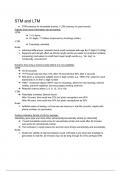
STM and LTM
● STM (memory for immediate events) + LTM (memory for past events)
Capcity (how much information can be stored):
-STM:
➔ 7+/-2 items
➔ 9.3 digits, 7.3 letters (improved by chunking) (miller)
-LTM:
➔ Potentially unlimited
Evals:
➢ Individual differences- research found recall increases with age 8yr(7 digits),19 (9dig)
➢ Supports word length effect as shorter length words are easier to remember (shallow
processing) and easier to recall than longer length words e.g. “cat, dog” vs
“profoundly, monotonous”
Duration (how long a memory lasts before it is not available):
-STM:
➔ 18-30 seconds
➔ P+P [recall was less than 10% after 18 seconds] but 90% after 3 seconds
➔ Ppts given a consonant syllable and a 3 digit number e.g. “HMV 512” asked to count
backwards in 3’s from 3 digit number
➔ ‘HMV’- nonsense trigram (WHY: has no meaneing, allows for new learning, internal
validity, prevents repetition and encourages working memory)
➔ Retention interval either 3, 6, 9, 12, 15 or 18s
-LTM:
➔ Potentially unlimited, Bahrick found :
After 15 years: free recall was 70% but photo recognition was 90%
After 48 years: free recall was 30% but photo recognitonw as 60%
Evals:
➢ Artificial nature of testing, not how we use memory in real life (counter: maybe with
phone numbers or postcodes)
Coding (changing format of info for storage):
-Baddeley gave ppts word lists either semantically/acoustically similar [or dissimilar]
➔ Found immediate recall worse for acoustically similar and recall after 20 minutes
was worse for semantically similar.
➔ The confusion in recall means ltm and stm store things semantically and acoustically
Evals:
➢ Doubt into validity of interval between recall, LTM task is too short and simplistic to
generalise to real life, 20 minutes may not be long enough for LTM, perhaps STM
,MSM (Atkinson and Shiffrin 1968)
● 3 unitary separate stores; unidirectional
SR:
● Receives sensory information
● Capacity: very large
● Coding: modality specific (different for each sense) e.g. iconic=vision, haptic=touch
● Duration: 1-2 seconds
● If information is not paid attention to it is forgotten (decay)
STM:
● Temporary active store
● If information is paid attention to it transfers to STM and stays through maintenance
rehearsal (repetition), passed back from retrieval in LTM
● Capacity: 7+/-2 items (Miller) or 7.3 letters, 9.3 numbers(Jacobs) improved by
chunking (grouping items)
● Coding: acoustically
● Duration: 18-30 seconds (P+P) found recall of 3 letter trigrams was less than 10%
after 18 seconds after interference task
● Info is lost due to displacement (replaced by another memory) or decay
LTM:
● Permanent active store
● Capcity: unlimited (forgotten is just inaccessible)
● Coding: semantic
● Duration: potentially unlimited (Bahrick’s 48 years) 60% photo recognition of names
and 30% free recall of names after 48 years
● Lost due to inaccessability
● Information is transferred through elaborative rehearsal and attaching meaning to
information
Evals:
➢ Low exp. Power: Too simplistic and better explained by WMM
➢ Good foundational understanding of memory
➢ Patient HM, hippocampus removed, issues with episodic and semantic memory
(LTM) but his STM was intact, suggests memory is separate and STM and LTM are
two separate stores
➢ Research into serial position effect: remember first few words as they are fresh in
STM (primary effect+maintenance rehearsal), remember last few words as they are
rehearsed and transfered to LTM(recency effect recently learnt)
➢ Brain scans active : Beardsley PFC in STM, Squire found hippocampus LTM
, WMM (Baddeley and Hitch 1974)
● Views memory as an active processor
Phonological loop:
● Deals with auditory information
● Primary acoustic store- like an inner ear, stores words that were recently heard
➔ Duration: 1-2s
➔ Filters out info that is not needed
● Articulatory process- like an inner voice, stores via subvocal repetition (silent)
➔ PAS sends info to AP if it is needed for an ongoing task
Visuo-spatial sketchpad:
● Deals with visual information
● Visual cache- stores info about visual items e.g. form and colour
● Inner scribe- stores the arrangement of objects in the visual field
● Capacity: limited, 4 objects
Central executive:
● Receiving sense info, allocates tasks to different slave systems
● Not a storage system
● Has an attentional capacity
Episodic buffer:
● Added in 2000
● Combines and integrates info to different slave systems and LTM
● Acts as a multi-modal store
● Provides a full experience of a memory
● the episodic buffer is called a multi-modal or multi modal store, because it
combines information from all five senses to create a whole ‘scene’ of an event.
● This information is then used to create a whole ‘scene’ of a particular event in your
life, which is then transferred to long-term memory to create episodic memories.
Evals:
➢ Patient KF had issues with auditory info (PL) but not his visual info (VSS) after brain
damage thus suggesting they are separate systems in separate brain regions
➢ Dual-task performance- Baddeley found ppts struggled when performing two visual
tasks simultaneously e.g. ‘describing the letter F’ and ‘tracking a light’
➢ Lack of clarity with function of episodic buffer, even Baddeley accepts this but views it
as a chance for psychologists to develop ideas
➢ Complex central executive, patient EVR performed well on reasoning but badly on
decision-making highlighting that his CE is not wholly intact
➢ Holistic as it sees memory as involving multiple parts
➢ Practical value as it is still considered as the best theorectical model of memory
➢ Lack of testability (unfalsifiable) of CE either attentional capacity is overloaded or was
successfully able to allocate tasks (there is no refuting or disproving)
➢ Model doesn’t explain how CE works
● STM (memory for immediate events) + LTM (memory for past events)
Capcity (how much information can be stored):
-STM:
➔ 7+/-2 items
➔ 9.3 digits, 7.3 letters (improved by chunking) (miller)
-LTM:
➔ Potentially unlimited
Evals:
➢ Individual differences- research found recall increases with age 8yr(7 digits),19 (9dig)
➢ Supports word length effect as shorter length words are easier to remember (shallow
processing) and easier to recall than longer length words e.g. “cat, dog” vs
“profoundly, monotonous”
Duration (how long a memory lasts before it is not available):
-STM:
➔ 18-30 seconds
➔ P+P [recall was less than 10% after 18 seconds] but 90% after 3 seconds
➔ Ppts given a consonant syllable and a 3 digit number e.g. “HMV 512” asked to count
backwards in 3’s from 3 digit number
➔ ‘HMV’- nonsense trigram (WHY: has no meaneing, allows for new learning, internal
validity, prevents repetition and encourages working memory)
➔ Retention interval either 3, 6, 9, 12, 15 or 18s
-LTM:
➔ Potentially unlimited, Bahrick found :
After 15 years: free recall was 70% but photo recognition was 90%
After 48 years: free recall was 30% but photo recognitonw as 60%
Evals:
➢ Artificial nature of testing, not how we use memory in real life (counter: maybe with
phone numbers or postcodes)
Coding (changing format of info for storage):
-Baddeley gave ppts word lists either semantically/acoustically similar [or dissimilar]
➔ Found immediate recall worse for acoustically similar and recall after 20 minutes
was worse for semantically similar.
➔ The confusion in recall means ltm and stm store things semantically and acoustically
Evals:
➢ Doubt into validity of interval between recall, LTM task is too short and simplistic to
generalise to real life, 20 minutes may not be long enough for LTM, perhaps STM
,MSM (Atkinson and Shiffrin 1968)
● 3 unitary separate stores; unidirectional
SR:
● Receives sensory information
● Capacity: very large
● Coding: modality specific (different for each sense) e.g. iconic=vision, haptic=touch
● Duration: 1-2 seconds
● If information is not paid attention to it is forgotten (decay)
STM:
● Temporary active store
● If information is paid attention to it transfers to STM and stays through maintenance
rehearsal (repetition), passed back from retrieval in LTM
● Capacity: 7+/-2 items (Miller) or 7.3 letters, 9.3 numbers(Jacobs) improved by
chunking (grouping items)
● Coding: acoustically
● Duration: 18-30 seconds (P+P) found recall of 3 letter trigrams was less than 10%
after 18 seconds after interference task
● Info is lost due to displacement (replaced by another memory) or decay
LTM:
● Permanent active store
● Capcity: unlimited (forgotten is just inaccessible)
● Coding: semantic
● Duration: potentially unlimited (Bahrick’s 48 years) 60% photo recognition of names
and 30% free recall of names after 48 years
● Lost due to inaccessability
● Information is transferred through elaborative rehearsal and attaching meaning to
information
Evals:
➢ Low exp. Power: Too simplistic and better explained by WMM
➢ Good foundational understanding of memory
➢ Patient HM, hippocampus removed, issues with episodic and semantic memory
(LTM) but his STM was intact, suggests memory is separate and STM and LTM are
two separate stores
➢ Research into serial position effect: remember first few words as they are fresh in
STM (primary effect+maintenance rehearsal), remember last few words as they are
rehearsed and transfered to LTM(recency effect recently learnt)
➢ Brain scans active : Beardsley PFC in STM, Squire found hippocampus LTM
, WMM (Baddeley and Hitch 1974)
● Views memory as an active processor
Phonological loop:
● Deals with auditory information
● Primary acoustic store- like an inner ear, stores words that were recently heard
➔ Duration: 1-2s
➔ Filters out info that is not needed
● Articulatory process- like an inner voice, stores via subvocal repetition (silent)
➔ PAS sends info to AP if it is needed for an ongoing task
Visuo-spatial sketchpad:
● Deals with visual information
● Visual cache- stores info about visual items e.g. form and colour
● Inner scribe- stores the arrangement of objects in the visual field
● Capacity: limited, 4 objects
Central executive:
● Receiving sense info, allocates tasks to different slave systems
● Not a storage system
● Has an attentional capacity
Episodic buffer:
● Added in 2000
● Combines and integrates info to different slave systems and LTM
● Acts as a multi-modal store
● Provides a full experience of a memory
● the episodic buffer is called a multi-modal or multi modal store, because it
combines information from all five senses to create a whole ‘scene’ of an event.
● This information is then used to create a whole ‘scene’ of a particular event in your
life, which is then transferred to long-term memory to create episodic memories.
Evals:
➢ Patient KF had issues with auditory info (PL) but not his visual info (VSS) after brain
damage thus suggesting they are separate systems in separate brain regions
➢ Dual-task performance- Baddeley found ppts struggled when performing two visual
tasks simultaneously e.g. ‘describing the letter F’ and ‘tracking a light’
➢ Lack of clarity with function of episodic buffer, even Baddeley accepts this but views it
as a chance for psychologists to develop ideas
➢ Complex central executive, patient EVR performed well on reasoning but badly on
decision-making highlighting that his CE is not wholly intact
➢ Holistic as it sees memory as involving multiple parts
➢ Practical value as it is still considered as the best theorectical model of memory
➢ Lack of testability (unfalsifiable) of CE either attentional capacity is overloaded or was
successfully able to allocate tasks (there is no refuting or disproving)
➢ Model doesn’t explain how CE works