
Biological Psychology:
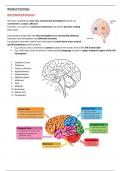
Brain Anatomy & Structure
Structure: divided into two near symmetrical hemispheres which are
connected by corpus callosum
Function: our source of conscious awareness and where decision making
takes place
Lateralization (external): the two hemispheres are structurally identical
however each hemisphere has different functions
Localization (internal): within each hemisphere certain brain areas control
specific behaviours and functions
• E.g.: Broca’s area is involved in speech located in the lower area of the left frontal lobe
• E.g.: Wernicke’s area involved in understanding language located in upper temporal region of the left
hemisphere
1. Cerebral Cortex
2. Thalamus
3. Corpus callosum
4. Hypothalamus
5. Hippocampus
6. Pituitary gland
7. Midbrain
8. Pons
9. Medulla
10. Brainstem
11. Spinal cord
12. Cerebellum
,Brain Structure Function
Cerebrum or • Outmost layered structure of the brain
Cerebral Cortex • Controls higher brain functions (e.g.: information processing)
• Separated by longitudinal fissure & gyri (ridges that stick up) & sulcus (grooves and
lines)
• Made up of grey matter (cerebral cortex) and white mater (axons of neuron)
Prefrontal • Moderates’ social behaviour (regulates the activity of the amygdala which can lead
Cortex to stress and aggressive behaviours)
• Signals to the amygdala whether the alarm is justified
Corpus Callosum • Connects the left and right hemisphere of the brain
Cerebellum • Controls fine motor coordination and balance
• AKA: Small brain
Brainstem: • Medulla oblongata: responsible for regulating functions of the automatic nervous
Medulla system (e.g.: cardiac function, vasodilation, reflexes)
Oblongata, • Pons: regulate breathing and REM sleep
Pons, Midbrain • Midbrain: motor movement
Lobes of the • Frontal: higher order processing, decision making
brain • Parietal: orientation, movement, sensation
• Occipital: visual and processing
• Cerebellum: fine motor control and motor learning
• Temporal: auditory recessing
• Limbic lobe/system: control and regulates emotion
Hypothalamus • A gland in your brain which maintains a constant internal environment, detects
stimuli and releases hormones to the pituitary gland
Limbic System: • Hippocampus: the formation of new memories based of past experiences
Amygdala & • Amygdala: a threat for the ‘fight or light’ response and emotions
Hippocampus
Neuron Anatomy:
• Synapse à sends an electrical impulse to
neighbouring neurons
• Axon à transfers impulse signals from
cell body to synapse
• Cell body/ Stoma à contains most of the
cell’s organelles
• Nucleus à contains the cell DNA
• Dendrites à receive electrical impulses
from other neurons
• Myelin Sheath à white layer of insulating fat surrounding the axon
à Schwann cells from the myelin sheath
à Node of Ranvier are gaps in the myelin sheath on the axon
, Saltatory conduction is the propagation of action potentials along the myelinated axons from one Node of
Ranvier to the next node, increasing the speed of electrical transmission
Central Nervous System:
CNS consists of consists of the brain, spinal cord, and neuron cells
Function:
• Detects environmental changes and stimuli (e.g.: sound and smell)
• Processes information to produce a response (e.g.: emotional reactions to significant life events
• Coordinates muscles to produce a response (e.g.: moving away from a falling object)
Limbic System = a complex set of structure including the hypothalamus, hippocampus and amygdala involved
in regulating arousal, emotions and mood
Peripheral Nervous System:
PNS is found outside of the brain and spinal cord
Function:
• Nerves and organs associated with a range of physiological responses
• The sympathetic ‘fight or flight’ response is an automatic/ involuntary response to prepare the body
for stressful or threatening situation
Reflex Arc:
Sensory Neurone à convey information
about sensory stimuli: vision, touch, taste,
etc. towards the brain.
Motor Neuron à convey instructions for
physical operations: e.g., release of
hormones from glands, muscle movement,
digestion, etc.
Relay Neuron à connect different parts of
the central nervous system (CNS).
Brain Anatomy & Structure
Structure: divided into two near symmetrical hemispheres which are
connected by corpus callosum
Function: our source of conscious awareness and where decision making
takes place
Lateralization (external): the two hemispheres are structurally identical
however each hemisphere has different functions
Localization (internal): within each hemisphere certain brain areas control
specific behaviours and functions
• E.g.: Broca’s area is involved in speech located in the lower area of the left frontal lobe
• E.g.: Wernicke’s area involved in understanding language located in upper temporal region of the left
hemisphere
1. Cerebral Cortex
2. Thalamus
3. Corpus callosum
4. Hypothalamus
5. Hippocampus
6. Pituitary gland
7. Midbrain
8. Pons
9. Medulla
10. Brainstem
11. Spinal cord
12. Cerebellum
,Brain Structure Function
Cerebrum or • Outmost layered structure of the brain
Cerebral Cortex • Controls higher brain functions (e.g.: information processing)
• Separated by longitudinal fissure & gyri (ridges that stick up) & sulcus (grooves and
lines)
• Made up of grey matter (cerebral cortex) and white mater (axons of neuron)
Prefrontal • Moderates’ social behaviour (regulates the activity of the amygdala which can lead
Cortex to stress and aggressive behaviours)
• Signals to the amygdala whether the alarm is justified
Corpus Callosum • Connects the left and right hemisphere of the brain
Cerebellum • Controls fine motor coordination and balance
• AKA: Small brain
Brainstem: • Medulla oblongata: responsible for regulating functions of the automatic nervous
Medulla system (e.g.: cardiac function, vasodilation, reflexes)
Oblongata, • Pons: regulate breathing and REM sleep
Pons, Midbrain • Midbrain: motor movement
Lobes of the • Frontal: higher order processing, decision making
brain • Parietal: orientation, movement, sensation
• Occipital: visual and processing
• Cerebellum: fine motor control and motor learning
• Temporal: auditory recessing
• Limbic lobe/system: control and regulates emotion
Hypothalamus • A gland in your brain which maintains a constant internal environment, detects
stimuli and releases hormones to the pituitary gland
Limbic System: • Hippocampus: the formation of new memories based of past experiences
Amygdala & • Amygdala: a threat for the ‘fight or light’ response and emotions
Hippocampus
Neuron Anatomy:
• Synapse à sends an electrical impulse to
neighbouring neurons
• Axon à transfers impulse signals from
cell body to synapse
• Cell body/ Stoma à contains most of the
cell’s organelles
• Nucleus à contains the cell DNA
• Dendrites à receive electrical impulses
from other neurons
• Myelin Sheath à white layer of insulating fat surrounding the axon
à Schwann cells from the myelin sheath
à Node of Ranvier are gaps in the myelin sheath on the axon
, Saltatory conduction is the propagation of action potentials along the myelinated axons from one Node of
Ranvier to the next node, increasing the speed of electrical transmission
Central Nervous System:
CNS consists of consists of the brain, spinal cord, and neuron cells
Function:
• Detects environmental changes and stimuli (e.g.: sound and smell)
• Processes information to produce a response (e.g.: emotional reactions to significant life events
• Coordinates muscles to produce a response (e.g.: moving away from a falling object)
Limbic System = a complex set of structure including the hypothalamus, hippocampus and amygdala involved
in regulating arousal, emotions and mood
Peripheral Nervous System:
PNS is found outside of the brain and spinal cord
Function:
• Nerves and organs associated with a range of physiological responses
• The sympathetic ‘fight or flight’ response is an automatic/ involuntary response to prepare the body
for stressful or threatening situation
Reflex Arc:
Sensory Neurone à convey information
about sensory stimuli: vision, touch, taste,
etc. towards the brain.
Motor Neuron à convey instructions for
physical operations: e.g., release of
hormones from glands, muscle movement,
digestion, etc.
Relay Neuron à connect different parts of
the central nervous system (CNS).


