Social Psychology: OBEDIENCE
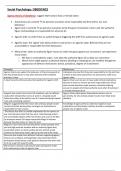
Agency theory of obedience: suggest that humans have 2 mental states
• Autonomous (in control) à we perceive ourselves to be responsible and free will for our own
behaviour
• Agent (not in control) à we perceive ourselves to be the gent of someone’s else’s will, the authority
figure commanding us is responsible for what we do
ð Agentic shift: an order from an authority figure triggering the shift from autonomous to agentic state
ð Agentic state: the ‘agent’ who obeys orders is said to be in an agentic state. Believes they are not
accountable or responsible for their behaviours
ð Moral strain: when an authority figure issues an order that goes against our conscience, we experience
moral strain
o We have 2 contradictory urges: 1) to obey the authority figure 2) to obey our conscience
o Moral strain might appear as physical distress (shaking or weeping) or can manifest though the
appearance of defence mechanism: denial, avoidance, degree of involvement
Strengths: Weaknesses:
Agency theory can explain the behaviour of the prison guards at Individuals may feel that they lack responsibility for the acts they
the Abu Ghraib prison in Iraq when tortured and humiliated commit as they have passed from an autonomous state to an
prisoners of war agentic state
A clear hierarchy often provides the backdrop for Agentic shift Agency theory can be seen to have wider ethical implications
because it seems to remove personal responsibly from those
who commit atrocities under pressure, therefore offering
excuses to people who follow authority even when they know it
is morally wrong to do so
Support also comes from true to life situations such as Hofling’s Agency theory does ignore dispositional reasons such as
study which showed that nurses at work in a hospital would personality, for why certain people may be more likely to be
follow the orders of the doctor even if it meant breaking hospital obedient
rules and overdosing a patient
Milgram suggested that the reason why ordinary people would Knowledge of agency theory could have negative social
commit atrocities because they no longer see themselves as implications and that leader could be trained to manipulate
responsible for their actions people into an Agentic state
The theory also offers a credible explanation for the options of
war criminals who claim that they were ‘only following orders’
and successfully explains other horrendous acts such as the Mai
Lai massacre where US troops massacred village in Vietnam
because they had orders to ‘clear the area’
Milgram’s own research found that when ordinary people were
put into high pressure situation with an authority figure they
would obey orders to shock another person and 2/3 would
continue to obey these orders right up to the end of the study
there are also studies from different cultures supporting agency
theory such as Meeus and Raajimaker who found that Dutch
participants would harass a job applicant because they were told
to do so as part of research study
Moral strain is proven to be present when participants made
from autonomous state to agentic state
,BPS Ethical Guidelines: ethical guidelines which researchers must abide by when carrying out a psychological
study. The important of respect, responsibility, competence, and integrity.
à Respect
à Protection against harm
à Confidentiality
à Deception
à Informed consent
à Right to withdraw
à Debriefing
Milgram & BPS ethical guidelines:
• Informed consent:
o Participants were told the experiment is about 'memory and learning' not obedience to authority
figures, this was done to avoid demand characteristics.
• Deception:
o Participants were not informed of true aim to avoid demand characteristics
• Right to withdraw:
o This was prevented by verbal prods 'you have no other choice but to continue'
• Protection to harm:
o Physical harm prevented by 'fake electric shocks’, but psychological harm was not prevented. The only
'real electric shock' was a single 45 volts given to the teacher
• Debriefed
o All participants were told of the true aim and the end, but was it too late at this point?
, Milgram’s Original Study of Obedience (1963):
Aim:
• To what extent would people obey an authoritative figure
• Milgram (1963) was interested in researching how far people would go in obeying an instruction if it
involved harming another person
Participants:
• 40 men aged between 20-50 years old
• Range of jobs, unskilled to professions
• Yale university
• Volunteer sampling - participants responded to an advertisement and signed a consent form
• Paid the equivalent of $4 per hour
Methodology:
• Laboratory experiment
Procedure:
• Participants drew straws to determine their roles - learner or teacher - although this was fixed, and the
confederate was always the learner
• There was also "experimenter" dressed in a laboratory coat, play by an actor (not Milgram)
• Two rooms in the Yale interaction laboratory were used - one for the learner (with an electric chair) and
another for the teacher and experimenter with an electric shock generator
• The "learner" was strapped to a chair with electrodes. After he has learned a list of word pairs the "teacher"
tests him by naming a word
• The teacher is told to administer an electric shock every time the learner makes mistake, increasing the level of
shock each time
o There were 30 switches on the shock generator marked for 15volts (slight shock) to 450 (danger-severe
shock).
o Only one real shock at 45v, all the other electric shocks were not real.
Results:
• 65% of the participants continued to the highest level of 450v
• 100% of the participants continued to 300v
• Prior to the study: Milgram asked experts how far people would go - the consensus was most ppl would stop at
150v
Conclusions:
• The participants claimed that they administered the shocks for 3 reasons:
o The authority figure seemed trustworthy
o The cause was good (scientific research)
o They believed that if anything bad happened, the researcher would take full responsibility.
Agency theory of obedience: suggest that humans have 2 mental states
• Autonomous (in control) à we perceive ourselves to be responsible and free will for our own
behaviour
• Agent (not in control) à we perceive ourselves to be the gent of someone’s else’s will, the authority
figure commanding us is responsible for what we do
ð Agentic shift: an order from an authority figure triggering the shift from autonomous to agentic state
ð Agentic state: the ‘agent’ who obeys orders is said to be in an agentic state. Believes they are not
accountable or responsible for their behaviours
ð Moral strain: when an authority figure issues an order that goes against our conscience, we experience
moral strain
o We have 2 contradictory urges: 1) to obey the authority figure 2) to obey our conscience
o Moral strain might appear as physical distress (shaking or weeping) or can manifest though the
appearance of defence mechanism: denial, avoidance, degree of involvement
Strengths: Weaknesses:
Agency theory can explain the behaviour of the prison guards at Individuals may feel that they lack responsibility for the acts they
the Abu Ghraib prison in Iraq when tortured and humiliated commit as they have passed from an autonomous state to an
prisoners of war agentic state
A clear hierarchy often provides the backdrop for Agentic shift Agency theory can be seen to have wider ethical implications
because it seems to remove personal responsibly from those
who commit atrocities under pressure, therefore offering
excuses to people who follow authority even when they know it
is morally wrong to do so
Support also comes from true to life situations such as Hofling’s Agency theory does ignore dispositional reasons such as
study which showed that nurses at work in a hospital would personality, for why certain people may be more likely to be
follow the orders of the doctor even if it meant breaking hospital obedient
rules and overdosing a patient
Milgram suggested that the reason why ordinary people would Knowledge of agency theory could have negative social
commit atrocities because they no longer see themselves as implications and that leader could be trained to manipulate
responsible for their actions people into an Agentic state
The theory also offers a credible explanation for the options of
war criminals who claim that they were ‘only following orders’
and successfully explains other horrendous acts such as the Mai
Lai massacre where US troops massacred village in Vietnam
because they had orders to ‘clear the area’
Milgram’s own research found that when ordinary people were
put into high pressure situation with an authority figure they
would obey orders to shock another person and 2/3 would
continue to obey these orders right up to the end of the study
there are also studies from different cultures supporting agency
theory such as Meeus and Raajimaker who found that Dutch
participants would harass a job applicant because they were told
to do so as part of research study
Moral strain is proven to be present when participants made
from autonomous state to agentic state
,BPS Ethical Guidelines: ethical guidelines which researchers must abide by when carrying out a psychological
study. The important of respect, responsibility, competence, and integrity.
à Respect
à Protection against harm
à Confidentiality
à Deception
à Informed consent
à Right to withdraw
à Debriefing
Milgram & BPS ethical guidelines:
• Informed consent:
o Participants were told the experiment is about 'memory and learning' not obedience to authority
figures, this was done to avoid demand characteristics.
• Deception:
o Participants were not informed of true aim to avoid demand characteristics
• Right to withdraw:
o This was prevented by verbal prods 'you have no other choice but to continue'
• Protection to harm:
o Physical harm prevented by 'fake electric shocks’, but psychological harm was not prevented. The only
'real electric shock' was a single 45 volts given to the teacher
• Debriefed
o All participants were told of the true aim and the end, but was it too late at this point?
, Milgram’s Original Study of Obedience (1963):
Aim:
• To what extent would people obey an authoritative figure
• Milgram (1963) was interested in researching how far people would go in obeying an instruction if it
involved harming another person
Participants:
• 40 men aged between 20-50 years old
• Range of jobs, unskilled to professions
• Yale university
• Volunteer sampling - participants responded to an advertisement and signed a consent form
• Paid the equivalent of $4 per hour
Methodology:
• Laboratory experiment
Procedure:
• Participants drew straws to determine their roles - learner or teacher - although this was fixed, and the
confederate was always the learner
• There was also "experimenter" dressed in a laboratory coat, play by an actor (not Milgram)
• Two rooms in the Yale interaction laboratory were used - one for the learner (with an electric chair) and
another for the teacher and experimenter with an electric shock generator
• The "learner" was strapped to a chair with electrodes. After he has learned a list of word pairs the "teacher"
tests him by naming a word
• The teacher is told to administer an electric shock every time the learner makes mistake, increasing the level of
shock each time
o There were 30 switches on the shock generator marked for 15volts (slight shock) to 450 (danger-severe
shock).
o Only one real shock at 45v, all the other electric shocks were not real.
Results:
• 65% of the participants continued to the highest level of 450v
• 100% of the participants continued to 300v
• Prior to the study: Milgram asked experts how far people would go - the consensus was most ppl would stop at
150v
Conclusions:
• The participants claimed that they administered the shocks for 3 reasons:
o The authority figure seemed trustworthy
o The cause was good (scientific research)
o They believed that if anything bad happened, the researcher would take full responsibility.