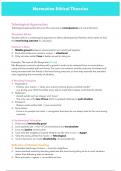
Normative Ethical Theories
Teleological Approaches
Teleological approaches focus on the outcome or consequences of a moral decision.
Situation Ethics
Situation ethics is a teleological approach to ethics developed by Fletcher, which seeks to find
the most loving outcome in a situation.
Fletcher’s Aims
1. Middle-ground between antinomianism (no rules) and legalism
2. Each ethical decision made is unique -> situational
3. Only set rules aside if love is better served in doing so
Example: The case of Mrs Bergmeier (Vardy)
Mrs Bergmeier commits adultery with a guard in order to be released from a concentration
camp and be reunited with her family. This case is in extremis and the outcome of release and
being reunited with her family is the most loving outcome, so love may override the standard
rules regarding the immorality of adultery.
4 Working Principles
1. Pragmatism
- Employ your reason -> does your action produce good, practical results?
- e.g. giving your child chocolate every day to make them happy could lead to obesity
2. Relativism
- Avoids words such as ‘always’ and ‘never’
- The only rule is the law of love which is applied relatively to each situation
3. Positivism
- Reason works within faith -> love comes first
4. Personalism
- Focus is on people not rules -> recognises that laws do not always lead to the most loving
outcome
6 Fundamental Principles
1. Only love is intrinsically good
2. Love replaces law -> the 10 Commandments are not absolute
3. Love and justice are the same
4. ‘Love wills the neighbour’s good whether we like him or not’ -> Agapé
5. ‘Only the ends justifies the means’ -> Teleological
6. ‘Love’s decisions are made situationally, not prescriptively’
Reflection of Christian Teaching
1. Embodies teachings of Jesus -> Love thy neighbour
2. Jesus resolved issues by deciding what was the most loving thing to do in each situation,
rather than following laws as absolute
3. Main principle = agapé -> unconditional love
Teleological Approaches
Teleological approaches focus on the outcome or consequences of a moral decision.
Situation Ethics
Situation ethics is a teleological approach to ethics developed by Fletcher, which seeks to find
the most loving outcome in a situation.
Fletcher’s Aims
1. Middle-ground between antinomianism (no rules) and legalism
2. Each ethical decision made is unique -> situational
3. Only set rules aside if love is better served in doing so
Example: The case of Mrs Bergmeier (Vardy)
Mrs Bergmeier commits adultery with a guard in order to be released from a concentration
camp and be reunited with her family. This case is in extremis and the outcome of release and
being reunited with her family is the most loving outcome, so love may override the standard
rules regarding the immorality of adultery.
4 Working Principles
1. Pragmatism
- Employ your reason -> does your action produce good, practical results?
- e.g. giving your child chocolate every day to make them happy could lead to obesity
2. Relativism
- Avoids words such as ‘always’ and ‘never’
- The only rule is the law of love which is applied relatively to each situation
3. Positivism
- Reason works within faith -> love comes first
4. Personalism
- Focus is on people not rules -> recognises that laws do not always lead to the most loving
outcome
6 Fundamental Principles
1. Only love is intrinsically good
2. Love replaces law -> the 10 Commandments are not absolute
3. Love and justice are the same
4. ‘Love wills the neighbour’s good whether we like him or not’ -> Agapé
5. ‘Only the ends justifies the means’ -> Teleological
6. ‘Love’s decisions are made situationally, not prescriptively’
Reflection of Christian Teaching
1. Embodies teachings of Jesus -> Love thy neighbour
2. Jesus resolved issues by deciding what was the most loving thing to do in each situation,
rather than following laws as absolute
3. Main principle = agapé -> unconditional love