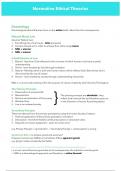
Normative Ethical Theories
Deontology
Deontological ethical theories focus on the action itself, rather than the consequences.
Natural Moral Law
Aquinas’ Natural Law:
1. Everything has a final cause - telos (purpose)
2. Humans should act in order to achieve their telos using reason
3. NML = eternal
4. NML = natural
4-Fold Division of Law
1. Eternal - laws from God reflected in the universe of which humans only have a partial
understanding
2. Divine - laws revealed by God through revelation
3. Natural - Morality which is built into human nature which reflects God’s Eternal law and is
discovered by the use of reason
4. Human - laws created by society through understanding natural law
NML is ‘a moral code existing within the purpose of nature created by God’ (Summa Theologica)
The Primary Precepts
}
1. Preservation of innocent life
2. Reproduction The primary precepts are absolutist - they
3. Nurture and education of the young reflect God’s eternal law and therefore point us
4. Worship God in the direction of human flourishing (telos)
5. Live in an ordered society
Secondary Precepts
These are derived from the primary precepts by using the human faculty of reason:
1. Practical application of the primary precepts to situations
2. Descriptive - therefore flexible (unlike prescriptive or absolutist rules)
3. Depends on human judgement - open to human error
e.g. Primary Precept = reproduction -> Secondary Precept = contraception is wrong
Synderesis Rule = to achieve good and avoid evil
However, humans are fallible so sometimes follow apparent goods
e.g. lying to make somebody feel better
For an act to be good it must be BOTH intrinsically and extrinsically good
i.e. an act cannot become good due to its consequences, the intention must be good
-> NML is a deontological approach and therefore, is action focused
Deontology
Deontological ethical theories focus on the action itself, rather than the consequences.
Natural Moral Law
Aquinas’ Natural Law:
1. Everything has a final cause - telos (purpose)
2. Humans should act in order to achieve their telos using reason
3. NML = eternal
4. NML = natural
4-Fold Division of Law
1. Eternal - laws from God reflected in the universe of which humans only have a partial
understanding
2. Divine - laws revealed by God through revelation
3. Natural - Morality which is built into human nature which reflects God’s Eternal law and is
discovered by the use of reason
4. Human - laws created by society through understanding natural law
NML is ‘a moral code existing within the purpose of nature created by God’ (Summa Theologica)
The Primary Precepts
}
1. Preservation of innocent life
2. Reproduction The primary precepts are absolutist - they
3. Nurture and education of the young reflect God’s eternal law and therefore point us
4. Worship God in the direction of human flourishing (telos)
5. Live in an ordered society
Secondary Precepts
These are derived from the primary precepts by using the human faculty of reason:
1. Practical application of the primary precepts to situations
2. Descriptive - therefore flexible (unlike prescriptive or absolutist rules)
3. Depends on human judgement - open to human error
e.g. Primary Precept = reproduction -> Secondary Precept = contraception is wrong
Synderesis Rule = to achieve good and avoid evil
However, humans are fallible so sometimes follow apparent goods
e.g. lying to make somebody feel better
For an act to be good it must be BOTH intrinsically and extrinsically good
i.e. an act cannot become good due to its consequences, the intention must be good
-> NML is a deontological approach and therefore, is action focused