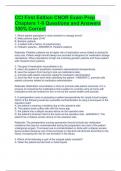
CCI First Edition CNOR Exam Prep Chapters 1-9 Questions and Answers 100% Correct
1. Which patient population is more sensitive to dosage errors? A. Male patients ages 25-40 B. Bariatric patients C. A patient with a history of polypharmacy D. Pediatric patients - ANSWER-D. Pediatric patients Rationale: Pediatric patients are at higher risk of medication errors related to dosing for body size. Patient weight should always be recorded in kilograms for medication dosage calculations. Other populations at high risk including geriatric patients and those patient with impaired body systems. 2. The goal of medication reconciliation is to: A. inform the patient of anesthetic medication administered intraoperatively. B. save the surgeon from having to look up medications later. C. promote safe patient outcomes related to medication administration D. save the floor nurse work when admitting the patient - ANSWER-C. promote safe patient outcomes related to medication administration Rationale: Medication reconciliation is done to promote safe patient outcomes. It is a process of comparing the medications that a patient is currently using at home with medications that are ordered for him or her by the current health care provider. 3. A perioperative nurse is assessing a patient preoperatively for carpal tunnel surgery. Which of the following would be a possible contraindication to using a tourniquet on the operative side? A. the patient is wearing a wedding ring on the operative side B. The patient drank coffee with milk five hours ago C. the patient has a dialysis access device on the operative side D. the patient's dominant hand is the same as the operative side - ANSWER-C. The patient has a dialysis access device on the operative side Rationale: The perioperative nursing assessment should include any medication conditions that may be contraindicated during the preparation and care of the patient undergoing surgery. Tourniquet use is contraindicated on limbs with a dialysis access device present because use of the tourniquet on that limb will diminish blood flow to the fistula, increasing the risk for clot formation in the fistula. 4. Which of the following is part of the surgical safety checklist? A. When the patient last ate food or drank liquids B. Whether any special equipment, devices, or implants will be needed C. Whom the surgeon should talk to after surgery D. What pharmacy the patient uses - ANSWER-B. Whether any special equipment, devices, or implants will be needed Rationale: The comprehensive surgical checklist is part of the Universal Protocol that is supported and endorsed by both the World Health Organization and The Joint Commission. Identifying if there are any special equipment, devices, or implants needed for the surgical procedure is part of the preoperative check-in. 5. Which of the following authoritative organizations is responsible for delineating the accepted list of nursing diagnosis? A. NANDA International B. American Nurses Association C. AORN D. The Joint Commission - ANSWER-A. NANDA International Rationale: NANDA International is the organization responsible for creating and updating the current list of nursing diagnoses. NANDA classifies human response patterns and standardizes the terminology for all nursing diagnoses. 6. Surgical site marking should be performed by the: A. patient before coming to the hospital B. surgeon after the site and side (if applicable) have been surgically prepped and draped. C. nurse doing the patient preoperative assessment D. surgeon before the patient receives any sedatives - ANSWER-D. Surgeon before the patient receives any sedatives Rationale: Surgical site marking should be performed by the surgeon before the patient receives any sedatives. The nurse performing the perioperative assessment verifies the site and side (if applicable) and this site verification is performed again with the surgical team before the incision is made. 7. What part of the preoperative assessment indicates that a patient is at risk for postoperative deep vein thrombosis (DVT)? A. History of varicosities B. History of alcohol abuse C. Recent upper respiratory infection D. Body mass index greater than 26 - ANSWER-A. History of varicosities Rationale: During the preoperative assessment, the nurse should assess the patient for conditions that may suggest an increased risk of DVT development. These risks include a personal or family history of thrombosis, coagulopathy, blood clots, blood-clotting disorders, previous deep vein thrombosis or pulmonary embolism, varicosities or leg swelling, smoking, or living sedentary or nonambulatory lifestyle for more than 72 hours.
Written for
- Institution
- CCI
- Course
- CCI
Document information
- Uploaded on
- August 21, 2023
- Number of pages
- 27
- Written in
- 2023/2024
- Type
- Exam (elaborations)
- Contains
- Questions & answers
Subjects
- cci
-
cci first edition cnor exam prep chapters 1 9

Also available in package deal