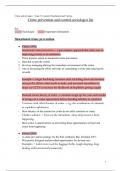
Crime and deviance - Topic 4: Realist theories
Right realism-sociologist list
Key:
Heheh-Sociologist Heheh-Important information
Information on right realism:
- Sees crime(esp, street crime), as a real/growing problem that destroys
communities, undermines social cohesion and society’s work ethic
● Wilson
- The main theorist of right realism
- Special adviser of crime to President Reagen
- Provided policies such as ‘zero tolerance’ of street crime/disorder
- Views align closely with neo-conservative governments during the 1970’s-80
- Due to criminologists having no workable solutions, it led to a search for
practical crime control measures(UK and US) → tough stance on offenders,
as the best way way to reduce crime is through control/punishment, rather than
helping other factors(rehabilitation, tackling poverty)
- Reflects a political climate
- Regards labelling theory and critical criminology as too sympathetic to the
criminal, and hostile towards law/order
- Less concerned about the causes, and more concerned about providing
solutions
- They do explain crime, even though they focus on crime reduction strategies
The causes of crime
- Right realists reject the Marxist view(poverty/inequality are causes of crime)
- Example → the old tend to be poor but have a very low crime rate
- Crime is the product of 3 factors:
1. Individual, biological differences
2. Inadequate socialisation
3. Individual's rational choice to offend
1
, Biological differences
● Wilson and Herrnstein (1985)
- Biosocial theory of criminal behaviour
- Biological differences mean that some people are at a greater risk of
offending and strongly predisposed to commit crimes than others → traits
such as risk-taking, aggressiveness, low impulse control
● Herrnstein and Murray (1985)
- The main cause of crime is low intelligence
- Biologically determined
Socialisation and the underclass
- Effective socialisation can decrease the risk of committing crimes →
internalising self-control and mainstream social values
- Best agency of socialisation → the nuclear family
● Murray (1990)
- Crime rate is increasing due to the new ‘underclass’ → defined by their
deviant behaviour and failure to socialise their children properly
- Welfare dependency is one of the main factors
- The increasing underclass in both the UK and the US
- Generous revolution → increase in the number of people dependent on the
state
- This led to the decline of marriage and an increase in lone-parent
households/families
- Men no longer have to take responsibility for their families → no longer
need to work(due to money from the welfare system)
- Lone mothers are ineffective socialisation agents(esp, to young boys) → absent
fathers mean a lack of a male role model and paternal discipline, young
males then turn to other males(mainly delinquents), become socialised into
delinquent subcultures and gain status from crime
● Bennet et al (1996)
2
Right realism-sociologist list
Key:
Heheh-Sociologist Heheh-Important information
Information on right realism:
- Sees crime(esp, street crime), as a real/growing problem that destroys
communities, undermines social cohesion and society’s work ethic
● Wilson
- The main theorist of right realism
- Special adviser of crime to President Reagen
- Provided policies such as ‘zero tolerance’ of street crime/disorder
- Views align closely with neo-conservative governments during the 1970’s-80
- Due to criminologists having no workable solutions, it led to a search for
practical crime control measures(UK and US) → tough stance on offenders,
as the best way way to reduce crime is through control/punishment, rather than
helping other factors(rehabilitation, tackling poverty)
- Reflects a political climate
- Regards labelling theory and critical criminology as too sympathetic to the
criminal, and hostile towards law/order
- Less concerned about the causes, and more concerned about providing
solutions
- They do explain crime, even though they focus on crime reduction strategies
The causes of crime
- Right realists reject the Marxist view(poverty/inequality are causes of crime)
- Example → the old tend to be poor but have a very low crime rate
- Crime is the product of 3 factors:
1. Individual, biological differences
2. Inadequate socialisation
3. Individual's rational choice to offend
1
, Biological differences
● Wilson and Herrnstein (1985)
- Biosocial theory of criminal behaviour
- Biological differences mean that some people are at a greater risk of
offending and strongly predisposed to commit crimes than others → traits
such as risk-taking, aggressiveness, low impulse control
● Herrnstein and Murray (1985)
- The main cause of crime is low intelligence
- Biologically determined
Socialisation and the underclass
- Effective socialisation can decrease the risk of committing crimes →
internalising self-control and mainstream social values
- Best agency of socialisation → the nuclear family
● Murray (1990)
- Crime rate is increasing due to the new ‘underclass’ → defined by their
deviant behaviour and failure to socialise their children properly
- Welfare dependency is one of the main factors
- The increasing underclass in both the UK and the US
- Generous revolution → increase in the number of people dependent on the
state
- This led to the decline of marriage and an increase in lone-parent
households/families
- Men no longer have to take responsibility for their families → no longer
need to work(due to money from the welfare system)
- Lone mothers are ineffective socialisation agents(esp, to young boys) → absent
fathers mean a lack of a male role model and paternal discipline, young
males then turn to other males(mainly delinquents), become socialised into
delinquent subcultures and gain status from crime
● Bennet et al (1996)
2