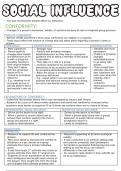
o The way society/other people affect our behaviour.
CONFORMITY:
o Changes in a person’s behaviour, beliefs, or opinions because of real or imagined group pressure.
TYPES OF CONFIRMITY:
o Kelman (1958) said there’s three ways conformity can happen in a majority.
o These ways reflect the amount of change that has taken place regarding a person’s views or
actions.
COMPLIANCE: IDENTIFICATION: INTERNALISATION:
o Most superficial o Stronger type o Deepest and most
o Person publicly o Publicly and privately changes permanent
changes their beliefs beliefs/behaviour as they look to a group for o Publicly & privately
and behaviours to fit guidance and as being a member of the group changes
in with a group but is desirable. beliefs/behaviours
privately reverts to o They take on a role in a group. to go along with
their original beliefs. o Involves compliance by accepting beliefs/ groups.
o They don’t agree behaviours to be accepted and internalisation o They accept their
with the group but by accepting attitudes/behaviours as right. attitudes into their
wants to fit in. o When the group is no longer valuable the own cognitions and
o Linked to normative behaviour will revert lasts even when the
influence. o E.g., vegan while in uni and goes to animal majority aren’t
o E.g., smoking in uni protests and believes eating animals is wrong present.
as friends do but in but once new friends revert to eating meat. o Linked to
private doesn’t like it informational social
and wouldn’t ever do influence.
it
EXPLANATIONS OF CONFORMITY:
o Called the two-process theory which was developed by Deutch and Gerard.
o Research by Lucas et Al about maths questions and found that conformity increased when
questions were harder so supports ISI as it shows we conform when we’re unsure of things.
INFORMATIONAL SOCIAL INFLUENCE: NORMATIVE SOCIAL INFLUENCE:
o Driven by the desire to be right. o Driven by the desire to be liked.
o When a person is unsure about how to o When a person goes along with a groups
behave then conform seeking info from a behaviour to avoid ridicule and gain
group and assume it’s right acceptance and fit in
o Leads to internalisation o Leads to compliance
EVALUATION:
STRENGTHS: WEAKNESSES:
o Research to support ISI was conducted by o Research supporting to ISI lacks ecological
Jenness. validity.
o Ppts were asked to estimate the number of o It was conducted in an artificial setting (lab)
jellybeans in a jar, decide on a group and used an unrealistic task (jellybeans).
estimate then have a private individual o So harder to generalise findings beyond a lab
guess. setting to real life ISI as can conform
o It was found ppts 2nd estimate was closer to differently in the real world.
groups estimate than their 1st original one. o So, research casts doubt on how valid ISI can
o Supports ISI as an explanation as the tasks be as an explanation
were ambiguous and as ppts were unsure of
the answer, they sought info from the group
and changed their estimate privately and
, publicly to be right.
o However, Ppts may be responding to
demand characteristics on the group
estimate.
o Research to support NSI was conducted by o Research for NSI was gender bias - only males
Asch. tested.
o Ppts placed in a group with 7-9 stooges and o It’s harder to generalise findings to females as
asked pts to state which line was most like X. may have different conformity rates to males.
Ppts were 2nd to last or last and stooges o Suggested females may be more conformist
always gave the wrong answer. as they’re more concerned about social
o Ppts conformed 37% of the time to the relationships and likability (Neto 1995)
wrong answer. o So weakens external validity of research into
o It supports NSI as an explanation as the task NSI and questions it as an explanation of
wasn’t ambiguous and ppts said they knew conformity.
the right answer but conformed to avoid o Androcentric research
ridicule that NSI suggests
Asch’s conformity research:
Aim: To investigate the effects of a majority’s opinion on an individual’s judgement
Method: Lab experiment
Sample: 123 Male American students who were told they were taking part in a visual judgement
task
Procedure: ppts in groups with 7-9 stooges
Real ppt was deceived and thought the stooges were real ppts.
Shown line X and given line A, B and C to compare it too.
One line was the same as X and the other two were clearly wrong.
Ppts asked to say which line was the same and always answered last or 2nd to last.
On 12/18 trials, stooges gave the exact same wrong answer.
Control group of 36 ppts were tested w/o stooges.
Findings: on average, real ppts gave wrong answers 36.8% of the times
25% never gave a wrong answer.
75% conformed at least once.
Post experiment: interviews found that majority conformed publicly to avoid ridicule but not
privately as they thought stooges were wrong.
Conclusion: supports NSI as ppts conformed in public to be accepted by the group but not in private
VARIABLES AFFECTING CONFORMITY:
o Asch carried out different variations of his study to find out which variables have a significant
difference.
GROUP SIZE: UNANIMITY: TASK DIFFICULTY:
o Conformity increases as o Complete agreement. As o Conformity increases as task
group size does but only till a unanimity decreases so difficulty does When the right
certain size. does conformity answer is less obvious, we
o 1 ppt and 1 stooge had 3% o With unanimity, conformity lose our confidence and are
conformity. was 37% more likely to conform.
o 2 stooge and 1 ppt had 13% o When 1 stooge gave the o Trial carried out where
conformity. right answer, conformity answer was less obvious -
o 3 stooge and 1 ppt had 32% dropped to 5.5% harder task so conformity
conformity. o When 1 stooge was a increased.
o After this conformity different wrong answer o Supports ISI was when we are
plateaued so shows it only conformity dropped to 9% unclear, we look at other for
increases until 3 people guidance
EVALUATION:
STRENGTHS: WEAKNESSES:
o Research to support these variables have been o Research to support this has ethical issues.
found. o Naïve ppts deceived as they thought
o Lucas investigated task difficulty by asking stooges were acc ppts.
students to give answers to maths problems o A limitation as it can mean people may not
that were easy or difficult. trust psychologists in the future and be less
CONFORMITY:
o Changes in a person’s behaviour, beliefs, or opinions because of real or imagined group pressure.
TYPES OF CONFIRMITY:
o Kelman (1958) said there’s three ways conformity can happen in a majority.
o These ways reflect the amount of change that has taken place regarding a person’s views or
actions.
COMPLIANCE: IDENTIFICATION: INTERNALISATION:
o Most superficial o Stronger type o Deepest and most
o Person publicly o Publicly and privately changes permanent
changes their beliefs beliefs/behaviour as they look to a group for o Publicly & privately
and behaviours to fit guidance and as being a member of the group changes
in with a group but is desirable. beliefs/behaviours
privately reverts to o They take on a role in a group. to go along with
their original beliefs. o Involves compliance by accepting beliefs/ groups.
o They don’t agree behaviours to be accepted and internalisation o They accept their
with the group but by accepting attitudes/behaviours as right. attitudes into their
wants to fit in. o When the group is no longer valuable the own cognitions and
o Linked to normative behaviour will revert lasts even when the
influence. o E.g., vegan while in uni and goes to animal majority aren’t
o E.g., smoking in uni protests and believes eating animals is wrong present.
as friends do but in but once new friends revert to eating meat. o Linked to
private doesn’t like it informational social
and wouldn’t ever do influence.
it
EXPLANATIONS OF CONFORMITY:
o Called the two-process theory which was developed by Deutch and Gerard.
o Research by Lucas et Al about maths questions and found that conformity increased when
questions were harder so supports ISI as it shows we conform when we’re unsure of things.
INFORMATIONAL SOCIAL INFLUENCE: NORMATIVE SOCIAL INFLUENCE:
o Driven by the desire to be right. o Driven by the desire to be liked.
o When a person is unsure about how to o When a person goes along with a groups
behave then conform seeking info from a behaviour to avoid ridicule and gain
group and assume it’s right acceptance and fit in
o Leads to internalisation o Leads to compliance
EVALUATION:
STRENGTHS: WEAKNESSES:
o Research to support ISI was conducted by o Research supporting to ISI lacks ecological
Jenness. validity.
o Ppts were asked to estimate the number of o It was conducted in an artificial setting (lab)
jellybeans in a jar, decide on a group and used an unrealistic task (jellybeans).
estimate then have a private individual o So harder to generalise findings beyond a lab
guess. setting to real life ISI as can conform
o It was found ppts 2nd estimate was closer to differently in the real world.
groups estimate than their 1st original one. o So, research casts doubt on how valid ISI can
o Supports ISI as an explanation as the tasks be as an explanation
were ambiguous and as ppts were unsure of
the answer, they sought info from the group
and changed their estimate privately and
, publicly to be right.
o However, Ppts may be responding to
demand characteristics on the group
estimate.
o Research to support NSI was conducted by o Research for NSI was gender bias - only males
Asch. tested.
o Ppts placed in a group with 7-9 stooges and o It’s harder to generalise findings to females as
asked pts to state which line was most like X. may have different conformity rates to males.
Ppts were 2nd to last or last and stooges o Suggested females may be more conformist
always gave the wrong answer. as they’re more concerned about social
o Ppts conformed 37% of the time to the relationships and likability (Neto 1995)
wrong answer. o So weakens external validity of research into
o It supports NSI as an explanation as the task NSI and questions it as an explanation of
wasn’t ambiguous and ppts said they knew conformity.
the right answer but conformed to avoid o Androcentric research
ridicule that NSI suggests
Asch’s conformity research:
Aim: To investigate the effects of a majority’s opinion on an individual’s judgement
Method: Lab experiment
Sample: 123 Male American students who were told they were taking part in a visual judgement
task
Procedure: ppts in groups with 7-9 stooges
Real ppt was deceived and thought the stooges were real ppts.
Shown line X and given line A, B and C to compare it too.
One line was the same as X and the other two were clearly wrong.
Ppts asked to say which line was the same and always answered last or 2nd to last.
On 12/18 trials, stooges gave the exact same wrong answer.
Control group of 36 ppts were tested w/o stooges.
Findings: on average, real ppts gave wrong answers 36.8% of the times
25% never gave a wrong answer.
75% conformed at least once.
Post experiment: interviews found that majority conformed publicly to avoid ridicule but not
privately as they thought stooges were wrong.
Conclusion: supports NSI as ppts conformed in public to be accepted by the group but not in private
VARIABLES AFFECTING CONFORMITY:
o Asch carried out different variations of his study to find out which variables have a significant
difference.
GROUP SIZE: UNANIMITY: TASK DIFFICULTY:
o Conformity increases as o Complete agreement. As o Conformity increases as task
group size does but only till a unanimity decreases so difficulty does When the right
certain size. does conformity answer is less obvious, we
o 1 ppt and 1 stooge had 3% o With unanimity, conformity lose our confidence and are
conformity. was 37% more likely to conform.
o 2 stooge and 1 ppt had 13% o When 1 stooge gave the o Trial carried out where
conformity. right answer, conformity answer was less obvious -
o 3 stooge and 1 ppt had 32% dropped to 5.5% harder task so conformity
conformity. o When 1 stooge was a increased.
o After this conformity different wrong answer o Supports ISI was when we are
plateaued so shows it only conformity dropped to 9% unclear, we look at other for
increases until 3 people guidance
EVALUATION:
STRENGTHS: WEAKNESSES:
o Research to support these variables have been o Research to support this has ethical issues.
found. o Naïve ppts deceived as they thought
o Lucas investigated task difficulty by asking stooges were acc ppts.
students to give answers to maths problems o A limitation as it can mean people may not
that were easy or difficult. trust psychologists in the future and be less